Two numbers decide whether carbide pays back on a given route: the interval between changeouts, and what an hour of that truck’s downtime costs the operation. Everything else in the comparison is arithmetic around those two figures.
This is the cost anatomy of that decision, written for the person who has to defend it to a finance committee rather than to a workshop. The worked examples are illustrative models, not quotations: substitute your own numbers and the method still holds.
The inputs that decide the answer
Compare cost per lane kilometre, not cost per blade.
The comparison needs four inputs per edge type: delivered cost including freight and duty, the lane kilometres the edge covers before it is retired, the labour and equipment time for one changeout, and the downtime cost of the truck being off the route.
Delivered cost is usually the number a purchaser has to hand, and it is the least important of the four. The others are operational and often unrecorded, which is why blade decisions default to price: the invoice is visible and the changeout is not. A fleet that has never measured its changeout interval cannot compare two edge types, because the dominant variable is missing.
The measurement is not difficult. Log the odometer or lane kilometres at each changeout for one season, per route class, and record who did the work and how long it took. That single season of data converts the decision from an argument about unit price into a calculation with an auditable answer. Freight, duty and origin documentation belong in the delivered cost, and the entry-level framing for import paperwork is published by US Customs and Border Protection.
Edge price versus edge life
Edge price and edge life are the two halves of the same fraction, and buyers tend to know one and estimate the other. The useful discipline is to treat life as a measured figure with a route attached rather than as a supplier claim.
A wear-life multiple is a range, not a constant. SENTHAI publishes a range for its carbide edges rather than a single figure and states plainly that the multiple depends on surface, load and how the route is worked, which is exactly why a fleet should test on its own roads before converting. A trial batch on one route produces a number that a committee can accept.
Where no measurement exists, the conservative planning assumption is the shortest plausible interval, because an over-optimistic life estimate produces a spare-parts shortage in the middle of a season. The recorded interval can then be refined each year as the fleet accumulates data.
Change-out labour and downtime
Labour is the input that most often decides the answer, and it is the one that varies most between fleets. The same edge on two trucks in different organisations can have entirely different changeout cost, because one fleet changes edges at the roadside and the other in a workshop with a lift.
Downtime is the harder half. If a unit is out of service during a storm, the cost is not just the mechanic’s time; it is the route that does not get cleared, the overtime that follows, and for contractors the contractual penalty or the lost client. A single avoided mid-season changeout can be worth more than the price difference between edge types, which is why the decision belongs to operations and finance together rather than to procurement alone.
The practical measurement is a changeout time per position: front, underbody and wing. Those are the figures the calculation needs, and they are usually available from the workshop even if nobody has written them down as a cost.
Route surface and salt exposure
Surface mix decides which edge type gets the chance to pay back at all. Abrasive surfaces reward wear resistance; surfaces with obstacles reward toughness. Salt exposure adds a cost that affects both options equally and is often left out of the comparison.
Corrosion consumes edges between storms, particularly when blades are stored outside or returned to the rack wet. An edge that rusts at the bolt line loses service life to a mechanism unrelated to abrasion, and the effect is invisible in a wear measurement taken only at the contact face. Inspect stored edges for pitting at the bolt line and around inserts, and treat corrosion protection as part of the specification rather than an afterthought.
Weather and surface conditions also drive how often the route is worked, which changes exposure without changing the blade at all. The relationship between weather events and road network performance is documented by the Federal Highway Administration, and the transport statistics that a business case often needs are published by the Bureau of Transportation Statistics.
Worked example for a municipal route
Consider an illustrative municipal route: a tandem-axle plow on chip seal covering 3,000 lane kilometres in a season. Assume, for the model only, that a steel edge costs 100 units delivered and covers 500 lane kilometres, and that a carbide edge costs 400 units and covers 3,000 lane kilometres. Changeout labour is two hours, and the same labour applies to both.
The steel option needs six edges in the season, so its edge cost is 600 units and its changeout requirement is six jobs. The carbide option needs one edge, 400 units and one job. The gap widens once the five avoided changeouts are priced: multiply the changeout time by the loaded labour rate and add the route risk of a unit being off the road during a storm.
The model is deliberately round-numbered so it can be replaced with real figures. The method matters: price the edges, count the changeouts, then add the avoided downtime. Where the fleet’s own numbers show a much longer steel interval, the conclusion changes accordingly, which is exactly why the measurement comes first. The same arithmetic applied to a different route profile is set out in the SENTHAI note on carbide edge payback per lane kilometre.
Worked example for an airport apron
Now move the same comparison to an airport apron, where the constraints differ in ways that change the arithmetic. Clearing has to restore friction and hold an availability standard rather than simply move snow, and a unit that is out of service has consequences beyond the shift.
In that setting the dominant term is usually downtime rather than edge price, because the operational cost of a failed clearing pass is high and the acceptable surface condition is exacting. A specification that reduces the number of unplanned changeouts therefore pays back through availability, even where the abrasion rate is moderate.
Airport operations guidance published by the Federal Aviation Administration is the reference for how those programmes are structured. The edge consequence is that the specification should favour predictable wear and documented batch records over the lowest unit price, because a failure has to be explained as well as repaired.
Sensitivity: what breaks the payback
A payback calculation is only as good as its weakest input, and four inputs move the answer most. Testing them one at a time is what turns a model into a decision.
| Input | If it moves this way | Effect on the payback |
|---|---|---|
| Lane kilometres between changeouts | Shorter than assumed | Payback weakens quickly; the edge is retired early |
| Changeout labour cost | Lower than assumed | Payback weakens; cheap changeouts reduce the saving |
| Downtime cost per hour | Higher than assumed | Payback strengthens; availability dominates |
| Impact exposure on the route | More gravel or exposed joints | Payback can fail outright through chipping |
Two of those inputs are measured rather than estimated, and those are the ones worth collecting first. Where a fleet has no data, the sensible approach is a trial batch on the route in question: one season on one truck produces a defensible interval and a wear pattern to inspect. Material performance claims behind those tests can be checked against the published methods of ASTM International, and the raw material cost inputs that move over time are summarised in the US Geological Survey mineral commodity reporting.
When steel is still the right answer
Steel remains the correct specification in three situations, and a fleet that ignores them overpays rather than underperforms. The first is mild abrasion with a short season, where the wear interval is long enough that the extra cost of carbide never returns. The second is high impact exposure, where a hard edge would chip and a tougher steel edge would simply wear. The third is a workshop that can change edges quickly and cheaply outside storm hours.
The defensive case for steel is also administrative. Steel is easy to source, easy to fabricate and easy to hold in stock, and it does not depend on a bond that has to be controlled at high temperature. Where a fleet runs mixed equipment and a wide range of mounting patterns, that simplicity has a real cost advantage.
The honest conclusion for most fleets is a mixed specification: carbide on the routes that generate the abrasion, and steel or a flex edge where the route punishes hardness or the surface has to be protected. Independent research on winter maintenance practice and cost models is published by the Transportation Research Board, and suppliers that manufacture both edge types can quote the comparison against a single specification rather than a preferred product.
One administrative input belongs in the model as well: the documentation that comes with the edge. A batch reference, a material certificate and a dimensional record cost nothing at quotation stage and turn a disputed failure into an evidence-based claim, which is the difference between absorbing a loss and recovering it. The controls behind those records are described on the SENTHAI quality control page.
FAQ
How can a fleet tell whether an edge is carbide or steel?
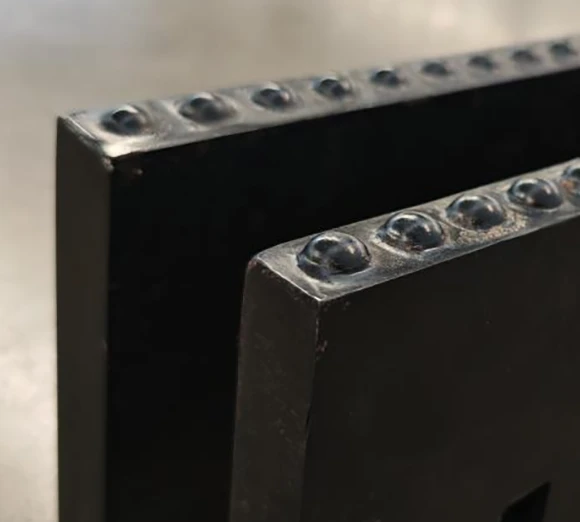
Look at the contact face rather than the blade. A carbide edge shows separate inserts or a strip of distinctly different material joined to a steel carrier, often with a visible bond line; a steel edge is one continuous section with no joint at the wear face. Ask for the material specification and the batch record as well, because the appearance alone does not confirm the grade behind it.
Are carbide blades more expensive per lane kilometre?
Not necessarily, and on abrasive routes they are usually cheaper per lane kilometre even though they cost more per blade. The price difference sits on the invoice, while the saving sits in the changeout interval: fewer changes means less labour, fewer spare edges tied up on the shelf and less downtime during a storm. On light routes with little abrasion the arithmetic can reverse.
What breaks the payback on a carbide edge?
Three things. The first is impact: on gravel or a route with exposed joints, a hard grade chips before it wears and the edge is retired early. The second is the changeout cost itself, because if a fleet can change edges cheaply in-house and never loses a lane, the labour part of the saving shrinks. The third is misuse, such as running an edge past its design point or storing it wet between seasons.
When is a steel edge still the right choice?
Steel stays the sensible answer where abrasion is mild, where impact risk is high, and where the fleet changes edges cheaply. Short residential seasons, gravel work with loose stone, and yard or lot clearing all fall into that group. Steel also wins where the edge is expected to deform rather than wear out, because a section that can be straightened and reused has a lower whole-life cost than one that chips.
Send one season of changeout records for two routes and the current edge specification. The SENTHAI engineering desk will build the cost per lane kilometre comparison and quote both edge types against the same mounting drawing.