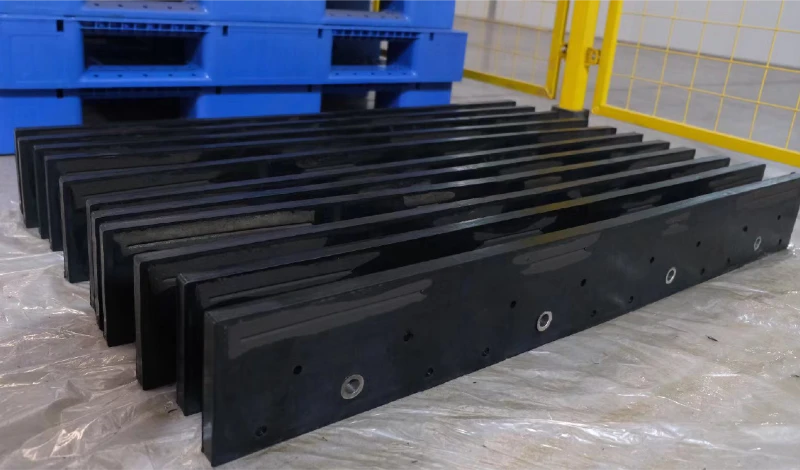
Two depots put the same set of rubber-flex edges away in April. One racks them on a support that carries the full length of the backing; the other stacks them flat on a concrete floor with a pallet of spare parts on top. In November the first set goes straight back into service and the second comes out with two permanently flat sections and a hardened base along the loaded part of the edge, which is damage that no workshop can reverse.
The symptoms are worth working backwards from, because almost every storage failure has a specific cause that can be removed before the edge goes away for the summer. This guide covers what ages a rubber edge, how to support and stack it, what humidity and light do over six months, how to protect the carbide, and the inspection routine that catches a problem while it can still be fixed.
Rubber flex blade storage: the damage that appears in November
Off-season damage comes from load, light and moisture.
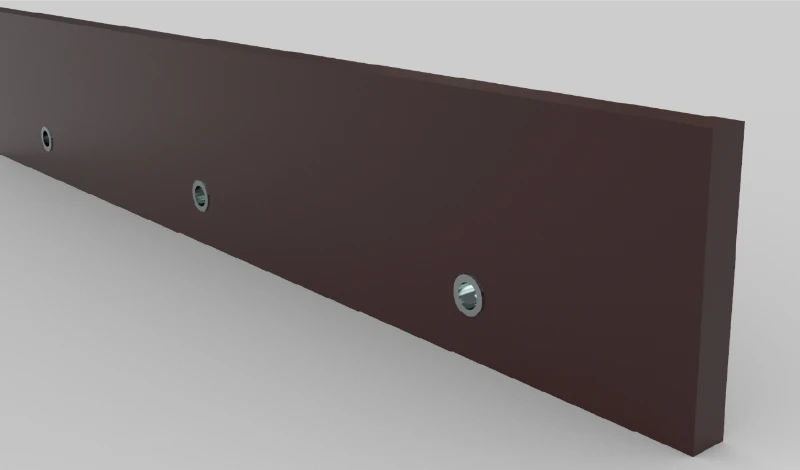
A rubber-flex edge is a rubber base bonded to a backing, and the two materials behave differently when left alone for six months. The rubber hardens and can take a permanent set if held under load; the backing corrodes where moisture is trapped against it; the bond between them suffers from both.
Damage found at first fit in autumn is almost always one of those three, and it is almost always preventable at removal.
The reason it matters commercially rather than only technically is timing. A blade discovered to be flat or hardened in November is discovered at the start of the season, when there is no spare capacity to replace it; a blade inspected in April can be replaced in a quiet period or sent for re-segmentation without disturbing a route. Storage is a scheduling decision as much as a housekeeping one.
Rubber ageing factors to avoid
Rubber does not fail in storage the way metal does; it ages. Three mechanisms account for almost all of it, and each one has an obvious countermeasure once it is named.
The first is heat. A rubber compound held at elevated temperature for months continues to cure and hardens as a result, which is why a blade stored against a south-facing wall in a metal shed comes out stiffer than one stored in a shaded corner of the same building. The second is ultraviolet light, which attacks the surface of the compound and produces the chalky bloom that makes an edge look older than it is. The third is load: rubber held under sustained compression takes a set, and a set of that kind is permanent.
Testing methods for rubber hardness and tensile behaviour are published by ASTM International, and the vocabulary used to describe aged and set rubber comes from the same source. Where a fleet operates a formal stores system, published research on winter maintenance practice from the Transportation Research Board is useful for how other depots record the same conditions.
Stacking and support practice
How an edge is supported decides whether it comes out straight, and the rules are simpler than they look. Three practices cover most of the risk.
- Support the backing along its full length, either flat on a timber bearer or upright on a rack that holds the steel rather than the rubber.
- Never span a gap: a blade resting across two bearers with nothing in the middle takes a set in the shape of the gap.
- Keep stacked weight off the rubber; load belongs on the backing and on the segments, never on the flexible base.
The upright option deserves a note because it is usually adopted for space reasons and often executed badly. A rack that holds a flex edge by its rubber base loads the exact material the storage is meant to protect. The same rack holding the same blade by the backing and the segments is fine, and the difference between the two is a few minutes of rack modification.
Humidity and UV exposure
Moisture attacks the steel side of the assembly, and light attacks the rubber side, so a storage position has to answer both. The practical test is whether the surface under the blade stays dry through a damp week: concrete slabs draw moisture up and hold it against whatever sits on them, which is why a bearer or a rack matters even in a building that is otherwise dry.
On the light side, direct sun is the condition to avoid rather than daylight in general. A blade stored under a bench or in a racked aisle keeps most of its flexibility, and the same blade stored across a window or against an open door does not. Coating or painting the rubber is not a substitute, and on some compounds it interferes with the way the edge releases material in service; keeping light off is the reliable approach.
Keeping carbide segments protected
Carbide itself does not care much about a summer in a shed, but the joint between the carbide and the steel does. That joint is where corrosion starts, and corrosion at the insert is the storage failure that costs the most because it is discovered late and repaired expensively.
Three measures reduce it. Keep the edge clear of standing water and off the floor rather than on it. Avoid storing the edge in contact with a dissimilar metal that will drive galvanic corrosion, which in practice means not leaning it against aluminium or galvanized racking for a whole season. And keep impact away from the inserts, since a chipped insert in storage is a replacement rather than a touch-up. Corrosion mechanisms and their control are set out by NACE International, and the receiving and handling conventions that support a claim are described on the SENTHAI warranty and shipping page.
Labelling and inventory records
A stored blade without a record is an unknown quantity, and unknown quantities get replaced twice. Four items on the label turn a stack of edges into an inventory that can be planned against.
- The machine or plow position the edge came off, so it can go back to a known fitment.
- The wear measurement taken at removal, so the next season knows what it is starting with.
- Any damage noted at removal, described rather than graded, with the date.
- The storage position, so a blade stored somewhere unusual can be found without a search.
The measurement is the entry that pays for itself. A fleet that records wear at removal knows which edges are candidates for re-segmentation in the summer and which are finished, and it stops carrying dead inventory through a season on the assumption that the edge still has life in it.
Pre-season inspection routine
The inspection is quick if it is done in a fixed order, and the order below moves from the things that are cheapest to fix to the things that are not.
- Check the backing for straightness along its full length, on a flat surface rather than in the rack.
- Check the rubber base for hardening and for flat spots, and compare it against a blade from the same batch where one is available.
- Check the bond line around each segment by tapping along it and listening for a change in tone.
- Check the inserts for chips and the joint for corrosion, and check the fixing holes for elongation.
- Record the outcome against the storage label before the edge goes back on a machine.
Step five is the one that creates the following season’s records, and it is the step most often skipped when the weather turns and the fleet is under pressure to get trucks out. Doing it in the quiet week before the season starts costs an hour and replaces guesswork with a number.
Common storage mistakes
The mistakes below account for most of the damage found at first fit, and each one is a housekeeping fix rather than a purchase. Stacking edges so that weight bears on the rubber is the most common, and it is usually a symptom of having no rack rather than of not knowing better. Storing against an outside wall or under a skylight is the second, and it produces the hardening and bloom that make an edge feel older than its years.
Leaving edges on the ground through the summer is the third, and it combines the moisture problem with the risk of impact damage from whatever else is moved around the yard. The fourth is the absence of a label, which turns every later question into an inspection. None of these need capital; they need a storage position that was chosen rather than inherited.
Getting a blade ready before it goes into storage
The storage season starts on the day the edge comes off the machine, not on the day it goes into the rack. Cleaning the edge of the salt and grit that has collected around the segments removes the material that holds moisture against the steel, and taking the wear measurement at that moment is far easier than measuring a stack of blades in a store room later.
It is also the moment to decide what the edge is for. A blade with one worn section and sound neighbours is a re-segmentation candidate; a blade that is at its wear limit across the width is finished and should leave the inventory rather than consume storage. Sorting at removal also means anything that needs to be ordered for the next season is ordered early, while lead times are short.
When there is no heated store
Most fleets do not have a climate-controlled building for wear parts, and they do not need one. What they need is to remove the three conditions that do the damage: direct sun, standing moisture and sustained load. A covered rack in a shaded part of an existing shed does all three, and a timber bearer on a dry floor does most of it where rack space is unavailable.
Where the only option is an unheated, unlined building, prioritise the blades that have the most life left in them. Storage damage costs the fleet the residual value of the edge, so the newest edges have the most to lose and should get the best position. Guidance on how winter maintenance equipment is specified and handled across a season is published by the Association of Equipment Manufacturers, and fleet-level practice by the National Association of Counties.
Where storage damage sits on a warranty claim
Storage damage is not a manufacturing defect and is generally distinguishable from one on sight. A flat spot or a curve in the backing follows the shape of whatever the blade rested on; corrosion tracks along the joint rather than appearing where road salt would have reached in service; hardening across the whole surface points to heat and light rather than to a material fault.
That distinction is the reason the records matter. A fleet that can produce the removal measurement, the damage note and the storage position can show that the edge went away sound. The same fleet relying on a description six months later usually cannot. Where an edge has already been damaged, the options are set out on the repair and re-segmentation page, which covers which storage damage can be reworked and which cannot.
Standards work on storage, handling and material condition is published by ISO, and SENTHAI manufactures rubber-flex blades and carbide edges in Rayong, Thailand, with documentation carried at batch level so that an edge in storage can be traced back to its production record.
FAQ
Should rubber flex blades be stored flat or upright?
Flat, on a support that carries the edge along its length, or upright on a rack that holds the backing rather than the rubber. What must be avoided is a span with no support under it, because a flexible edge that sits across a gap takes a set over the summer and goes back into service with a curve in it.
Does a rubber edge expire in storage?
It ages rather than expires. Rubber hardens and can take a permanent set over time, and those changes accelerate with heat, sunlight and ozone exposure. A blade stored dark, cool and supported keeps its properties far longer than one stored in a sunlit bay, which is why the storage location matters more than the storage duration.
How should carbide segments be protected off season?
Keep the edge out of standing water and away from surfaces that hold moisture against the steel, and keep impact away from the inserts. Corrosion at the joint is the main risk, because it attacks the bond and the steel around it rather than the carbide itself, and it often goes unnoticed until the first pre-season inspection.
What should be recorded when a blade goes into storage?
The machine it came off, the wear measurement taken at removal, any damage noted at that point, and the position it is stored in. Those four records are what turn a stack of edges into an inventory, and they let the next season’s decisions be made from history rather than from a visual guess in a dim store room.
Does poor storage affect warranty claims?
Storage damage is distinguishable from service wear, and it usually falls outside a manufacturing claim. Blades that come back with a flat spot from unsupported stacking, or with corrosion tracking along a joint, show a pattern that is easy to read. Recording how the edge was stored is what lets a fleet argue a claim on its merits rather than by description.
Send the blade dimensions, the segment layout and the surface the edge works. The SENTHAI engineering desk will confirm the fitment and the storage handling that suits the compound in the edge you are running.
This article is one step in the JOMA Style Rubber-Flex Blade Guide, which covers segments, clamps, insert retention and off-season storage.