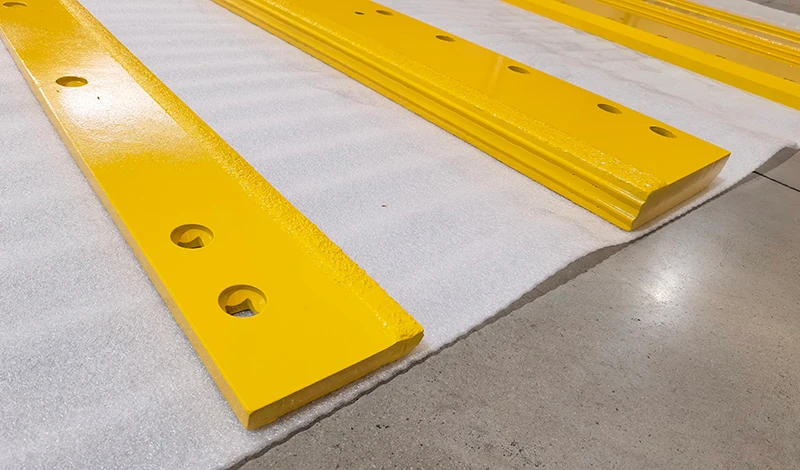
Three ice-control designs appear on the same route network, and they are often specified by habit rather than by mechanism. Studded edges grip, segmented edges conform and can be partly replaced, and insert edges cut by concentrating pressure. Those are three different jobs, and whichever one a fleet chooses is the job its equipment will do well.
This comparison organises the three around the variables that actually separate them: how each contacts the surface, whether the mechanism is grip or cutting, where each one wears, what happens under impact, and what each does to the pavement. It closes with a selection table and a note on mixing designs deliberately rather than accidentally.
The three designs and what separates them
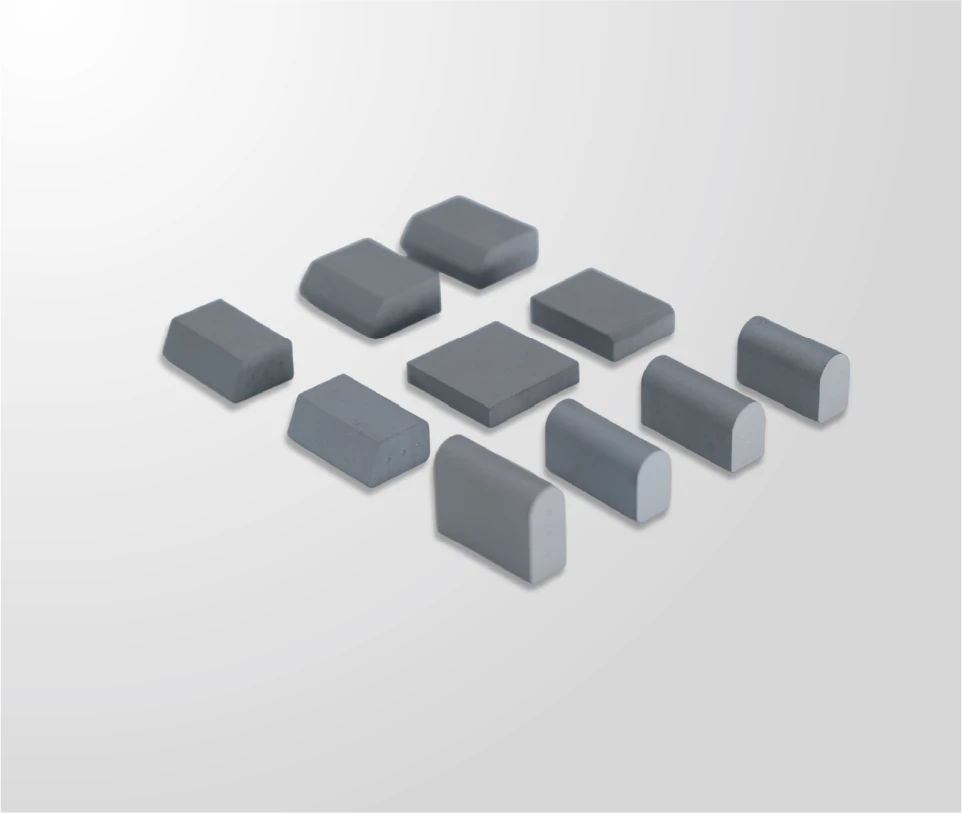
The three approaches differ first in what they present to the road, and everything else follows from that. A studded edge presents a series of protruding points that are loaded along their axis. A segmented edge presents a set of separate cutting sections, each of which can be replaced independently. An insert edge presents carbide inserts set into a steel body, arranged so that the available down force concentrates at a small contact.
Those differences determine how each design transfers load into the assembly as well as how it affects the surface. A point loaded along its axis transfers force almost entirely into the fixing that holds it. A cutting section loaded along its edge transfers force into the body that carries it. An insert loaded at its face transfers force into the joint beneath it as well as into the pocket around it.
That is why the designs fail in different places, and why a comparison based on service life alone tends to be misleading. Each one lasts a long time where its load path is supported and fails early where it is not.
Carbide studded blade: how each design contacts ice
Contact geometry decides the mechanism on all three.
A studded edge contacts the surface at a small number of points, each with a narrow tip area, so the pressure at each point is high and the stud penetrates rather than shears. That produces traction and a marked surface.
A segmented edge contacts along a series of short cutting sections, so pressure is distributed along each section’s edge and the action is a cut rather than a penetration. An insert edge contacts at a row of small faces and fractures the bond between the layer and the pavement, which removes the layer rather than marking or gripping it.
The practical reading is that studs suit traction and cutting edges suit removal. A fleet that specifies studs to clear ice gets a marked surface that is still icy, and a fleet that specifies a cutting edge to hold a machine on a gradient gets a cleared surface with less grip than the studs would have given.
Grip versus cutting mechanisms
The two mechanisms are not variations of each other, and the differences matter to how the machine behaves as well as to the surface.
- Grip works by resisting movement, so it depends on the surface being load-bearing enough to hold the point in place.
- Cutting works by causing the material to fail, so it depends on pressure being high enough at the contact to exceed the strength of the layer.
- Grip transfers force into the fixing, cutting transfers it into the body and the joint.
- Grip is limited by the number of points that can be brought to bear; cutting is limited by the down force available.
The last point is the one that decides most equipment questions. Adding studs increases the number of contacts without requiring more down pressure, while a cutting edge depends on the carrier’s ability to hold a load. A machine with limited down pressure is therefore a candidate for grip, not for cutting, whatever the surface looks like.
Wear distribution and service life
Where each design wears is more useful than how long it lasts, because the wear position determines the replacement routine. The table below sets out where the loss appears and what that means for a fleet.
| Design | Usual wear position | Replacement implication |
|---|---|---|
| Studded | Stud tips round off; studs are lost individually | Studs are replaced as individual items, so cost tracks loss rate |
| Segmented | Joints and the end sections of the working width | Sections are replaced independently, which limits the cost of local damage |
| Insert | Across the contact face of the insert row | Rows are replaced together, since a mixed-height row loads the newest hardest |
The third row is the one that most often surprises a fleet changing from another design. Replacing a single insert leaves it standing proud of its neighbours, taking the transition impacts and wearing faster than the row, which is why a row replacement is usually the cheaper routine over a season.
Retention risk under impact
Impact behaves differently on each design because of where the load enters. A stud is loaded along its axis and transmits that load straight into its fixing, so a heavy impact tends to loosen or snap the stud rather than damage the body around it. An insert is loaded at its face, which puts the load into the joint and the seat, so impact damage shows up as movement or loss rather than as a fractured component.
A segmented edge sits between the two. The segments are usually retained by the same hardware as a conventional edge, so impact is carried by the body, and the failure that results is most often damage at a joint or at the end of the row rather than across the whole working width. The failure signatures behind those outcomes are set out on the insert loss page.
Surface damage considerations
Each design marks a surface differently, and on municipal work that is a specification question rather than a side effect.
- Studded edges mark pavement most, because load is concentrated on a small tip that is loaded along its axis.
- Segmented edges mark least on average, because load is distributed along the section edge, but they can gouge where a joint catches.
- Insert edges cut rather than mark, but over-pressure on thin pavement produces the same result as any cutting edge set too deep.
- All three cause more damage where the surface is newly laid, since the material is softer in its first season.
The last entry is the practical rule for mixed fleets: an ice-control design that is acceptable on a worn arterial may not be acceptable on a recently resurfaced residential street, and the route plan is where that distinction belongs.
Selection by route and equipment
Selection comes down to four conditions, and they can be checked in order without a trial. The first is what the route needs: traction or removal. The second is what the carrier can supply, in particular whether it can hold down pressure. The third is what the pavement can tolerate. The fourth is how the route damages equipment, since a design that can be partly replaced has an advantage where damage concentrates in one place.
Where a route needs removal and the carrier can hold pressure, an insert edge is the match. Where a route needs traction on gradients or on surfaces that cannot be cut, studs are. Where damage concentrates and the fleet wants to avoid replacing a whole edge, segmentation pays for itself. How the insert arrangement produces its cutting action is described on the packed ice kit page.
Comparison table
The table below places the three designs side by side on the variables a specification has to decide.
| Variable | Studded | Segmented | Insert |
|---|---|---|---|
| Primary mechanism | Grip by penetration | Cut along section edges | Cut by concentrated pressure |
| Effect on surface | Marked and broken | Cut, with joint risk | Layer removed |
| Carrier requirement | Number of contacts, little down pressure | Conventional blade load | Controllable down pressure |
| Replacement unit | Individual stud | Individual section | Insert row |
| Suits | Gradients and traction-critical surfaces | Routes with localised damage | Bonded hardpack and refrozen layers |
Read across the third row and the equipment constraint appears: the three designs ask different things of the same carrier, and only one of them depends on down pressure being controllable. That single variable eliminates more wrong choices than any comparison of wear life.
Mixing designs across one fleet
Most networks end up with more than one design, and the risk is drift rather than mixing. The way to keep it deliberate is to standardise the mounting across the fleet and vary only the working end, so any carrier can take any design without modification and a spare can be drawn from a common position.
Two conditions keep the mix manageable: write the route group each design was chosen for, so a later review knows the reasoning; and keep the fixing pattern and hardware common, so the difference between designs does not multiply into a difference in fittings. Geometry decisions that sit alongside this choice are compared on the trapezoid versus bullnose page.
SENTHAI manufactures studded and insert components, packed ice carbide kits and plow edges in Rayong, Thailand, with the arrangement and grade confirmed against the carrier and the surface a route produces. Equipment standards are maintained by SAE International, test methods for the materials by ASTM International and ISO, and winter maintenance research by the Transportation Research Board and the Federal Highway Administration. Designs that need to be matched to a mixed route can be discussed through the contact page.
FAQ
Which edge type grips ice best?
Studs grip best by penetration, because each one is loaded along its axis and holds against the surface. Inserts cut rather than grip, which produces a broken surface rather than traction. If the aim is traction on a slope, studs; if the aim is removing the layer, a cutting edge.
Are studded edges hard on the pavement?
Any hard contact concentrated on a small area marks a surface if it is applied with enough pressure, and studs concentrate load more than a cutting edge does. That makes them a poor choice on thin or newly surfaced pavement and a reasonable one on gravel or on worn surfaces where marking is not the concern.
Do segmented edges actually cut ice?
They cut where the segments present an edge to the surface and conform to it across the width. Their advantage is replacement: a worn or damaged section can be changed without taking the whole edge out of service, which matters where a route damages one part of the pattern repeatedly.
What wears fastest on each design?
Studs round off or are lost, inserts wear across their contact face, and segments wear at the joints and at the ends of the working width. The wear position is the practical difference, because each one calls for a different replacement routine.
Can the three types be mixed on one fleet?
Yes, and on a mixed network it is usually the right answer, provided the mixing is deliberate. The condition is that the mounting and fixing pattern stays common across the fleet, so a carrier can take any of the three without modification and the spares list stays manageable.
Send the route types, the gradients and the carrier’s down-pressure capability. The SENTHAI engineering desk will confirm which contact mechanism suits each route group and what the arrangement should be.
This article is one step in the Packed Ice Edge Guide, which explains why a standard edge skates across hardpack and how to set one up so it bites.