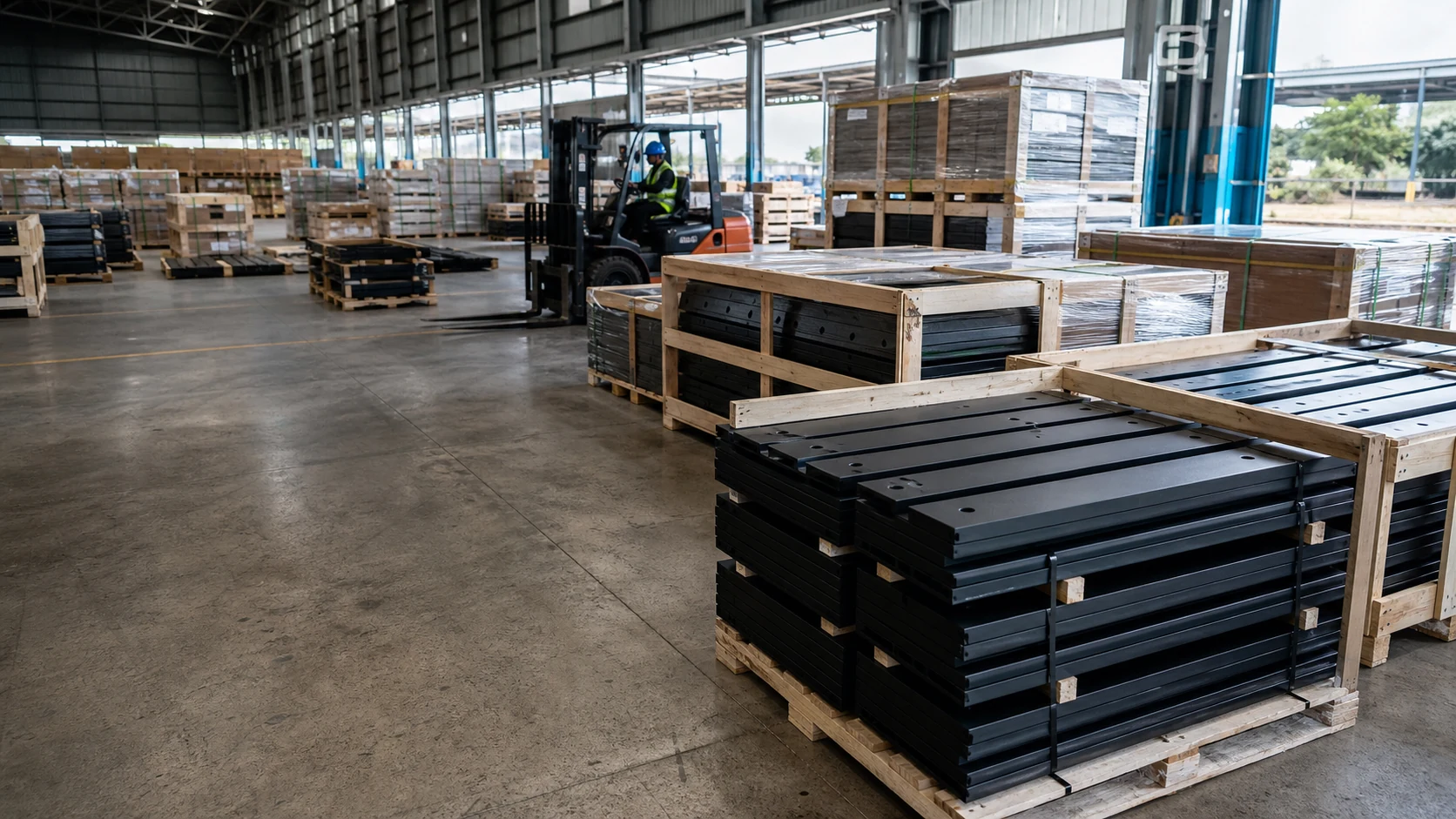
Two fleets of similar size start the winter with the same number of edges in store. One of them runs out in the first hard week and keeps a machine off the route waiting for a delivery; the other finishes the season with stock remaining, having consumed less than it held for most of the winter. Neither fleet’s figure was obviously wrong, because both had been set from a quantity rather than from two records: how fast the fleet consumes edges, and how long a replacement takes to arrive.
This is a decision path through the stock level question. It works through the demand drivers, the consumption rate, the lead time risk, which spares are genuinely critical, and how to set a level and a restock trigger that can be reviewed at the end of the season rather than argued about during one.
Plow blade inventory planning: the question behind the question
Set the level from consumption and lead time.
The question is not how many blades a fleet should own, it is how much exposure a fleet is willing to carry between ordering and receiving.
That reframing produces a figure with two inputs: the rate at which the fleet consumes edges, and the time a replacement takes to arrive at the point in the season when it is ordered. Both are measurable, and neither is a matter of judgement.
The reason fleets get it wrong is that they set the level once and treat it as a policy. Consumption changes with the winter, lead time changes with the season and the supplier’s own load, and a level that was right in an average year is either excessive in a mild one or short in a severe one.
Demand drivers across a season
Three drivers move blade consumption within a single winter. The severity of the season sets how much work the fleet does, which drives the total abrasion the edges see. The distribution of that work matters as much as the total, because a season with four concentrated storms consumes more edges than a long mild winter with the same number of hours.
The third driver is route change. A machine moved to a route with a more abrasive surface consumes edges faster than the same machine on its previous duty, and the change is often not recorded anywhere the store keeper can see. Where a fleet replans routes before the season, the consumption assumption for the affected machines should be reviewed at the same time.
Consumption rate per vehicle
Consumption rate is the number of edges a machine uses over a season, and it is best expressed per unit of work rather than per season so that two winters can be compared. Events, lane-kilometres and hours are all usable, provided the same unit is used throughout the calculation.
Two refinements make the figure useful rather than merely historical. Recording consumption per machine rather than per fleet shows which units are driving the total, and it is usually a small number of them. And recording it per route type makes the figure portable when a machine is reassigned, which is what stops a route change from quietly invalidating the stock level. The measurement that produces the underlying wear rate is described on the blade wear measurement page.
Lead time and shipping risk
Lead time is the second input and the one that turns a consumption figure into a stock level. What matters is not the nominal lead time from a catalogue but the lead time at the point in the season when the order would be placed, which for wear parts is the period when every fleet in the region is ordering.
Three components belong in the figure. The supplier’s production or picking time. The transit time, including any customs or border process where the goods cross one. And a margin for the order that arrives incomplete, which is a scheduling problem rather than a quality one and is common at the peak. Where a fleet has never recorded actual lead time, the first season of recording it produces a figure more useful than any estimate.
Critical spares versus nice-to-have
Not every edge in the fleet deserves the same stock cover, and treating them alike is what produces both stockouts and obsolescence in the same store room.
- Edges on machines that have no substitute, where a stockout removes a route rather than a machine.
- Edges on machines with a short working season, where the whole season’s consumption falls into a few weeks.
- The hardware and consumables needed to fit an edge, without which the blade in store cannot be used.
- Edges on machines that can be substituted or rotated, where a stockout costs performance rather than service.
The third entry is the one most often omitted from the calculation. A store room holding a full set of blades and no fasteners is not covered, and the gap appears at the point of fitting rather than at the point of ordering.
Budgeting the inventory
The inventory budget covers two costs that behave in opposite directions. Holding cost rises with the stock level: capital tied up, space occupied, and a proportion of the stock that will obsolesce before use. Stockout cost falls with the stock level and is concentrated at the moment a machine is needed.
For winter wear parts the balance usually sits higher than a general inventory model would suggest, because the stockout is not a delayed sale but a route that is not treated. That does not justify holding everything; it justifies holding more cover on the critical positions and less on the ones that can wait.
Mid-season restock triggers
The trigger is a level rather than a date, and setting it correctly is what prevents a stockout in the weeks when ordering is slowest.
| Input | Where it comes from | What it decides |
|---|---|---|
| Consumption per week during peak | Previous seasons’ records, by machine | How fast the remaining stock is falling |
| Lead time at peak | Actual delivery records from previous orders | How much stock has to cover the gap |
| Critical positions | The list of machines with no substitute | Which lines are triggered earlier than the rest |
| Season severity to date | Event counts against the seasonal average | Whether to pull the trigger earlier this year |
The fourth row is what makes the trigger adaptive rather than annual. A fleet that has already worked more than its seasonal average by mid-January should be restocking on a trigger set for a severe season, and the event count is the record that tells it so.
Storage and handling
Stock that is held badly is not stock. Four practices keep the inventory usable and countable.
- Edges stored off the floor and out of standing water, so the steel and any bonded joints do not corrode in store.
- Labelling by part number and pattern, so a change-out does not depend on recognising the edge by eye.
- Hardware stored with the edge it fits, so a fitting is not delayed by a missing nut.
- A count that matches the record, since a stock level nobody trusts is a stock level that will be duplicated by extra ordering.
The fourth entry is the one that quietly inflates inventory. Where the store record and the store room disagree, the practical response is to order more, and the fleet ends up holding more than it intended without deciding to.
What the stock level is not
Three things are sometimes asked to do the job of a stock level, and none of them can.
| Substitute | Why it fails |
|---|---|
| A larger number chosen for safety | It raises holding cost without reference to consumption or lead time |
| A standard quantity applied across the fleet | It ignores that consumption per machine varies by a large factor |
| An emergency order route | It works until the week every fleet in the region is using it |
The third row is the one that fails most visibly. A fleet that relies on being able to order at short notice discovers the limit of that arrangement in the hardest week of the season, when lead times extend and the order that was going to save the route arrives after it.
Holding cost versus stockout cost
The comparison is worth making explicitly before setting a level, because it is the argument that justifies the number to a finance function. Holding cost is the capital, space and obsolescence attached to the stock level. Stockout cost is the value of the service the fleet fails to provide when a machine cannot be edged.
Two properties of the second figure make it larger than it appears. It arrives all at once, and it is measured in untreated route rather than in a delayed repair. A fleet that prices a stockout at the cost of the blade will always hold too little, because the blade is not what the stockout costs.
Setting the level for a first season
Where a fleet has no consumption history, the first season is used to establish one rather than to strike a balance. The practical approach is to hold cover based on the best estimate available, record what is actually consumed per machine and per event, and record the actual lead time of every order.
Three records from one season are enough to set the level properly for the second: consumption per machine, lead time by order and by period, and the number and cause of any stockout or emergency order. That is a small amount of bookkeeping and it replaces an assumption that would otherwise persist for years.
Reviewing the level after a season
The review is short if the records exist, and it answers four questions. Was the level sufficient, or was there an emergency order? Was it excessive, or did stock remain at the end of the season? Did consumption move from the assumption, and on which machines? And did lead time change from the previous year?
Any of those four moving is a reason to adjust one figure rather than to change the whole policy. Adjusting one input a season is what produces a stock level that converges on the fleet’s real demand, and it is a great deal less work than re-deciding the policy every autumn. Inventory practice at fleet level is published by the National Association of Counties, winter operations practice by the Snow and Ice Management Association, network guidance by the Federal Highway Administration, research by the Transportation Research Board, and cost context by the American Association of State Highway and Transportation Officials.
SENTHAI manufactures plow edges, wear plates and carbide inserts in Rayong, Thailand, and supplies fleets and distributors against a specified pattern, with lead times that depend on the order’s position relative to the season. Stock planning that needs the pattern and the supply position confirmed can be raised through the contact page, and the part number count that the stock level depends on is examined on the blade standardisation page.
FAQ
How many spare plow blades should a fleet keep?
Enough to cover consumption over the supplier lead time, plus a deliberate buffer for the critical positions that stop a machine. The figure comes from two records rather than from a rule: how fast each machine consumes edges, and how long a replacement takes to arrive.
Which blade spares are critical rather than optional?
The ones whose absence takes a machine out of service. That usually means the edges on machines with no substitute and the hardware to fit them, while a second spare for a machine that can be rotated to another route is not critical in the same way.
When should a mid-season restock be triggered?
When the remaining stock is close to the quantity the fleet will consume before a new order can arrive, not when the shelf is empty. The trigger is therefore a level rather than a date, and it has to be set from the lead time in the season the fleet is actually having.
Is it cheaper to hold more stock or to risk a stockout?
It depends on what the missing part stops. Where the part takes a machine off a route during a storm, the cost of the stockout is the route rather than the blade, and the holding cost is small by comparison. Where a spare sits unused for several seasons, the holding cost is real and the stock level was set too high.
Send the machines, the patterns in use and the consumption you have recorded. The SENTHAI engineering desk will confirm the part numbers and the supply position so the stock level can be set against a lead time rather than an assumption.