Four clauses decide whether a wholesale blade programme is still running in its third season, and the headline discount is not one of them. Range depth, commitment structure, territory and review cadence carry the weight, because each one determines whether the distributor can actually sell the stock it has been encouraged to buy.
A programme is not a price list. It is a set of decisions about what sits on the distributor’s shelf, what happens when it does not sell, and how the two parties adjust when the season turns out different from the forecast.
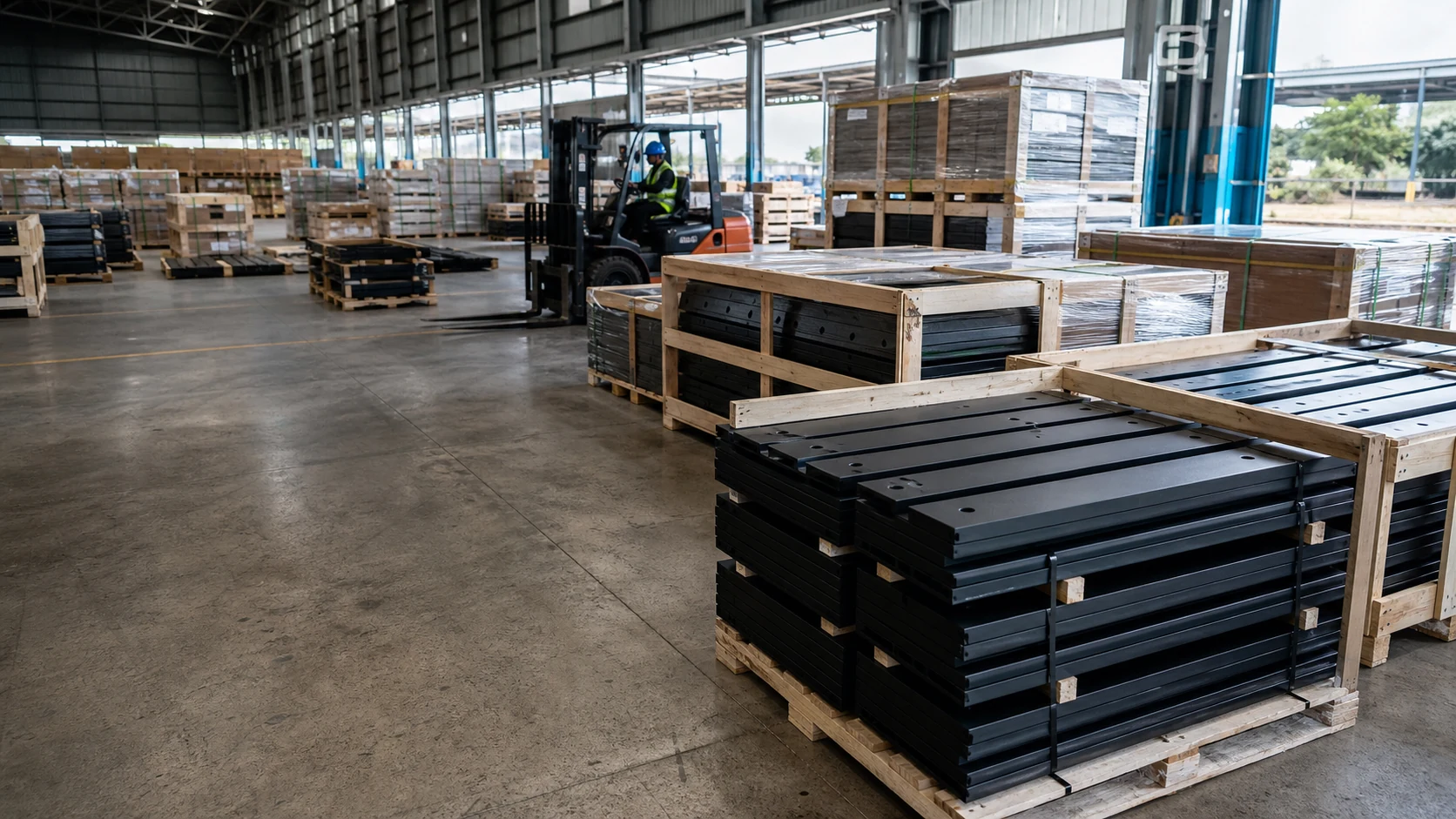
Wholesale snow plow blades: the terms that decide whether a programme works
A distributor programme is decided by four clauses.
Range depth, pricing tiers, territory and review cadence carry more weight than the discount itself, and each one can be tested against a real season before the first order rather than argued over in the second.
The reason the discount attracts the attention and the other four clauses decide the outcome is that blade demand is narrow and seasonal. A handful of sizes accounts for most of the volume, sales happen in a window measured in weeks, and the distributor has to commit stock before knowing which sizes the winter will ask for. A programme that ignores this and prices everything the same way leaves the distributor holding the slow lines and short of the fast ones.
Each section below takes one decision in the order it has to be made, starting with what the distributor stocks and finishing with how the arrangement ends. The order matters more than any single clause, because a weak range decision cannot be rescued by a better price.
Range and stocking depth
The range is the first decision because everything else is measured against it, including the volume commitment that sets the pricing tier.
A workable programme separates the range into three groups rather than treating it as one list. The first is the core sizes that every distributor in the region should carry, chosen from the machine population the territory actually runs. The second is the seasonal sizes that appear in most winters but not every one. The third is the long tail, which the programme covers by availability rather than by stocking.
Depth matters as much as breadth. A distributor holding two pieces of ten sizes will run out of the core size before the second snowfall, while the eight lines behind it occupy the shelf for the whole season. Depth on the core and availability on the rest is the pattern that keeps a programme funded.
Pricing tiers and annual commitments
Pricing tiers are the part of a programme that distributors negotiate hardest, and the part that most often produces unintended behaviour.
The problem with a single volume tier is that it rewards the total rather than the mix. A distributor can reach a tier by ordering deeply into one convenient size and never stocking the sizes its customers actually need, which damages both parties: the distributor is stuck with a slow line, and the supplier’s product does not appear on the machines it was designed for.
| Tier basis | What it rewards | Where it goes wrong |
|---|---|---|
| Total annual volume | Order size, in any mix | Concentrates stock in one or two sizes |
| Volume by size family | Stocking the core range as designed | Needs a clear definition of which sizes belong to which family |
| Pre-season commitment with in-season top-up | Forecasting, which is what makes supply reliable | Requires a firm top-up lead time and honest forecast review |
The third structure usually produces the best winter for both sides, because it moves the commitment decision to the point where the distributor can still influence it and leaves replenishment inside the season. It only works with a stated top-up lead time, since a promise of replenishment that cannot be delivered in the window is worse than no promise at all.
Territory and channel protection
Territory is where a programme either feels safe or does not, and the definition matters more than the amount of protection.
A radius on a map is the weakest definition, because two distributors a mile apart may serve completely different customers: one supplies municipalities, the other supplies contractors and dealers. Naming the channel and the account types each distributor serves is what actually prevents the overlap that destroys trust in a programme.
Protection also has to be reciprocal to be credible. If the supplier reserves national accounts, fleet programmes and tendered municipal contracts, the distributor needs to know which of its own customers fall inside those reservations before it invests in stock. That list is worth more to a distributor than a wider boundary.
Stock rotation and slow movers
Stock rotation is the clause that determines whether a distributor is willing to stock deeply, and it is usually the least specified.
The question to answer is what happens to a line that has not moved after a full season. Three answers are common, and they produce very different behaviour.
| Option | Mechanism | Effect on stocking behaviour |
|---|---|---|
| No rotation | Slow stock remains the distributor’s risk | Encourages shallow ordering and a narrow range |
| Exchange within the family | Slow sizes convert into core sizes at an agreed rate | Encourages a broader initial range at controlled risk |
| Annual buy-back of a defined share | A fixed percentage of the year’s purchases returns | Encourages depth on core sizes; needs a condition on the state of goods |
Exchange within the family is the option with the fewest disputes, because the goods return in the same packaging and the credit is spent on a line the distributor already sells. It also gives the supplier information, since the returned sizes record what the territory does not run.
Technical support and training
Technical support is the part of the programme a distributor uses most often in the first season and prices least often in the negotiation.
The support that matters is fitment-related: which edge a given plow model takes, how a bolt pattern is verified, what a wear measurement means, and when a blade has reached its limit. A distributor answering those questions well converts a stock order into a repeat customer, and the answers come from the manufacturer rather than from the catalogue.
Two forms of support are worth writing into a programme: a named technical contact with an agreed response window, which turns a question during a snow event into a sale rather than a lost order, and a short training session for the distributor’s counter staff, delivered before the season rather than during it. A manufacturer with the full process chain on one site can support both, and the production scope behind that support is described on the factory page.
Marketing and catalogue support
Catalogue and marketing support reduces the cost of selling the line, and for many distributors it is worth more than an extra point of discount.
The items that get used are specific: image files and specification sheets the distributor can put into its own catalogue, a part-number cross-reference against the machines in its territory, a recommended retail price band, and a short technical note that explains the range to a fleet manager. Generic brand assets are rarely used, because the distributor sells under its own identity to its own customers.
For distributors running a brand of their own, the same programme can carry private label and custom elements rather than catalogue-branded goods. That combination is described on the custom blade programme page, and it is usually the point at which a distributor asks for terms that look more like a manufacturing agreement than a wholesale one.
Performance review cadence
The review cadence is what keeps a programme from silently drifting into a price list, and it works best as a short, fixed sequence rather than an annual meeting.
The agenda should be narrow enough to finish in one session, and identical every time, so that both parties prepare the same numbers.
- Consumption by size against the core range, including the sizes that did not move.
- Stock on hand and weeks of cover for each core size, measured before the season rather than after it.
- Service performance: lines delivered complete and on time, and any backorders carried through the season.
- Claims and returns, with the reason recorded rather than only the credit issued.
- Adjustments to the range, the depth or the top-up lead time for the next season.
Running this cadence twice a year, once before the season and once after it, is usually enough. The pre-season review is the one that changes outcomes, because the range and depth are still adjustable.
Term length, exit and continuity of supply
A term shorter than a full season cannot be evaluated, and a term with no exit route is difficult to sell to a distributor’s own management.
The practical structure is a term covering at least one complete winter, with renewal tied to the review rather than to a calendar date, so that the renewal decision is taken with a season of data on the table. Where a distributor is investing in stock depth on the strength of the programme, a single-season term is often too short to justify the commitment.
Exit terms need to answer three questions: what happens to outstanding orders placed before the notice date, what happens to stock already committed or exchanged, and how supply is maintained through the notice period, since a distributor still has customers to serve while the agreement runs down. Naming the notice period, the last order date and the run-off arrangements is enough; the point is that none of them is discovered mid-season.
Where programmes break in practice
Programmes rarely fail because the discount was wrong. They fail because one of the four structural clauses was left vague and both parties assumed the other had understood it the same way.
The most common break is a volume tier with no mix definition, so the distributor buys one size deeply and the range never gets onto the machines. The second is territory defined geographically, which produces two distributors chasing the same municipal account. The third is a replenishment promise with no stated lead time, which works in a mild winter and fails in the one that matters.
The fourth is subtler: a programme with no review, where the size mix drifts for two seasons because nobody is looking at the consumption data. Model distribution contract terms are published by the International Chamber of Commerce, and the equipment standards a tier definition may reference come from SAE International. Industry practice across the sector is documented by the Snow and Ice Management Association, and public-agency purchasing conventions by the National Association of Counties and the American Association of State Highway and Transportation Officials.

FAQ
What should a wholesale blade programme price be based on?
Annual volume by size family, not a single headline discount. Blade demand is concentrated in a few sizes, so a tier structure tied to the families a distributor actually stocks rewards the stocking decision and avoids discounting lines that will never be reordered.
How long should a distributor agreement run?
Long enough to cover a full winter season and the buying cycle in front of it, which in practice means a term measured in seasons rather than in months. A term shorter than one season cannot be judged, because neither party has seen a complete demand cycle.
How is territory protection usually defined?
By the accounts or channels the distributor serves, not by a radius on a map. Two distributors can sit in the same city and serve different customers, so naming the channel and the account types prevents the overlap that a geographic boundary fails to prevent.
If you are setting up a distributorship or rewriting the terms of an existing one, send the territory, the customer types and the sizes you expect to stock. SENTHAI will come back with a range and depth proposal, a tier basis and the support that comes with the programme.
This article is one step in the Sourcing Carbide Wear Parts Guide, which covers the technical pack, supplier selection, landed cost and supply risk.