A minimum order quantity is not a measure of how much a supplier would like to sell. It is a measure of what one production run costs to start, divided by the number of pieces the buyer wants to take from it.
That distinction matters because it tells the buyer which levers exist. A minimum driven by set-up can be reduced by accepting a higher price or by sharing the tool; a minimum driven by a furnace load or a material lot cannot be moved at all, only spread across more sizes or more time.
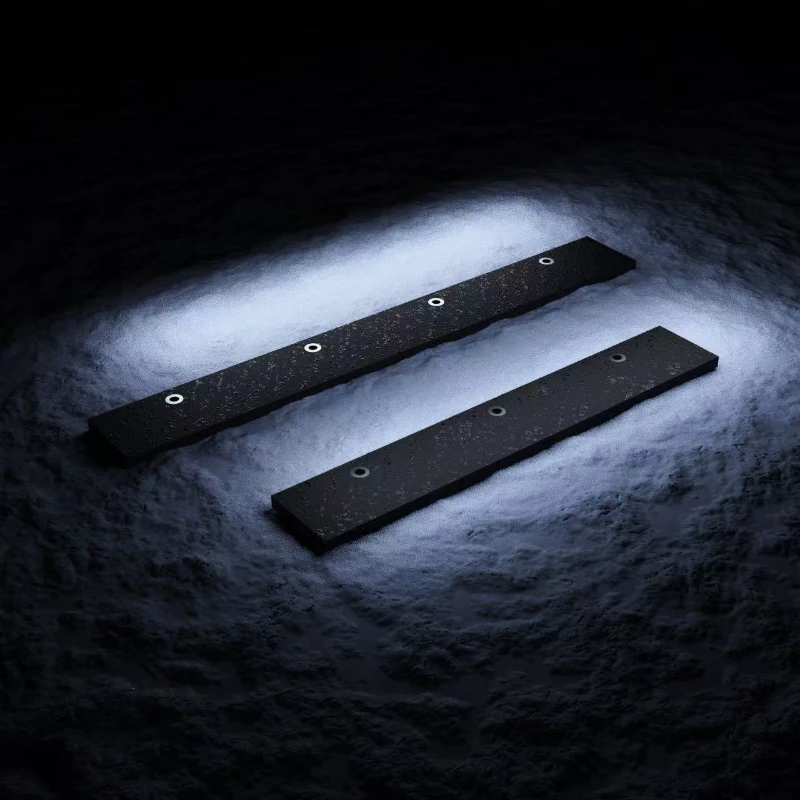
What MOQ carbide wear parts figures are actually made of
An MOQ is one production run’s break-even quantity.
It covers the set-up, the material lot and the yield loss a run creates before the first saleable part; the figure falls when the item is already tooled and rises when the grade, the profile or the packaging changes.
Read that way, the number stops being arbitrary. Four costs sit behind almost every minimum quoted for carbide edges, inserts and wear plates, and each behaves differently as volume grows. Two are one-off, so they disappear from later orders; two are recurring, so they never disappear at all.
The practical consequence is that a buyer comparing minimums is really comparing how much of the cost the supplier is willing to carry forward. A supplier that amortises tooling over the first three orders quotes a lower first minimum than one that wants the whole set-up recovered immediately, and neither is being unreasonable.
Why the minimum is not the plant’s capacity
Production capacity sets the largest order a plant can handle, not the smallest, and the two are unrelated figures that get confused in negotiation.
A press rated at tens of tonnes still needs a die, a setting and a first-piece inspection before it produces anything saleable, and those costs are identical whether the machine runs for two hours or two days. The minimum exists to cover that fixed block, while capacity is the ceiling above it.
The confusion matters because buyers often argue a minimum down by pointing at idle capacity. Idle capacity reduces the opportunity cost of a run, which is real, but it does not reduce the material lot that has to be bought, the tool that has to be mounted, or the inspection that has to be recorded.
Cost drivers behind an MOQ
Four drivers account for the figure in most quotations, and naming the driver is what makes the number negotiable.
Set-up is labour and machine time to mount, adjust and verify the first piece. The material lot is the smallest quantity of the specified grade, insert or steel that can be purchased and traced as one batch. Grade changeover is the cleaning, purge and re-qualification between one grade and the next. Tooling is the die, fixture or print plate that exists only for that item.
| Driver | What it pays for | Behaviour as volume grows |
|---|---|---|
| Set-up | Mounting, adjustment and first-piece verification | Fixed per run; spread across more pieces, but charged again on every run |
| Material lot | The smallest traceable quantity of the specified grade | Steps rather than scales; a bigger order moves to the next lot size |
| Grade changeover | Cleaning, purge and re-qualification between grades | Fixed per switch; avoided entirely by running the same grade |
| Tooling | The die, fixture or print plate unique to the item | One-off; disappears from the price once it has been paid for |
The table also explains why two suppliers quote very different minimums for the same drawing. One may be treating the tool as a charge to the buyer, the other as a capital cost it will recover across the programme. Both are valid commercial positions, and the choice between them shows up in the unit price rather than in the minimum.
Stock items versus custom production
A catalogue item and a custom item carry different minimums because they carry different histories, not because the supplier applies a different policy.
A catalogue edge has already been tooled, sampled and approved, and its set-up cost was absorbed by earlier orders. What remains is a material lot and a running set-up, which is why catalogue minimums usually track the production lot size rather than a development cost. A custom edge starts at zero: the drawing has to be reviewed, the process proven, the first article inspected and often the packaging created.
That is the reason a first custom order looks expensive and a fifth one does not. If the buyer intends to grow into a programme, asking for the first-order and steady-state minimums separately is more useful than asking for one figure, because the two numbers describe different phases rather than a negotiation position. The route from a first article to a programme is set out on the custom blade page.
Grade and insert changeover effects
Grade changeover is the driver that most often makes a small order impossible, and it is the one buyers rarely see in the quotation.
Moving a press or a furnace from one carbide grade to another is not a setting change. The line is cleaned, the first output is checked and often discarded until the process is stable again, and the tooling may need a different fit. Those costs are fixed per switch, so they land hardest on small orders that switch grades often.
The practical implication is that mixing grades across a small order can cost more than ordering two single-grade lines. Consolidating on one grade for a trial, or accepting the grade the plant is already running for the size in question, removes a fixed cost that would otherwise be quoted back to the buyer.
Tooling and setup amortisation
Tooling is the only driver that can genuinely disappear, and how it is treated decides whether the first order is viable.
Three arrangements are common. The tool is charged to the buyer and owned by the buyer. The tool is charged once and owned by the supplier, who then uses it for that buyer’s orders. Or the tool is carried by the supplier as programme capital and recovered through the unit price over an agreed volume.
Each has a consequence worth stating at the enquiry stage. Buyer-owned tooling usually needs a clause covering storage, access and what happens on termination; supplier-owned tooling can make it difficult to move the item to another plant later; a capital arrangement normally carries a volume commitment, which is fine provided the commitment is one the buyer can actually forecast. Definitions of the trade terms used in those arrangements are published by the International Chamber of Commerce.
Negotiating staged first orders
A staged order is the standard way to buy a minimum quantity without taking the whole risk at once, and it works because it separates the tooling decision from the volume decision.
- Agree the specification and the first-article acceptance criteria before quantities are discussed.
- Separate the tooling charge from the production quantity, so each is quoted as its own line.
- Set a first delivery against the production minimum, not against the tooling minimum.
- Fix the balance of the quantity with a delivery window rather than a date.
- Confirm that the second and later deliveries are priced at the same unit rate as the first.
The fourth step is where staged orders are usually lost. Holding stock at the plant for a twelve-month window is a cost to the supplier, and a buyer who asks for it without acknowledging that will either be refused or find the cost hidden in the unit price. A three to six month call-off window is normally the point where both sides can commit.
Consolidating sizes into one order
Consolidation lowers the effective minimum only when it removes a cost rather than shifting it, and the test is simple: do the sizes share the material, the grade and the set-up?
Sizes cut from the same steel, in the same grade, on the same tooling can often be run together, which spreads the set-up across the whole order. Sizes that need a different thickness, a different insert grade or a different bolt pattern introduce their own set-up, so adding them increases the total rather than diluting it.
The exception is the material lot. Where several sizes use the same grade, buying that grade in one lot and drawing it down across sizes usually lowers the total material cost, even when the pieces are machined in separate runs. Buyers planning a season should ask which of their sizes share a grade before they ask for a discount.
Realistic minimums by product type
Expectations should be set by product type rather than by supplier policy, because the drivers differ so much between a catalogue edge and a custom insert.
A stock blade edge is normally quoted at a production lot, since nothing new has to be created. A custom profile carries tooling and a first article, so its first minimum sits well above the steady-state figure. Replaceable inserts are usually the least flexible, because they are pressed and sintered in a furnace load that cannot be part-loaded economically. A packaged kit sits somewhere between, since the packaging run is often the binding constraint.
| Product type | Binding driver in most cases | Where flexibility comes from |
|---|---|---|
| Catalogue blade edge | Production lot size | Drawing on an existing run rather than ordering separately |
| Custom profile edge | Tooling and first-article approval | Sharing the tool across sizes, or paying the tool separately |
| Replaceable inserts | Furnace load and grade run | Consolidating on one grade; almost none on the load itself |
| Packaged kit | Print run and components kit | Plain packaging first, branded packaging once volumes are known |
Equipment and material standards referenced in the specification come from bodies such as SAE International and ASTM International, while fleet buying practice is documented by the American Association of State Highway and Transportation Officials and the National Association of Counties. Trade practice across the winter maintenance sector is published by the Snow and Ice Management Association.
FAQ
Is a high MOQ not just a way of pushing stock onto the buyer?
Sometimes, but a genuine minimum has a visible cost behind it. Ask which of the four drivers sets the figure: the material lot, the set-up, the grade changeover or the tooling. If the supplier cannot name one, the number is a commercial policy rather than a production constraint.
Would paying more per piece not remove the minimum?
It can reduce it, because a higher unit price can absorb a fixed set-up across fewer pieces. The trade-off is real rather than a trick: a small first order bought at a premium is a legitimate way to test a supplier, as long as the price returns to the normal band at volume.
Can several sizes be combined to reach one minimum?
Only where the sizes share the same material lot, the same grade and the same tooling. Combining sizes that need a different grade or a different set-up does not reduce the cost the minimum exists to cover, so the total is simply split differently.
Why is the minimum on a custom item higher than on a catalogue item?
A catalogue item carries set-up that has already been paid for by earlier orders, so only its material and running costs remain. A custom item carries the first set-up, the first inspection and often a new tool, and none of that is recoverable from a handful of pieces.
Does the minimum fall automatically once we buy regularly?
It falls where the constraint was set-up or tooling, because those are one-off costs that a repeat programme has already absorbed. It does not fall where the constraint is a material lot or a minimum furnace load, because those costs recur with every run regardless of history.
Send the sizes, the grade and the quantity you can commit to in the first twelve months. SENTHAI will quote the tooling, the first lot and the steady-state minimum separately, so you can see which of the four drivers is setting the number.
This article is one step in the Sourcing Carbide Wear Parts Guide, which covers the technical pack, supplier selection, landed cost and supply risk.