One buyer sends a photograph of a worn edge and a machine model; another sends a drawing with tolerances, a grade callout and a packing specification. The first enquiry produces three quotations that cannot be compared, and the second produces one that can be built.
The difference between the two is a technical pack, and it is usually assembled from documents the buyer already has. This is what belongs in it, in the order a manufacturer reads it.
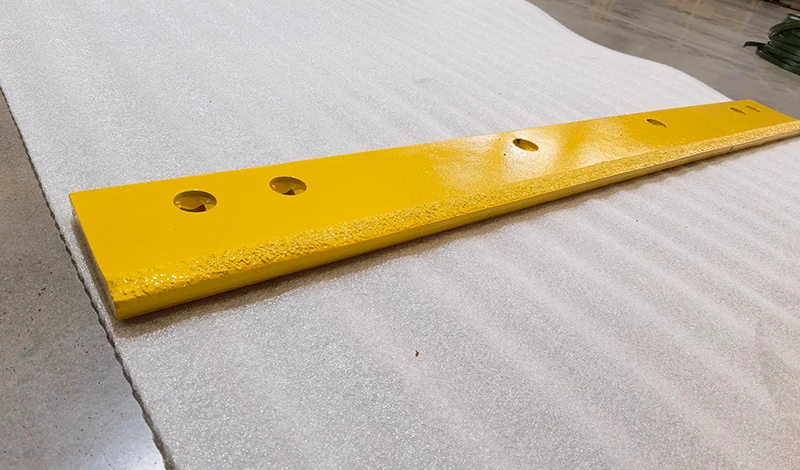
What a technical pack for a custom blade has to settle
A technical pack exists to remove assumptions.
Geometry, tolerances, grade, spacing, hardware, finish, marking, volume and delivery: once those are written down, two manufacturers quoting the same item are quoting the same thing.
The pack exists because a manufacturer can only build what it can interpret. Every gap in the documents is filled by a decision taken at the plant, and that decision will be the cheapest or the most convenient one rather than the one the buyer would have made. A tolerance left unstated becomes whatever the process naturally produces; a marking left unspecified becomes the default; a packing expectation left to the supplier becomes whatever is already on the shelf.
None of that is bad faith, and none of it is visible until the first shipment. The purpose of the pack is to move those decisions to the buyer’s desk, where they cost nothing, instead of the receiving dock, where they cost a rework.
Drawings and CAD formats
A drawing or a dimensioned layout is the core of the pack, and the format matters less than the completeness.
Native CAD is convenient but rarely necessary. A dimensioned PDF or a measured layout with hole positions called out by coordinates is enough for most custom edges, provided the drawing states the revision and the units. Where the part is a replacement for an existing item, a measured layout taken from the machine and checked against the worn part is often more accurate than a drawing that has been re-drawn from an old catalogue page.
Two conventions make the drawing easier to use. Dimension the bolt layout as a set of coordinates rather than a pitch, because the same pitch with different hole sizes or offsets produces a different part. And state the datum the measurements are taken from, so a supplier that measures the part on arrival measures it the same way.
Tolerances and critical dimensions
The pack should say not only what the dimensions are, but which of them carry the cost of being wrong.
A generic tolerance block spreads the same allowance across every dimension, which is easy to write and expensive to hold. Marking two or three dimensions as critical concentrates the attention and the inspection, and it leaves the rest of the part free to be produced on the economical side of the process.
- The dimensions that control fitment to the machine, normally the bolt layout and the mounting face.
- The dimensions that control wear, normally the edge thickness and the insert exposure.
- The dimensions that control interface with adjacent parts, such as the lap or the end profile.
- Everything else, which can carry a general tolerance.
Geometric dimensioning practice for the drawing itself is published by the American Society of Mechanical Engineers, and the material test methods a dimensional record may reference come from ASTM International. Where a dimension is genuinely unknown, marking it open invites a proposal rather than an assumption.
Material and grade specification
The material section should state the grade, the form and the standard the values are measured to, rather than only a trade name.
For the wear element, that means the carbide grade with its hardness range and nominal grain size, plus the joining method if the pack is specifying it. For the body, it means the steel specification and thickness. Trade names travel badly between suppliers; a grade description plus an acceptance range can be checked on a delivered lot.
Where the application is unusual, the pack is also the right place to state the condition the part has to survive: abrasive gravel, packed ice, high-speed highway work, or a mix. A supplier choosing between a harder and a tougher grade needs that sentence more than it needs another drawing view.
Insert configuration and spacing
Insert geometry and spacing decide how the edge wears, and they are the parameters most often left to the manufacturer by default.
Three values describe most configurations: the insert shape, the spacing or density along the edge, and the exposure above the body. Shape sets the contact pattern, spacing sets how the load is distributed between inserts, and exposure sets the compromise between bite and retention. Changing any one of them changes the wear behaviour without changing the drawing outline, which is why they belong in the pack rather than in a conversation.
Equipment standards published by SAE International and fleet specification practice from the American Association of State Highway and Transportation Officials are useful references when the buyer wants to describe a configuration in terms another supplier will recognise.
Hardware and interface details
Hardware is the part of the pack that prevents a fitment failure on the first delivery, and it is the one buyers most often treat as someone else’s responsibility.
The pack should state the bolt diameter, the thread, the grade and the coating if it matters, the nut type where the machine uses a conical or flanged nut, and the torque the fastening is to be tightened to. Where the edge is supplied with its own hardware, the pack should say whether the fasteners are included in the item or shipped separately, because the two are quoted differently.
Interface details cover everything the edge touches: the mouldboard profile, the lap on a multi-piece edge, the wing or underbody mounting, and any shoe or skid that shares the same bolts. A pack that states which of those parts are being replaced, and which stay, avoids the common case of a new edge that fits the plate but not the hardware already in the yard.
Finishing, marking and packaging
Finish, marking and packaging are specified as precisely as the geometry, because they are what the buyer’s customer sees.
Finishing covers edge preparation, any coating and the surface condition of the body. Marking covers whether the brand is applied to the product or only to the packaging, what the text says, and where it sits. Packaging covers the carton, any sleeve or label, the unit quantity, and whether the pieces are packed for pallet delivery or for a shelf.
The reason to state all three in the pack is that they are the easiest items to change between a sample and a batch, and the hardest to detect at goods-in unless the pack names them. A dated photograph of the approved sample belongs in the pack alongside the written description.
Volume and delivery expectations
Volume and delivery expectations belong in the technical pack because they change the process route, not only the price.
A quantity that justifies dedicated tooling is produced differently from one that is drawn from a shared run, and a delivery split across a season is planned differently from a single shipment. Stating the expected annual quantity, the first order quantity and the delivery pattern lets the manufacturer choose the process that fits, rather than quoting a process and discovering the volume later.
The pack should also state the delivery point and the required date basis, since a lead time quoted from order behaves differently from one quoted from payment. Trade practice across the winter maintenance sector, including typical programme structures, is documented by the Snow and Ice Management Association and the equipment manufacturing body, the Association of Equipment Manufacturers.
Document control practice
A pack without revision control becomes a set of loose documents within a year, and the manufacturer ends up building to a version nobody can identify.
The practice that works is simple enough to keep. Every document in the pack carries the same revision number, the pack itself carries a cover sheet listing what is inside, and the supplier quotes the revision on its order acknowledgement. When something changes, the revision number changes with it.
- Number the pack and every document inside it with the same revision.
- List the enclosed documents on a cover sheet with their dates.
- Send the pack as one item, so nothing arrives out of context.
- Require the supplier to quote the revision on the acknowledgement and the delivery note.
- Retire the previous revision explicitly when a new one is issued.
The fifth step is the one that gets forgotten, and it is the reason two revisions end up in circulation. Retiring the old pack in writing, and asking the supplier to confirm it, takes one email and prevents a batch being made to a superseded drawing.
What to leave out of the pack
A pack gets harder to use as it gets longer, and a few common inclusions work against it.
Do not include an internal cost breakdown, since it invites a quotation built around the buyer’s own assumptions rather than around the process. Do not include superseded drawings, even as background, because a manufacturer reading a pack for the first time cannot tell which version governs. And do not include requirements the buyer is not prepared to inspect, because an unenforceable requirement adds cost that nobody checks.
The one thing worth adding beyond the technical content is a named contact on both sides. A pack with a single technical contact at the buyer and one at the manufacturer resolves ambiguities in hours, while a pack routed through an inbox resolves them in days. The route from a pack to a built part is described on the factory page.
FAQ
Do we really need a drawing if we send a physical sample?
A sample tells the manufacturer what the part looks like; a drawing tells it which dimensions matter. Without the second, the supplier has to guess where to spend the tolerance, and the guess usually lands on the dimension the machine is most sensitive to.
Is our drawing not giving away proprietary design information?
A manufacturer needs the geometry to make the part, not the reason behind it. Buyers who are concerned about disclosure can send the fitment-critical dimensions, the grade and the interface details while withholding the application context, and should agree confidentiality in writing before the pack is sent.
What if several dimensions are simply unknown?
Say so in the pack rather than leaving them off. A dimension marked as open invites the manufacturer to propose a value and explain the reasoning, and a proposal is easier to review than a silent assumption that appears later in a first article.
How often should the pack be reissued?
On every change that affects fitment, wear or appearance, and with a revision number that the supplier quotes back. A pack that is silently updated is worse than an outdated one, because the supplier will be building to a document the buyer no longer recognises.
Should commercial terms sit inside the technical pack?
Keep them separate but send them together. Volume and delivery expectations influence the tooling and the process route, so the manufacturer needs them at the enquiry stage, while price, payment terms and delivery terms belong in the commercial document that accompanies the pack.
Send the drawing, the measured layout or the worn part, and SENTHAI will tell you which items are missing from the pack before quoting. The review is a document check, not a sales step.
This article is one step in the Sourcing Carbide Wear Parts Guide, which covers the technical pack, supplier selection, landed cost and supply risk.