Ready-to-press powder for wear parts and finished carbide inserts look related on a purchase order, but they answer different questions. Powder is the grade decision—binder, grain size, flow, and green density—while the insert is that grade after pressing, sintering, and grinding into a geometry your plow or crusher can mount.
(Last modified date: November 12, 2026)
Buyers who confuse the two end up specifying hardness on a drawing that the powder route already locked weeks earlier. This guide walks the powder-metallurgy chain for ready-to-press powder for wear parts vs inserts, shows which parameters belong on which document, and points to how SENTHAI documents lots on the quality control page. For finished edge geometry, pair this with the carbide inserts product page and the mounted assembly on a carbide snow plow blade.
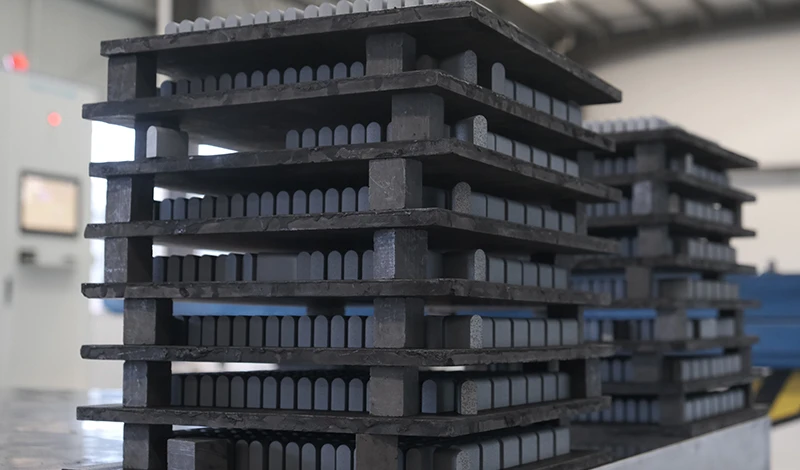
What the powder route decides
The powder route decides the properties the finished insert will have, and the later stages can only preserve or damage them.
Hardness, toughness, wear resistance and the tolerance a part can hold after sintering all trace back to the blend, the grain size, the way the powder was milled and dried, and how it compacted in the die. Pressing and sintering are often treated as the technical stages, and they are, but they cannot turn a coarse-grained blend into a fine-grained insert.
That ordering matters for a buyer because it explains where a specification has to be precise. Grinding a drawing to a tighter tolerance does nothing if the powder was mixed to a different binder content, and asking for a harder insert does nothing if the grain structure cannot deliver it at the toughness the application needs.
Ready-to-press powder for wear parts vs finished inserts
Ready-to-press (RTP) powder is the granulated blend a press can fill into a die: binder content, grain structure, flow, and lubricants already set. A finished insert is that same grade after compaction, sintering shrinkage, and grinding to a pocket or edge profile. Specifying RTP means you own grade control and still need press and sinter capacity; specifying inserts means you buy a verified geometry with lot documents.
| Decision | Ready-to-press powder | Finished carbide insert |
|---|---|---|
| What you control | Grade, grain, binder, green density targets | Pocket fit, length, chamfer, braze/weld interface |
| What you still need | Die, press, sinter cycle, grind capacity | Mounting procedure and inspection plan |
| Typical buyer | OEMs and plants with powder routes | Fleets and distributors buying edges |
| Document focus | Powder cert, grain size, flow, binder % | Grade + dimensions + lot / furnace record |
Most municipal and contractor buyers never buy RTP powder—they buy inserts and blades. The powder route still matters because grade drift, porosity, and shrinkage show up as early tip loss on the road. Ask suppliers which powder inputs and furnace windows sit behind the insert lot, not only the Rockwell number on a brochure.
Powder or finished inserts: which should a buyer order?
Most wear-part buyers should order finished inserts or finished edges, not ready-to-press powder. Powder only makes sense when your own plant presses and sinters carbide; everyone else is buying the result of those steps and should judge it by geometry, density and lot records.
- Order ready-to-press (RTP) powder when you run your own presses and furnaces, control the die and the sintering cycle, and can test green density and shrinkage in-house.
- Order finished inserts when you braze or clamp carbide into a carrier, a plow edge or a crusher tip and need a part that fits the pocket on arrival.
- Order a finished edge or blade when you do not want to manage brazing at all, for example a carbide snow plow blade with the inserts already joined.
The counter-intuitive part is that buying powder gives you more control over grade and less control over outcome: once the powder leaves the supplier, pressing, sintering and grinding errors become your errors. Buying inserts moves that risk back to the manufacturer, which is why the document set you request changes as well.
| You buy | Ask the supplier for | You still own |
|---|---|---|
| Ready-to-press powder | Grade and binder declaration, grain size class, lot number, flow and apparent-density data | Pressing, sintering, shrinkage, porosity and final grinding |
| Finished carbide inserts | Drawing revision, dimensional report, sintered density, lot traceability | Brazing or mounting into your carrier |
| Finished edge or blade | Bolt pattern, profile, insert grade, joint method, lot records | Fitment check and installation |
Powder metallurgy carbide parts: what each step contributes
Powder metallurgy decides the grade before shaping begins.
The blend, the grain size and the way the powder is milled and dried set the hardness and toughness the insert will have, and no amount of care at the press can recover a grade that was wrong when it arrived.
The five steps that follow carry that grade through to a finished part: blending, grain size control, milling and drying, compaction, and sintering to final density. Each one has a parameter that can be recorded, and each one has a defect that appears later if it drifts.
Read as a chain, the route explains why carbide parts are specified by grade rather than by hardness alone. Hardness is an outcome; the blend and the grain structure are the inputs that produce it, together with the toughness that has to come with it.
Tungsten carbide and cobalt blending
Blending combines the hard phase with the binder, and the proportions decide where the finished material sits between wear resistance and impact tolerance.
Tungsten carbide provides the hardness. Cobalt provides the toughness that holds the structure together. More binder generally means a tougher material with slightly lower hardness; less binder means a harder material that resists abrasion better and cracks more readily under impact. That single trade-off is the reason a fleet clearing gravel and a fleet clearing packed ice are usually buying different grades.
The blending step also has to produce a uniform mixture, because a blend that segregates will sinter into a part with local variations in binder content. Those variations do not show up as a visible defect; they show up as an insert that wears unevenly or fails earlier than its grade suggests.
Grain size control
Grain size is the second lever, and it moves hardness and wear resistance without changing the binder content.
A finer grain structure generally produces a harder, more wear-resistant material at the same cobalt level, which is the basis of micro-grain grades used where abrasion dominates. The trade-off is sensitivity to impact: a very fine structure has less capacity to absorb a shock load than a coarser one, so grain size cannot be pushed in one direction without considering what the edge will hit.
Control matters because grain size is set by the starting powder and by how the sintering cycle is run. A cycle that holds too long or too hot allows the grains to grow, which quietly moves the material towards the coarse end of its specification without changing any of the other numbers.
Wet grinding and spray drying
Milling and drying turn the blended constituents into a powder that can be pressed consistently, and both are usually done wet for a reason.
Wet milling breaks down agglomerates and mixes the phases at a scale that dry blending cannot reach, and it does so in a liquid that also suppresses dust. The milled slurry is then spray dried into granules, which flow into a die the way a powder has to in order to fill a complex shape evenly.
The output of this stage is not a finer powder for its own sake; it is a granule with the flow and the packing behaviour the press needs. A powder that has been milled but dried badly will not fill a die uniformly, and the resulting density gradient in the green part becomes a distortion in the sintered one.
Powder flow and compaction behaviour
Compaction turns the prepared powder into a shape that holds together until it is sintered, and it depends on the powder as much as on the press.
How a powder flows into the die, how much it packs, and how it responds to pressure determine whether the green part has a uniform density. Pressing applies pressure from one or more directions, and where the shape is complex, the tooling is designed so the pressure reaches the whole section rather than concentrating at the top.
- Fill the die evenly, which depends on granule flow rather than on filling time.
- Apply pressure so the density is distributed through the section, not only near the punches.
- Eject the green part without introducing cracks at the edges.
- Check the green part for weight and dimensions as the first control point of the lot.
The fourth step is worth more than it looks. Green density, expressed as a weight or a dimension before sintering, is the earliest point at which an out-of-specification lot can be detected without waiting for the furnace, and a supplier that records it is controlling the process rather than inspecting the result.
Shrinkage prediction
Sintering shrinks the part, and the die has to be made larger by exactly the amount the material will contract.
The shrinkage factor depends on the grade, the binder content and the green density, which means it is specific to the material rather than to the part. That is why a change of grade, even to a seemingly compatible one, can move a dimension unless the tooling allowance is rechecked.
For a buyer, the practical consequence is that a dimensional change between two lots from the same supplier usually points at one of two causes: the process drifted, or the material changed. Asking whether the grade or the supplier of the powder changed is a faster diagnostic than re-measuring the parts.
Common porosity defects and causes
Porosity is the characteristic defect of a powder route, and its causes are mostly upstream of the furnace.
Low green density leaves more void to close during sintering and can leave residual porosity. Uneven fill produces density gradients, and gradients close at different rates, which shows up as distortion or as localised porosity. Contamination in the blend can prevent proper bonding between grains, and an incorrect sintering cycle can leave the part under-densified even when everything before it was correct.
Because the defect appears after sintering, the useful control is the process record from before it. A density measurement on the green part, a note of the cycle, and a check of the incoming material batch are what allow a porosity problem to be traced rather than merely observed.
How buyers can verify consistency
Consistency is verified from three documents rather than from the appearance of the part.
The material declaration names the grade and the values the supplier measured. The dimensional record shows whether the same allowance produced the same final dimensions. And the process record shows whether the cycle was run inside its window. A lot that arrives with all three can be compared with the previous lot, and the comparison is what consistency actually means.
Material and test methods behind those documents come from standards bodies such as ASTM International and the measurement practice published by the National Institute of Standards and Technology. Where a claim or a tender requires a specification reference, the conventions for the drawing itself come from the American Society of Mechanical Engineers. The fitment and equipment conventions the finished part has to match come from SAE International and the American Association of State Highway and Transportation Officials, and the buying practice around them is published by the Snow and Ice Management Association.
The third document is the one buyers ask for least and use most. A furnace record is evidence that the part was produced the way the supplier says it was, and it is the only way to distinguish a grade problem from a process problem after the parts have been delivered. The document set SENTHAI issues with a lot is described on the quality control page. Finished geometries ship as carbide inserts or complete carbide snow plow blades; plant flow is summarised on our factory.
FAQ
What is ready-to-press powder for wear parts versus a finished insert?
Ready-to-press powder is the granulated carbide blend prepared for die fill. A finished insert is that grade after pressing, sintering, and grinding to a mountable shape. Powder buyers control grade chemistry; insert buyers purchase a verified geometry with lot evidence.
Is carbide dust from these powders a health risk?
Dust from tungsten carbide and cobalt powders is treated as a workplace hazard, which is why blending, milling and spray drying take place in enclosed equipment with extraction and the powder is handled wet wherever the process allows. The risk belongs to the plant; a buyer’s interest is that those controls exist.
Does a finer grain always mean a better insert?
No. Finer grains generally raise hardness and wear resistance at the same binder content, and they also make the insert more sensitive to impact. Choose grade against the surface and duty, not by grain size alone.
Can porosity be seen from the outside?
Usually not. Surface porosity may show as a small pit, but internal porosity and density gradients do not appear on a visual check. Process records and green-density measurements matter more than appearance.
How does a buyer check that powder grades are consistent between lots?
Compare the material declaration with sintered density and dimensional records across lots. Matching grade names without matching furnace windows or green density is not consistency.
Should I buy ready-to-press powder or finished carbide inserts?
Buy ready-to-press powder only if your plant presses and sinters carbide itself. If you mount carbide into plow edges, crusher tips or tools, buy finished inserts or finished edges and judge them by drawing, dimensional report, density and lot records.
If you are comparing ready-to-press powder against finished inserts for a plow or crusher program, send SENTHAI the surface, duty hours, and a photo or drawing of the pocket. We will map grade and grain structure to a documented insert or blade option—lead time and MOQ confirmed with the quotation, not as a fixed public number.