
Carbide vs carbon steel for wear parts is not a contest for a single “best” metal. Cemented carbide wins on abrasive life and hot hardness; carbon steel wins on impact tolerance, field fabrication, and unit price. The wrong pick fails either by early insert loss or by burning labour on mid-season changeouts.
(Last modified date: November 12, 2026)
This comparison lines up hardness, toughness, machining, and cost-per-hour so fleet and plant buyers can match material to surface—not to brochure rankings. Cross-check finished edges on the carbide snow plow blade page, insert grades on carbide inserts, and steel-grade context in 1045 vs A36 steel for wear equipment.
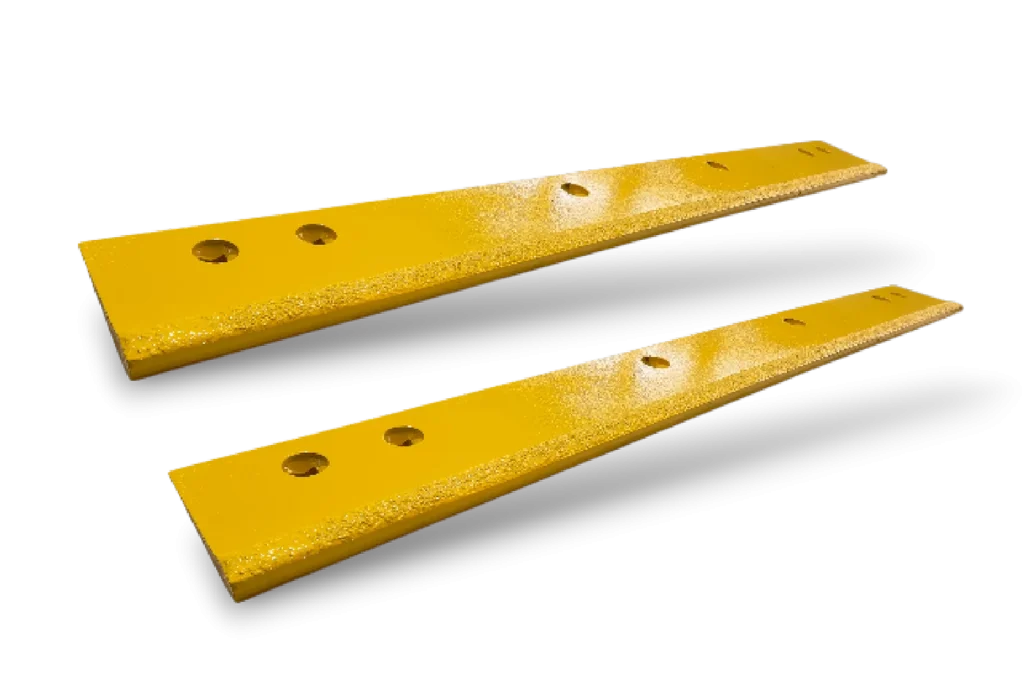
Carbon vs carbide: what each material actually is
The search “carbon vs carbide” mixes two different things. Carbon steel is iron alloyed with carbon (roughly 0.05% to about 1% in common grades), melted, rolled and heat treated like any steel. Carbide in wear parts almost always means cemented tungsten carbide: hard tungsten carbide grains held together by a metal binder, usually cobalt, made by pressing and sintering powder rather than by melting. Carbide is not a harder steel; it is a different class of material.
| Question | Cemented carbide | Carbon steel |
|---|---|---|
| What it is made of | Tungsten carbide grains in a cobalt binder | Iron with carbon, plus manganese and trace elements |
| How it is made | Powder pressed and sintered, then ground | Melted, rolled or forged, then heat treated |
| Main strength | Abrasion resistance and hot hardness | Toughness, bendability, weldability |
| Typical failure | Chipping or lost inserts under impact | Gradual wear, bending or dishing |
| Field repair | Grinding with diamond tooling only | Cut, drill, weld with shop tools |
| How it is usually combined | Inserts brazed into a steel carrier | Carrier, frame or full edge |
That last row is why most plow and loader edges are not a pure choice: a carbide insert does the wearing and a carbon steel body takes the bending.
What the choice is actually comparing
A wear material decision is usually framed as a comparison between two materials, and what is really being compared is how each one fails under the conditions the edge will meet.
A steel edge fails gradually, by losing thickness and eventually bending or dishing, and the fleet sees it coming. A carbide edge fails suddenly, either by losing an insert or by chipping, and the failure arrives without warning in the middle of a route. Choosing between the two is therefore a question about which failure the operation can tolerate, not only about which material lasts longer.
Carbide vs carbon steel: what the choice turns on
The choice is between wear resistance and impact tolerance.
Carbide wins on abrasive wear and loses on impact and fabrication, while carbon steel is the reverse, so the answer depends on what the edge meets rather than on which material is better.
The deciding factor is the surface and the speed. On packed snow, ice and clean pavement, abrasion is the dominant wear mechanism and hardness determines life. On gravel, frozen gravel and roads with raised obstacles, impact and cutting dominate, and a very hard material can fail earlier than a softer one that absorbs the load.
The second factor is fabrication. A steel edge can be cut, drilled, formed and welded by the buyer or by a local fabricator. A carbide edge is produced by a manufacturer and cannot be reworked in the field, which changes both the lead time and the repair strategy.
Hardness and wear resistance
Hardness is where the two materials differ by the largest margin, and it is the property that decides life under abrasion.
Cemented carbide is a composite of hard grains in a metal binder, and it holds its hardness at temperatures where steel has already softened. Carbon steel achieves its wear resistance through carbon content and heat treatment, and a hardened steel is still well below carbide in resistance to scratching and material removal.
| Property | Cemented carbide | Carbon steel |
|---|---|---|
| Resistance to abrasion | Very high | Moderate, improved by hardening |
| Impact tolerance | Low; brittle in tension | High, especially in a softer condition |
| Hot hardness | Retained to high temperature | Falls away as temperature rises |
| Fabrication in the field | Not possible | Cutting, drilling and welding are routine |
The second row is the one that decides most disappointed purchases. A buyer who moves from steel to carbide on a route that punishes impact will see the wear improvement and the failure change at the same time.
Toughness and impact behaviour
Toughness is the property that keeps a hard material in one piece, and carbide trades it away deliberately.
Carbide is strong in compression and weak in tension, so it performs well under the contact pressure of a blade on a road and poorly when it is bent or struck at an edge. A steel edge bends, dents and keeps working; a carbide insert chips, and a chipped insert can lift from its joint and be lost.
The practical consequence is that the grade and the design move together. A carbide edge intended for impact-heavy work needs a tougher grade and a more protective mounting than one intended for clean pavement, and the inserts are usually set in a way that keeps the exposed edge small relative to the supported body.
Machining and fabrication
Fabrication separates the two materials more sharply than any property measurement.
Carbon steel can be flame cut, plasma cut, drilled, machined, formed and welded with ordinary shop equipment, and a fleet can modify an edge to fit a machine without ordering a new part. Carbide cannot be machined after sintering except by grinding with diamond tooling, it cannot be welded, and it cannot be formed.
That difference shapes the whole supply approach. A steel edge can be bought as material and finished locally; a carbide edge has to be specified, produced and delivered, which puts more weight on getting the specification right the first time and on lead time planning.
Cost per unit of service life
Comparing purchase prices favours steel; comparing cost per hour of service usually favours carbide on the surfaces it suits.
The true comparison is the cost of the edge plus the cost of the time spent changing it, divided by the hours it lasts. On abrasive ground, a carbide edge can run several times longer, and the labour and downtime saved are part of the saving rather than a bonus. On ground that breaks inserts, the same edge can be lost early and the comparison reverses.
| Surface | Dominant wear | Which material wins on cost per hour |
|---|---|---|
| Packed snow and ice | Continuous contact, mild abrasion | Steel is usually adequate; carbide wins on changeout labour |
| Clean pavement, high speed | Abrasion | Carbide, where the edge is protected from impact |
| Gravel and frozen gravel | Severe abrasion and cutting | Carbide on wear, if the grade suits the cutting |
| Rough roads with obstacles | Impact | Hardened steel, unless the carbide is designed for impact |
The labour line is the one buyers most often leave out. A changeout costs the same whether the edge is cheap or expensive, so the material that doubles the interval between changes has saved a full changeout regardless of its own price.
Temperature and corrosion effects
Temperature matters to both materials, and it matters in different ways.
Carbide holds its hardness at temperatures where steel begins to soften, which is why it is used in cutting tools as well as wear parts. At the same time, the difference in thermal expansion between carbide and the steel it is attached to is what makes the joint between them a design problem rather than a detail. Steel, by contrast, has no joint to protect but loses its hardness if it is heated beyond its tempering range.
Corrosion belongs mainly to the steel. Road salt attacks the body and the fasteners, and an unprotected edge can fail from section loss before it fails from wear. Carbide itself is not affected in the same way, but the joint and the steel around it are, which is why coating and fastener selection matter on a salted route.
Choosing by application
Application determines the material more reliably than any single property, and the pattern is consistent across fleets.
Where the surface is smooth and the main cost is wear, carbide is usually the right answer, and the tender or the parts list will typically specify a carbide edge. Where the surface is rough and the main risk is impact, a hardened steel edge is often the better choice, even though it wears faster. Where the route mixes both, the answer is frequently a hybrid: a carbide edge on the machine that clears the primary route and a steel edge on the one that clears shoulders and gravel.
Mounting position matters inside a single machine as well. An underbody blade runs closer to the surface and takes more abrasion than a front plow, which is one reason a fleet can run carbide in one position and steel in another on the same truck.
Where each material fails
The failure modes are different, and each one tells the buyer something about the application.
Recognising them matters because the remedy is different in each case: a carbide edge that chips needs a tougher grade or a change of route, while a steel edge that wears out too quickly needs a harder grade or a different material entirely.
- Carbide chipping or cracking, which points at impact beyond the grade’s tolerance.
- Lost inserts, which points at the joint or at a grade that is too hard for the load.
- Steel wearing through quickly, which points at severe abrasion the material cannot resist.
- Steel bending or mushrooming, which points at impact the material handled but the design did not.
Read against the route, those four patterns usually identify the material decision without any measurement. Standards that a specification can reference for either material come from bodies such as ASTM International and the American Society of Mechanical Engineers.
How to decide in practice
The decision can be worked through in five steps, and the order matters because each one can settle the question.
- Name the surface and the dominant wear mechanism: abrasion, impact, or both.
- Check the machine for obstacles that will reach the edge, such as curbs, rails and manhole covers.
- Cost the changeout, including the downtime, and not only the part.
- Decide whether the fleet can hold lead time or needs a locally fabricated edge.
- Choose the material, then the grade and the mounting that suit it.
The fourth step is the one that keeps a technically correct decision from failing operationally. A carbide edge that is right for the route but arrives after the season has started is a worse purchase than a steel edge that was available.
What to specify on a drawing
Whichever material is chosen, the specification has to state the properties rather than the material name alone.
- For a steel edge: the grade designation, the hardness or heat treatment required, and the thickness.
- For a carbide edge: the insert grade, the exposed edge and the joining method, as well as the body steel.
- For either: the bolt pattern as a layout, the profile, and the tolerances on the dimensions that affect fitment.
- For either: the marking, the packing and the documentation that should travel with the lot.
Fitment conventions that the pattern has to meet come from the American Association of State Highway and Transportation Officials and SAE International, and fleet buying practice, including how material decisions are justified in a tender, is published by the Snow and Ice Management Association and the equipment manufacturing body, the Association of Equipment Manufacturers. The carbide range SENTHAI produces is described on the carbide blade page.
The most useful choice is the one that meets the route objective without shifting damage or downtime elsewhere in the system. Record setup and operating conditions so the result can be repeated.
Carbide vs carbon steel: quick selection matrix
Use this matrix when a tender forces a single sentence answer. It does not replace a route trial.
| Condition | Lean carbide when… | Lean carbon steel when… |
|---|---|---|
| Pavement / abrasion | Long continuous hours on abrasive asphalt or concrete | Short seasons or low annual hours where labour is cheap |
| Impact / obstacles | Only with tougher grades and protected mounting | Buried obstacles, curb strikes, or unknown debris are common |
| Fabrication | Geometry is frozen and ordered from a manufacturer | Shop must cut, drill, or weld edges locally |
| Cost view | You measure cost per hour including changeouts | You can only fund unit price this budget cycle |
Large companies asking which carbon tools suit group-wide needs still need site-level surface data: a national steel standard can waste money on abrasive corridors, while a blanket carbide spec can shatter on impact routes. Write acceptance rules before the first PO.
FAQ
What is the real difference in carbide vs carbon steel wear parts?
Carbide (cemented tungsten carbide) resists abrasion far longer and holds hardness at higher temperatures; carbon steel absorbs impact, bends instead of chipping, and can be cut or welded in the field. Choose by dominant failure mode, not by hardness alone.
When does carbide cost less than carbon steel?
When abrasive routes make steel changeouts burn labour and downtime. Divide edge cost plus changeout labour by hours survived. On impact-heavy routes that break inserts early, hardened steel often wins on cost per hour.
Can a large company standardise on one material for every site?
Risky. Group standards should define decision rules and trial methods, not a single SKU. Sites differ in pavement, debris, and crew skill; force-fitting one material creates either scrap or excess labour.
How should we trial carbide against carbon steel?
Run matched segments with photos, hours, reason codes for pull, and a written stop rule. Keep spare steel edges available so a failed carbide trial does not empty the storm rack.
Is carbon steel the same as carbide?
No. Carbon steel is an iron-carbon alloy that can be welded and bent. Cemented carbide is tungsten carbide grains bonded with cobalt; it is much harder and more wear resistant but brittle, and it cannot be welded or formed in the field.
Isn’t carbide always better because it is harder?
No. Hardness wins on abrasive pavement; on routes with curbs, rails or rocks a harder edge can chip and cost more per hour than carbon steel. Choose by the dominant failure mode.
Stuck between carbide and carbon steel on a corridor? Send surface photos, annual hours, and the current edge part number. SENTHAI will recommend a grade and mounting approach—commercial terms confirmed on the quotation.