1045 vs A36 steel questions keep appearing because the two grades look interchangeable on a materials list and are not. A36 is a weldable structural mild steel; 1045 is a medium-carbon grade that can be hardened for wear. Mixing them up produces brittle welds on “upgraded” brackets or soft edges that dish in a few storms.
(Last modified date: November 12, 2026)
This guide compares chemistry, strength, hardness, weldability, and wear behaviour so you put each grade where it belongs in plow frames, carriers, and wearing edges. When the wearing surface must outlast either steel, step up to a carbide snow plow blade or compare materials in carbide vs carbon steel wear parts. Structural and edge kits also sit under the snow plow hub.
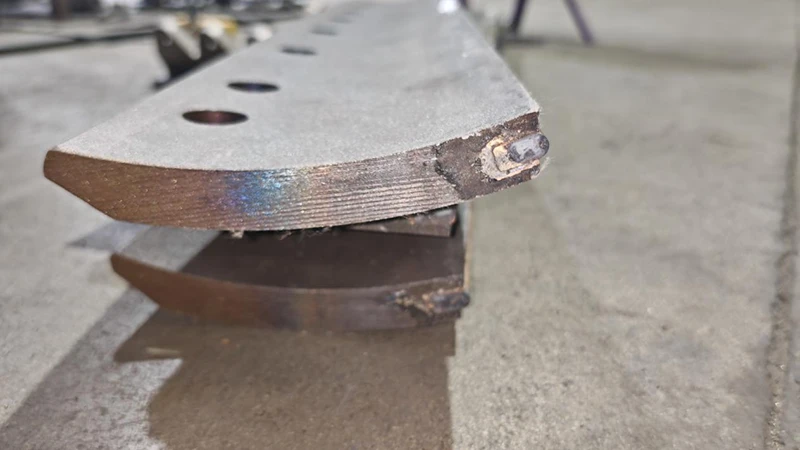
What the two grades are asked to do
The two are differentiated by carbon content, and that single difference drives everything else about them.
A36 is a structural mild steel with a low carbon content, chosen because it welds easily, tolerates forming and stays tough. 1045 carries enough carbon to respond to heat treatment, which makes it harder and more wear-resistant at the cost of weldability and of the shop processes needed to keep it sound.
In wear equipment the two usually appear in the same machine rather than as alternatives for the same part. The wearing surface wants the harder grade; the brackets, stiffeners and mounting plates want the one that will weld and bend without a procedure.
1045 vs A36 steel: what separates them
The two grades differ mainly in carbon content.
1045 carries enough carbon to be hardened and used where wear matters, while A36 is a structural grade chosen for weldability and toughness, which is why each belongs in different parts of the same machine.
The consequences run in opposite directions. Higher carbon gives 1045 strength and wear resistance, and it also makes the steel less tolerant of rapid cooling after welding, harder to form and more sensitive to how it is machined. Lower carbon gives A36 the properties that make fabrication simple, and it caps how much wear resistance the material can be given.
Choosing between them is therefore a question about what the part has to do: carry load and be assembled, or resist abrasion in service.
1045 vs A36 in numbers
| Property | A36 | 1045 |
|---|---|---|
| Type | Carbon structural steel | Medium-carbon steel |
| Carbon | 0.25–0.29% max, depending on product and thickness | 0.43–0.50% |
| Manganese | Up to 0.80–1.20% on thicker plate | 0.60–0.90% |
| Minimum yield | 36 ksi (250 MPa); 32 ksi for plate over 8 in. | No single minimum; depends on condition (hot rolled, cold drawn, quenched and tempered) |
| Tensile strength | 58–80 ksi (400–550 MPa) | Depends on condition; order to a stated minimum |
| Hardenable by heat treatment | Not meaningfully | Yes: quench and temper, or induction harden the surface |
| Welding | Readily weldable | Weldable with preheat and a qualified procedure |
The roughly doubled carbon content is what lets 1045 be hardened for a wearing surface, and it is also why the same carbon makes welding it riskier. A36 is specified by mechanical minimums, so it is the predictable choice for frames, brackets and mouldboards that get welded.
Chemistry and carbon content
Carbon content is the defining difference, and the surrounding elements decide how predictable that difference is.
1045 is a medium-carbon steel, in the range where the material responds to quenching and tempering and where hardness becomes a designable property rather than a supplier’s default. A36 is a low-carbon structural steel with a specified minimum yield strength, and its chemistry is controlled for weldability and toughness rather than for hardenability.
Manganese, sulphur and phosphorus sit around that difference. A steel that machines well usually has a deliberate addition or a controlled level of one of them, and a steel intended for welding keeps them low. Those secondary limits are why two materials with similar carbon content can behave differently in a workshop.
Strength and hardness comparison
The strength difference is real in the supplied condition, and it becomes much larger once heat treatment is applied.
Both grades have a minimum yield strength in their delivered state, and 1045 sits above A36. The larger difference appears when the part is hardened and tempered, because A36 has no meaningful hardenability and cannot be treated that way. Hardness therefore becomes a design tool with 1045 and not with A36.
| Property | 1045 | A36 |
|---|---|---|
| Carbon content role | Medium carbon; heat treatable | Low carbon; structural |
| Strength as supplied | Higher | Lower, with a specified minimum |
| Hardness after treatment | Can be raised substantially | Not a practical option |
| Weldability | Requires procedure and preheat | Routine |
| Typical use | Wearing edges, pins, shafts | Brackets, plates, structures |
The last row is the practical summary. A drawing that names 1045 for a bracket adds welding cost without adding wear resistance where it is needed; a drawing that names A36 for a wearing edge accepts a shorter interval between replacements.
Weldability and machinability
The two grades sit at opposite ends of the workshop scale, and both directions have cost.
A36 welds with ordinary practice: no preheat on normal sections, common fillers, and tolerance of the heat input that a repair involves. 1045 requires preheat, controlled interpass temperature and attention to cooling, because the heat-affected zone hardens as it cools and can crack. The same difference appears in machining, where 1045 is generally easier to cut cleanly and A36 tears and builds up an edge unless the tooling suits it.
The practical consequence for a fleet is the repair rule. A wearing edge in 1045 that has to be welded in a yard requires a procedure and a controlled heat source; if that is not available, a bolt-on design avoids the problem entirely, which is one reason replaceable edges are common.
Wear behaviour in abrasive service
In abrasive service the harder grade lasts longer, and the size of the difference depends on the treatment rather than on the grade name.
A hardened 1045 edge resists scratching and material removal better than an A36 edge, and the gap widens as the abrasion becomes more severe. The comparison only holds while the harder material stays in one piece: an edge that is hard enough to resist abrasion but has no toughness left will chip or crack on an obstacle, and the failure costs more than the wear it avoided.
That is why the grade is specified together with the hardness range and, on thicker sections, with the through-hardening or surface-hardening route. The same grade treated to different depths behaves very differently in service, and an edge that is hard on the surface and tough at the core is usually the compromise that survives a mixed route.
Availability and price
Availability usually favours A36 and total cost does not always follow it.
A36 is a widely stocked structural steel and can be bought in small quantities almost anywhere, which makes it the default for repair and for parts that are designed in a workshop. 1045 is commonly available in bar and plate but less often in the sizes and finishes a fleet needs immediately, and a hardened part may have to be ordered and treated rather than picked off a rack.
The cost comparison is therefore not the price per tonne. A cheaper material that has to be replaced twice as often, with the labour that implies, can be the more expensive choice, and a more expensive material that arrives late can be the most expensive of all. Wear rates and lead times belong in the same comparison.
Typical uses of each grade
The division of labour between the two grades is consistent across winter equipment.
1045 appears where a part has to resist wear or carry a concentrated load: wearing edges and scraper blades, pins and shafts, sprockets and small machine parts. A36 appears where a part has to be fabricated, welded and formed: mounting brackets, stiffeners, plates, guards and the structural members that hold the wearing parts in place.
The distinction is worth making explicit on a drawing because it is often left to the fabricator. A fabricator given a choice will usually select the material that is easiest to work with, which is rarely the one that wears best, and the difference appears a season later as a part that failed early or one that cost more than it needed to.
Selection guidance for wear parts
The selection sequence starts with what the part does and ends with how it will be made, because the fabrication route can rule out the technically better material.
- Decide whether the part is the wearing surface or the structure around it.
- If it wears, choose the harder grade and state the hardness and the treatment depth.
- If it is structure, choose the weldable grade and state the strength rather than the hardness.
- Check the fabrication route: whether the part is welded, formed or machined on site.
- Confirm the repair strategy, because a part that cannot be repaired locally needs a replaceable design.
| Component | Grade that usually fits | Reason |
|---|---|---|
| Cutting edge or scraper blade | 1045, hardened | It is the wearing surface and is replaced rather than repaired |
| Mounting bracket | A36 | Welded to the machine and not a wear surface |
| Stiffener or gusset | A36 | Toughness and weldability matter more than hardness |
| Pin or pivot shaft | 1045, treated | Load is concentrated and wear resistance matters |
Material standards that a drawing can reference are published by bodies such as ASTM International and the American Society of Mechanical Engineers, and the fitment conventions that a finished part has to meet come from the American Association of State Highway and Transportation Officials and SAE International.
The choice also has a supply side. Where a fleet buys complete edges rather than material, the grade decision belongs to the manufacturer, and the buyer’s question becomes which grade the offer actually contains rather than which grade is listed in a catalogue. Buying practice across the sector, including how grades are specified in fleet programmes, is published by the Snow and Ice Management Association and the Association of Equipment Manufacturers, and the blade range built on those grades is described on the carbide blade page.
1045 vs A36: where each grade belongs on wear equipment
| Part role | Prefer | Why |
|---|---|---|
| Mounting plates, brackets, stiffeners | A36 | Welds and forms without a special procedure |
| Wear bars that will be hardened | 1045 | Carbon content supports quench-and-temper hardness |
| Field-repaired structural members | A36 | Lower risk of hard brittle heat-affected zones |
| High-abrasion cutting edge (long hours) | Often carbide on steel carrier | Neither A36 nor 1045 matches cemented carbide abrasion life |
Write the grade on the drawing next to the heat-treat note. Calling out “steel edge” without naming 1045 vs A36 invites substitutions that look fine in receiving and fail in January.
FAQ
Is 1045 harder than A36?
In the as-supplied condition 1045 is typically stronger and harder because of higher carbon, and the gap widens after heat treatment. A36 has little hardenability, so it stays near its supplied condition.
Why is 1045 harder to weld than A36?
Higher carbon can form a hard, brittle zone beside the weld on fast cooling. Welding 1045 needs preheat, controlled heat input, and a suitable filler—treat it as a procedure, not a casual repair.
Which should I use for a wearing edge: 1045 or A36?
1045 when you can harden it and manage welding. A36 for brackets and structures that must weld easily and are not the wearing face. For severe abrasion, evaluate carbide edges instead of pushing either steel alone.
Is A36 the same as European S235?
Not automatically. They play similar structural roles and overlap mechanically, but chemistry limits and certification differ. Confirm any substitution against the standard named on the drawing.
Can I mix 1045 edges on an A36 frame?
Yes—that is the usual division of labour: hardenable wear members on a weldable structure. Control the joint design and heat input where 1045 meets A36.
What is the yield strength of A36 compared with 1045?
A36 has a specified minimum yield of 36 ksi (250 MPa). 1045 has no single minimum because its strength depends on the supplied condition and heat treatment, so state the required minimum on the purchase order.
Auditing a bill of materials that mixes 1045 and A36? Send the drawing pack and wear photos. SENTHAI can mark which members should stay mild steel, which can be hardened, and where a carbide edge is the cleaner upgrade—terms confirmed with the quote.