A drawing calls for 1045, a supplier in another country offers C45, and a mill certificate arrives quoting a third designation. All three can be the same steel, and none of them tells the buyer what condition the material is in.
Reading the designation is the first step in buying a wear part that behaves as specified. This is what the numbers mean, what an equivalent actually guarantees, and how to write the order so the answer is unambiguous.
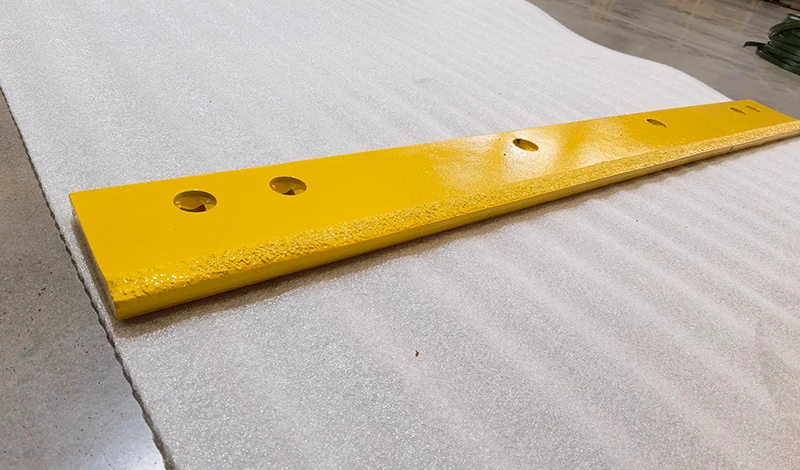
1045 steel equivalent: what the designation has to be read against
A 1045 designation describes a chemistry, not a product.
The number sets a carbon range and the system it came from, while the strength, the hardness and the condition depend on how the steel was made and treated, so an equivalent grade is a starting point rather than a substitute.
That is why the same designation can arrive in several conditions: hot rolled, cold drawn, normalised, quenched and tempered, or stress relieved. Each of those has the same chemistry and a different set of mechanical properties, and a drawing that names only the chemistry leaves the supplier free to deliver whichever is easiest to obtain.
The second thing to read is the standard. A designation that follows a national or international standard carries defined limits for chemistry and for the condition of supply; a designation used informally carries whatever the mill chose to put in it.
What the AISI and SAE designations mean
The four digits in 1045 are not arbitrary, and understanding the structure explains why equivalent grades cluster where they do.
The first two digits identify the family, and the last two give the nominal carbon content in hundredths of a percent. For 1045, that means a plain carbon steel in the 10xx family with a nominal carbon content of about 0.45 percent. There is no alloying addition in the designation because the grade relies on carbon alone for its hardenability.
AISI and SAE numbers for this grade describe the same ranges, so the prefix is a matter of which system the document follows rather than a difference in the steel. What the prefix does signal is the document the order should reference.
Common international equivalents
The equivalents most often quoted for 1045 sit in the same carbon band, and they differ in small but meaningful ways.
The nearest European equivalent is C45 or C45E, a medium-carbon steel with a comparable carbon range. Japanese and Chinese standards publish grades in the same band under their own designations, which is why a supplier may offer a locally produced equivalent and quote it alongside the original.
| Designation | System | What to check before accepting |
|---|---|---|
| 1045 | AISI or SAE (US) | Condition of supply and certificate requirements |
| C45 / C45E | European standard | Sulphur limits, which differ between the two variants |
| Local national grades | Other national systems | Chemistry limits, hardenability band and certificate form |
| No designation stated | None | Nothing can be checked; treat the offer as unspecified |
The difference between C45 and C45E is the clearest example of why the detail matters. The two share a carbon range and differ in their sulphur limits, which affects both machinability and weldability, and a drawing that names one while a supplier delivers the other has changed the material behaviour without changing the number.
Mechanical property ranges
The property ranges published for 1045 describe a band rather than a value, because the properties depend on the condition of supply.
In the normalised condition the grade has a moderate strength and reasonable toughness. Quenched and tempered at a suitable section size, it reaches a substantially higher strength and hardness with reduced toughness. Cold drawn bar reaches higher strength again through work hardening, at the cost of ductility and of any expectation of consistent response to later heat treatment.
The practical rule when comparing two sources is to compare the condition rather than the grade. Two offers of 1045 in different conditions are two different materials for the purpose of a wear calculation, even though the designation is identical.
Heat treatment response
Heat treatment is where a medium-carbon grade earns its place, and it is also where an equivalent grade can quietly disappoint.
The response to quenching depends on the hardenability of the steel, which is influenced by the chemistry in ways the designation does not fully express. Two sources of nominally the same grade can harden to different depths in the same section, because one has a slightly different manganese content or a different grain size from the steelmaking route.
The consequence for a wear part is that hardness achieved after treatment is not guaranteed by the designation alone. Where hardness matters, either the hardness after treatment is specified on the drawing or the hardenability requirement is stated, and the certificate should show which was met.
Substitution cautions
Substitution is a normal part of buying steel, and it is safe when it is recorded and unsafe when it is assumed.
The cases that cause trouble are the ones where the difference does not appear in the property table. A sulphur addition for machinability reduces weldability. A slightly higher carbon content raises hardness and reduces toughness. A different condition of supply changes both the strength and the response to any later treatment. Each of those is a small change with a real consequence on a wear part that is welded or heat treated after delivery.
Material standards that define these limits are published by bodies such as ASTM International and the American Society of Mechanical Engineers. Where a component is used in equipment covered by a fleet specification, the conventions that apply come from the American Association of State Highway and Transportation Officials and SAE International.
Specification wording for purchase orders
The wording on a purchase order decides whether an equivalent is acceptable, and it costs one sentence to get right.
Naming a designation alone leaves the condition, the standard and the certificate undefined, and those are the three items that turn a grade into a deliverable material.
- Name the grade and the standard it is defined by.
- State the condition of supply, such as normalised or quenched and tempered.
- State the property that matters, whether that is a tensile range, a hardness range or a hardenability requirement.
- State whether an equivalent grade is acceptable, and if so which ones.
- State the certificate required with the delivery, and what it has to show.
The fourth item is the one buyers most often omit. A purchase order that allows an equivalent without naming which ones hands the decision to the supplier, and the delivery will contain whichever grade was available.
Documentation for purchased material
The documents that travel with the steel are what prove the grade was supplied as ordered, and they should be requested at the order stage rather than after the parts are made.
A mill certificate or a certificate of analysis identifies the heat, states the chemistry and gives the mechanical results for the condition supplied. A declaration of compliance states that the material meets the standard without reproducing the values. Both are useful, and they support different levels of checking.
- Record the heat or batch number from the certificate against the material received.
- Check that the chemistry in the certificate falls inside the standard named on the order.
- Check that the mechanical results correspond to the condition that was ordered.
- Keep the certificate with the production record for the parts made from that heat.
The fourth step is what links a finished part back to the steel it was made from, and it is the reason a certificate held in a purchasing folder is less useful than one filed against the batch.
Why equivalents are not interchangeable
The distinction between an equivalent and an interchangeable material is the difference between the same chemistry and the same behaviour.
An equivalent grade matches the carbon and alloy ranges, which is enough for many applications and not enough for all of them. Interchangeability would require the condition of supply, the hardenability, the residual element limits and the certificate to match as well. Those are the properties that decide how the material performs when it is welded, formed or heat treated, and they are exactly the properties the designation does not carry.
A buyer who treats an equivalent as interchangeable is usually working from a property table and comparing two rows. The rows can match while the delivered behaviour does not.
Reading a mill certificate
A mill certificate can be checked in a few minutes once the four items that matter are known.
The heat number identifies the material and links it to the parts made from it. The chemistry shows whether the grade is inside the standard. The mechanical results show the condition. And the standard quoted shows which set of limits the mill was working to, which is the item that reveals a substitution made for the mill’s convenience rather than the buyer’s specification.
Where a certificate is unavailable and only a declaration of compliance is offered, the buyer is entitled to ask which standard the declaration refers to and who issued it. A declaration that names no standard is a sales document, not a material record, and the measurement practice behind the values in a full certificate is published by the National Institute of Standards and Technology.
When to ask the question
The question about equivalents belongs at the quotation stage, before the material is committed and long before the parts are made.
At that point the buyer can compare offers on the same terms, decide which substitutions are acceptable, and ask for the certificate before the steel is cut. Asking afterwards limits the options to accepting the material or rejecting the delivery, which is a more expensive conversation for both parties.
The same principle applies to the parts themselves. Where a wear part is supplied as a finished component rather than as material, the grade question becomes a question about the offer, and it is worth asking which grade the quotation actually contains. Sector practice for specifying and confirming grades in supply programmes is published by the Snow and Ice Management Association and the Association of Equipment Manufacturers.
FAQ
Is AISI 1045 the same as SAE 1045?
In practical terms yes, because both systems describe the same carbon and alloy ranges for the grade. The organisations behind the designations differ, and a purchase order should still name the standard it is buying to rather than relying on the prefix.
What is the European equivalent of 1045?
The nearest common equivalent is C45 or C45E, a medium-carbon steel in the same carbon band. Mechanical properties overlap, the permitted chemistry limits do not always match exactly, and the condition of supply has to be stated on the order either way.
Why are two equivalent grades not interchangeable?
Because equivalents match the carbon and alloy ranges rather than the delivered properties. Residual element limits, hardenability, the condition of supply and the certificate that comes with it can all differ, and any of them can change how the part performs after treatment.
If a drawing names a grade and you want to know what is acceptable as an equivalent, send the specification. SENTHAI will state which substitutions can be accepted, in which condition, and with what certificate.