A five-fold hardness difference between two materials does not automatically turn into a five-fold life difference, and on some parts it turns into a shorter one. What the difference buys depends on how the abrasive arrives: as a sliding stream, or as an object that hits the edge.
Choosing between hardened steel and carbide is therefore a diagnostic exercise before it is a materials decision. This is the sequence, starting with the pattern the worn part leaves behind.
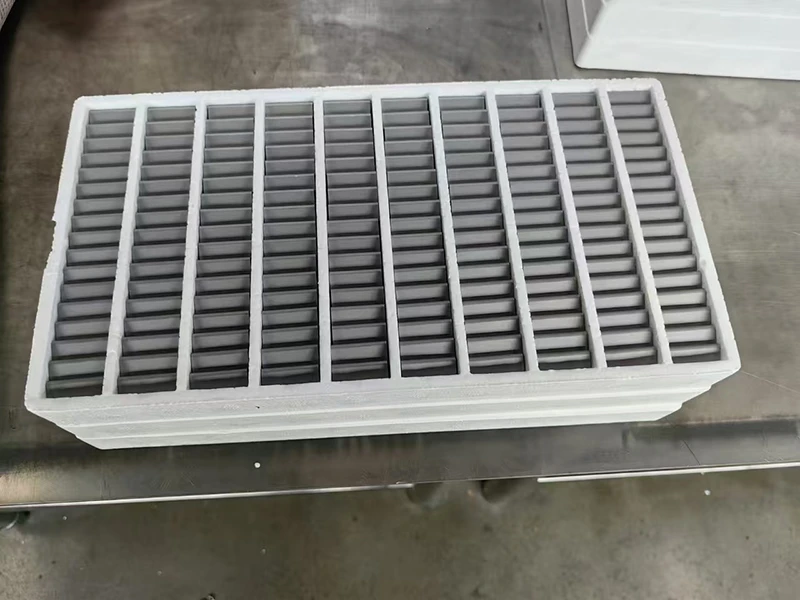
What the wear pattern tells you
The worn surface is the evidence, and it separates the mechanisms more reliably than any service record.
A face that has thinned evenly, or shows fine parallel grooves, has been worn by sliding abrasion. A face with deep individual cuts, ridges and displaced metal has been gouged. A face that is deformed, chipped or cracked at the edge has been loaded by impact, and the loss of material is a consequence rather than the cause.
Those three patterns lead to different answers. Sliding abrasion is where hardness converts most directly into life. Gouging is where material toughness and hardness act together, because a hard material that cannot absorb the local load fractures at the cut. Impact is a design problem before it is a material problem, since the edge geometry and the mounting decide how much of the load reaches the cutting material.
Hardened steel vs carbide: how the mechanism decides
The wear mechanism decides the material.
Gouging and sliding abrasion load the material differently, and the hardness ratio between the wear material and the abrasive acts on one of them far more strongly than on the other.
In sliding abrasion, the abrasive passes over the surface and removes material in proportion to the hardness relationship between the two. That is where a large hardness advantage pays, and it is the case for which carbide grades are developed.
In gouging, a particle or an object is pressed into the surface and dragged along it. Hardness resists the penetration and toughness resists the dragging, so a material that is extremely hard but brittle can lose volume faster than a softer one that deforms locally and keeps its structure. The same applies to impact, where the load is applied over a short time and the material’s capacity to absorb energy decides whether it survives.
Gouging versus sliding abrasion
The two mechanisms differ in how the load is applied, and the difference decides which property the design should emphasise.
Sliding abrasion applies a distributed load through many small contacts, and the response is wear of the surface. Gouging applies a concentrated load through few large contacts, and the response is local plastic flow, cracking or tearing. A material can be excellent in one and poor in the other at the same hardness.
| Feature | Sliding abrasion | Gouging |
|---|---|---|
| Contact | Many small contacts across the face | Few large contacts, often at an edge |
| Response of the material | Progressive loss of section | Local deformation, cracking or tearing |
| Property that resists it | Hardness | Hardness together with toughness |
| Where carbide is strongest | Clear advantage over steel | Advantage depends on grade and mounting |
Read together with the wear pattern, the table gives an answer before any testing. Polished and evenly worn means sliding; cut and ridged means gouging; deformed or chipped means impact.
Hardness ratio effects
The useful relationship is not the material’s hardness on its own but its hardness relative to the abrasive.
Where the wear material is substantially harder than the abrasive, wear rates fall sharply and the advantage of moving to an even harder material becomes small. Where the abrasive is comparable to or harder than the wear material, wear proceeds quickly and a modest increase in hardness produces a large gain. That is why the same grade performs differently on sand, on frozen gravel and on slag, even though the edge and the machine are identical.
The practical consequence is that grade selection should be made against the abrasive, not against a general expectation. A buyer who knows what the edge is actually clearing can make a smaller and better-founded material decision than one who is choosing for a regional average.
Impact and thermal loads
Impact and temperature arrive together on most real equipment, and both push the choice away from the hardest available material.
The three checks below establish what the edge has to survive beyond abrasion, and they are worth running before a grade is chosen.
- Whether the edge meets raised objects, such as curbs, rails or buried debris, and how often.
- Whether the abrasive is loose or attached to a heavier object that loads the edge on contact.
- Whether the contact generates heat that the binder in the material can tolerate.
The third item is easy to overlook on a winter application, where ambient temperature is low and the assumption is that heat is not a factor. Contact heating is local, however, and it depends on speed and pressure rather than on the weather, which is why a high-speed edge and a low-speed yard blade can need different specifications from the same material family.
Repair and replacement practice
How a part is maintained decides which material is economic, because the two fail in different ways and are restored by different means.
A hardened steel edge can be welded, built up and returned to service, and a fleet with a workshop usually does exactly that between replacements. A carbide edge is not repaired in the same way; individual inserts can be replaced where the design allows, and the alternative is to replace the edge. That difference is worth more than a small wear-rate advantage on equipment where the workshop is the deciding factor.
- Establish whether the part is restored or replaced when it reaches its wear limit.
- Check that the workshop can perform the restoration, including the heat treatment a repair in hardened steel requires.
- Price the replacement route for each material, including the downtime rather than only the part.
- Confirm what happens when the failure is partial, such as a lost insert or a chipped section.
The fourth item often decides the comparison. A partial failure on a steel edge means an earlier changeout; on a carbide edge it can mean continuing with a reduced cutting surface, which changes the wear pattern on the remaining inserts and on the machine.
Cost per operating hour
The cost per operating hour combines the purchase price, the interval and the labour, and it is the only comparison that reflects what the fleet experiences.
On predominantly sliding abrasion, a carbide edge can run several times longer than a hardened steel one, and the changeout labour saved forms part of the return. On gouging and impact, the interval becomes variable, and a comparison built on an average interval understates the cost of the early failures. That variability has an operational cost of its own in a route where the edge has to last until the machine comes back.
A practical way to handle the variability is to price both materials against the interval the fleet can plan for, rather than the interval the supplier reports. The difference between the two is the risk the operation is carrying, and it belongs in the decision even though it does not appear on a quotation.
Application matrix
The matrix below places the common applications, and it follows from the wear patterns rather than from the materials.
Sliding-dominated work groups around carbide, gouging-dominated work around hardened steel, and the middle ground is where a fleet keeps both materials on the shelf and decides by machine rather than by policy.
Applications worth placing explicitly include mainline pavement at speed, where sliding abrasion dominates and a harder material earns its cost; shoulders and gravel, where gouging and impact dominate; underbody blades, which run closer to the surface and see more continuous abrasion; and yard and loader work, where the load arrives through the bucket rather than through the edge.
When to combine both materials
The two materials are usually combined in one of three ways, and each has a limit that decides whether it works.
The first is the standard carbide edge, where inserts carry the wear and a steel body carries the load. The second is a hardened steel edge with inserts applied only at the points that wear first. The third is a fleet-level combination, where the same machine runs different materials in different positions.
- Decide what each material is doing: wear, load carrying, or both.
- Confirm that the joint between them is stronger than the load it carries.
- Check that a partial failure does not compromise the whole part.
- Record which position the part is on, so the next decision has evidence behind it.
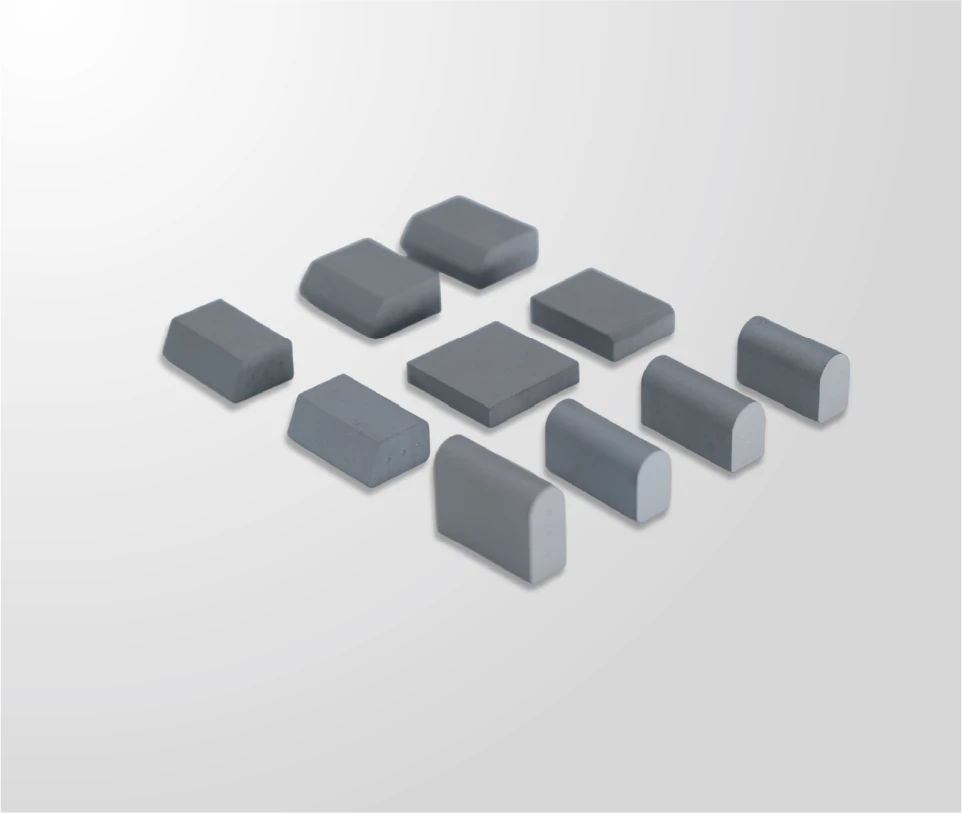
The second item is the one that governs every composite design. Material and test standards that support the specification come from bodies such as ASTM International and the American Society of Mechanical Engineers, with measurement practice published by the National Institute of Standards and Technology. Fitment conventions come from the American Association of State Highway and Transportation Officials and SAE International, and fleet practice in this area is documented by the Snow and Ice Management Association. The insert range SENTHAI produces for these applications is described on the carbide inserts page.
FAQ
Is carbide not simply better than hardened steel for abrasion?
It resists erosion better, and it is more sensitive to impact. Where the abrasive arrives as a loose particle at low load, carbide wins clearly; where the same material arrives attached to a heavy object that strikes the edge, the hardened steel can last longer because it deforms instead of cracking.
How do you tell which mechanism is wearing a part?
From the surface. Sliding abrasion leaves a polished, grooved or evenly thinned face. Gouging leaves deep individual cuts and ridges. Impact leaves deformation, chipping or fracture rather than loss of section, and each pattern points at a different remedy.
Can the two materials be used on the same part?
They are already used that way on a carbide edge, where carbide carries the wear and a hardened steel body carries the load. Combining them on the wearing face itself is usually a design decision rather than a materials one, since the joint between them is the point that fails first.
What if the mechanism is mixed along the same blade?
Then the material has to suit the dominant mechanism rather than the worst one, and the mounting and grade are chosen to protect against the other. Where the mix is genuinely even, the deciding factor is usually which failure the operation can absorb mid-route.
Send a photograph of the worn edge and the surface it runs on, and SENTHAI will identify the dominant mechanism and the material that suits it.