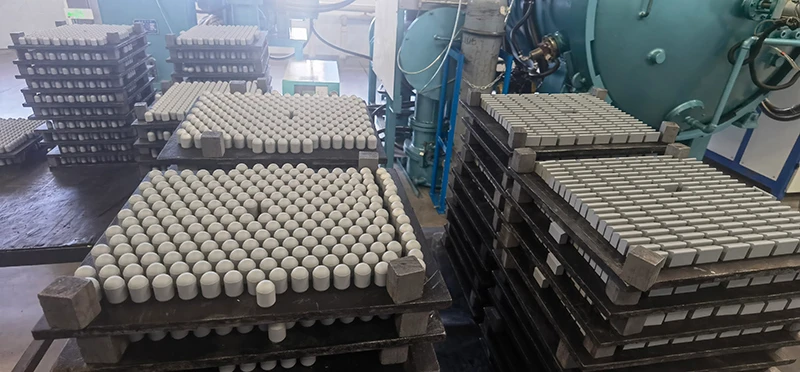
Two inserts can share the same hardness value and behave differently in service, because hardness is an average and the microstructure is what produces it. Grain size and binder content can be combined in opposite ways to reach the same number, and the two combinations do not wear the same way.
Understanding the structure is what lets a buyer read a grade specification rather than accept it. This is what a microstructure report describes, and which parts of it belong in a purchase decision.
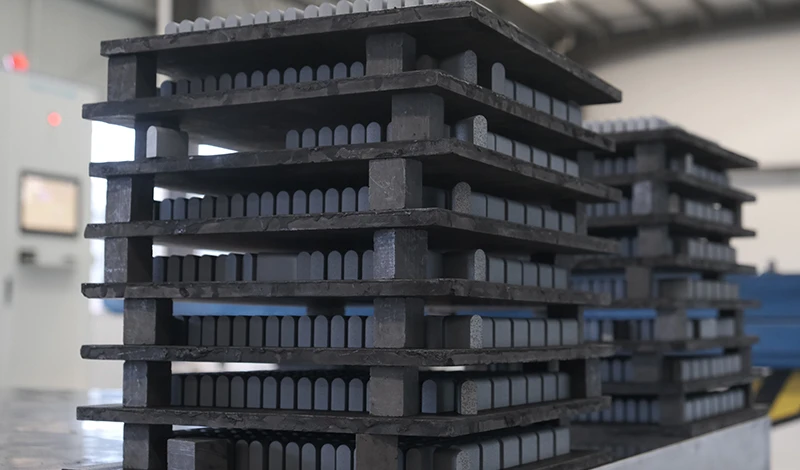
Cemented carbide microstructure: what the report describes
A microstructure report describes four things.
The size of the carbide grains, the binder content between them, the amount and type of porosity, and any other defect class the standard defines, such as uncombined carbon or a binder pool.
Those four items are linked. Grain size and binder content together set the hardness and toughness balance, and porosity acts on both by removing material from the structure and creating local stress concentrations. A grade with the right grain size and binder content can still fail early if the porosity is outside the permitted class.
The report exists because those properties cannot be inferred from a finished part. A buyer cannot see grain size on a delivered insert, and an indenter reading land on a dense area of a part with internal voids, which is why the structural report and the hardness certificate answer different questions.
Tungsten carbide grains and cobalt binder
Cemented carbide is a composite: hard grains held together by a softer, tougher metal.
The tungsten carbide grains provide hardness and resistance to abrasion. The cobalt binder wets them during sintering and holds the structure together, providing the toughness that allows the material to absorb load without fracturing. Neither component gives the finished properties on its own, which is why the ratio matters more than either figure separately.
The binder also determines how the material behaves at temperature and how it responds to a joint. Cobalt wets carbide well during brazing, which is part of why the material can be attached to a steel body at all, and the binder content influences how the insert tolerates the thermal cycle of that process.
Grain size classification
Grain size is classified into bands, and the band is part of the grade rather than a manufacturing detail.
At the same binder content, a finer grain structure produces a harder and more wear-resistant material, and a coarser one produces a tougher material that resists crack propagation better. The classification is what lets a buyer compare two offers that quote the same binder content and different performance.
| Band | Property emphasis | Where it is used |
|---|---|---|
| Fine and micro-grain | Hardness and wear resistance | Abrasive service where impact is limited |
| Medium | Balanced hardness and toughness | General wear parts and mixed conditions |
| Coarse | Toughness and crack resistance | Impact-heavy work and rough ground |
A supplier that quotes a grade without its grain band is quoting half a specification. Two inserts with the same cobalt content and different grain bands are different materials, and the difference is the one that shows up in service.
Binder content and property effects
Binder content moves hardness and toughness in opposite directions, and it is the lever that makes a grade family possible.
Increasing the binder content lowers hardness and raises toughness. Decreasing it raises hardness and lowers toughness. Because grain size acts in the same two directions, a grade can be tuned by combining the two: a fine grain with a higher binder content and a coarse grain with a lower one can meet in the middle of the property range while behaving differently in service.
The practical consequence for a buyer is that a grade should be specified by the application rather than by a hardness target. A grade selected to hit a hardness number, with no reference to grain size or binder, may meet the number and still be the wrong material for the work.
Porosity and defect classes
Porosity is the defect class that matters most on a wear part, and it is defined by the standard rather than by the supplier.
Porosity appears as voids inside the structure, either in the form of small evenly distributed pores or as larger isolated ones. The classes distinguish those forms and set the permissible size and frequency. Uncombined carbon and binder pools are separate classes, and each is treated differently because each affects the structure in a different way.
For a buyer, the relevant point is that porosity is specified as a class and verified by inspection on a sample. A grade declaration that gives no porosity class is a declaration that says nothing about one of the properties most likely to end a part’s life early.
Reading a microstructure report
A microstructure report can be checked for four items in a minute, and each one has a consequence when it is absent.
The items below are the ones that make the report checkable against the grade specification rather than merely descriptive.
- The grain size band, expressed either as a value range or against a standard classification.
- The binder content, with the method used to determine it.
- The porosity class, stated against the standard the product is supplied to.
- The sample identity, so the result can be tied to a lot rather than to a grade.
The fourth item is the one that turns a report into evidence. Standards that define these classes and the methods used to measure them are published by bodies such as ASTM International and the American Society of Mechanical Engineers, with measurement practice published by the National Institute of Standards and Technology.
Sampling and test reports
A microstructure result describes the sample, and the sampling basis is what decides how much of the lot it describes.
Because the test is destructive, it is performed on a section cut from a sample rather than on the delivered parts. That makes the sampling plan part of the specification: how many pieces, from where in the lot, and whether the result is reported per lot or per grade.
- Confirm that the sample was taken from the production lot rather than prepared separately.
- Check that the report names the lot or batch reference it applies to.
- Confirm which classes were inspected and which method was used.
- Compare the result with the grade specification rather than with a supplier’s general description.
The fourth step is where the document becomes useful. A report that is compared only with itself proves consistency; one compared with the specification proves conformance.
Linking structure to service life
The structure is what the service life is built from, and each element maps onto a failure mode.
Grain size and binder content together decide how the material resists abrasion and how it tolerates impact. Porosity decides where cracks begin. Uncombined carbon and binder pools act as local defects that shorten life in a way the hardness reading never reveals.
That mapping is why two inserts with the same hardness can perform differently on the same route. The hardness reading summarises the structure; it does not describe it, and the differences that matter in service sit in the parts of the structure the reading averages away.
Why hardness alone is not enough
Hardness is a useful acceptance check and a poor specification, and the reason is that it is an average.
An indenter reading taken on a polished surface summarises the resistance of whatever it landed on. It can be satisfied by a fine grain with high binder content or by a coarse grain with low binder content, and those two materials behave differently against abrasion and against impact. It says nothing at all about porosity, which is the defect that most often causes an early failure.
A specification built on hardness alone therefore accepts materials that will not perform as intended. The practical remedy is to specify the structure as well: grain band, binder content and porosity class, with hardness as one check among several.
What to ask a supplier
Four questions establish whether a supplier is describing a material or a grade family.
They are deliberately about the structure rather than about the product, because the product description is what the buyer already has.
- What grain size band does the grade sit in, and how is it classified?
- What is the binder content, and how was it determined?
- What porosity class does the product meet, and who inspects it?
- Does the lot documentation include a structure report, and does it carry the batch reference?
The fourth question is the one that separates a supplier selling from its own process records from one reselling a grade description.
Common misreadings
Three misunderstandings recur often enough to be worth stating plainly.
The first is that a harder grade is always the better grade, which ignores the toughness that was traded away to reach the number. The second is that binder content and hardness are interchangeable descriptions of the same thing, which they are not, because grain size acts on the same properties independently. The third is that a certificate of compliance covers the structure, when in most cases it confirms that the material was supplied to a standard without reporting the classes inside it.
Correcting those three at the specification stage is cheaper than correcting them after a season of early failures. Equipment and fitment conventions that the finished part has to meet come from SAE International and the American Association of State Highway and Transportation Officials, and the buying practice around grade selection is published by the Snow and Ice Management Association. The insert range SENTHAI supplies across these grades is described on the carbide inserts page.
FAQ
What is cemented carbide?
A composite material of hard tungsten carbide grains held together by a metal binder, usually cobalt. The grains provide hardness and wear resistance; the binder provides the toughness that keeps the structure together under load.
Is cemented carbide the same as tungsten carbide?
The two terms are used interchangeably in industry, and technically tungsten carbide is the compound while cemented carbide is the finished composite. A useful distinction to keep is that the compound has no binder, so it has no toughness to speak of.
How does cobalt content affect the properties?
More binder generally means lower hardness and higher toughness, and less binder means the opposite. The balance is what makes one grade suitable for abrasive conditions and another for impact, and it is chosen against the application rather than for a target hardness.
Ask SENTHAI for the structure behind a grade: grain band, binder content and porosity class, with the report that carries the batch reference.