Three areas on the same airfield impose three different loads on a blade. A runway is cleared at speed with a tight clearance requirement; a taxiway is narrower and slower; an apron is cleared around parked aircraft with almost no tolerance for contact damage.
A single blade specification cannot serve all three well, which is why airport fleets usually run more than one. This is how the requirement is built, area by area.
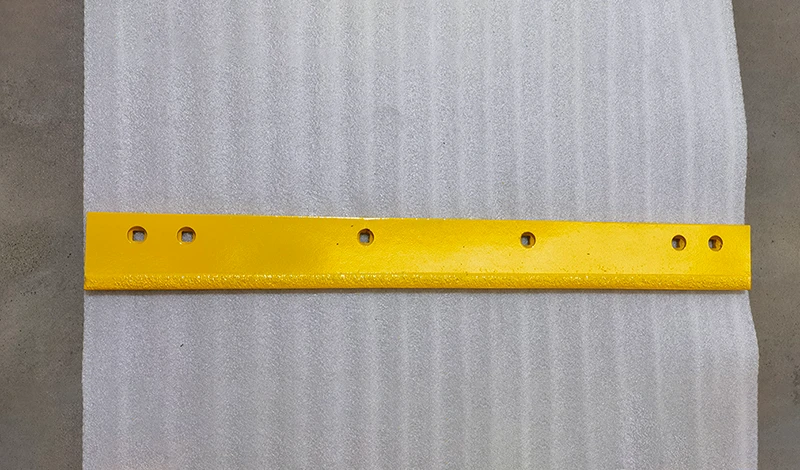
Airport snow plow blades: what a specification has to settle
Four decisions define an airport blade specification.
The area it will clear, the clearance and surface protection it has to satisfy, the carrier it has to fit, and the documentation that has to travel with it.
Those four are taken in order because each constrains the next. The area decides the material, the material interacts with the clearance requirement, the clearance and the material together decide the width and the mounting, and the documentation requirement is set by the operator rather than by the product.
The result is a specification that looks heavier than a highway equivalent, and the reason is the operating environment rather than the blade. On an airfield, the cost of damage to a surface or to an aircraft is far larger than the cost of the part that caused it.
Runway versus apron versus taxiway duty
The three areas differ in speed, in the consequences of contact, and in how the edge is used.
A runway is cleared early and repeatedly to keep it serviceable, which means long runs at speed with a consistent surface and therefore severe sliding abrasion on the leading edge. A taxiway is narrower and slower, with more turning and more variation in how the blade sits. An apron is cleared around equipment and aircraft at low speed, where the risk of a collision or of surface damage dominates.
Those differences point at different materials. The runway favours the most abrasion-resistant edge the carrier can hold. The apron favours an edge that will not damage what it touches and can be inspected easily, which is where rubber and composite edges appear. The taxiway usually takes something between the two.
Clearance standards and surface protection
Clearance standards and surface protection pull in opposite directions, and the specification has to state how the trade is resolved.
Leaving less snow means running the edge closer to the pavement, which increases the contact pressure and the risk of marking or damaging the surface. Running further off the surface protects the pavement and leaves a residue that has to be cleared by the next machine in the sequence. The setting that suits an apron is not the setting that suits a runway.
| Area | Duty on the edge | What the specification has to prioritise |
|---|---|---|
| Runway | Long runs at speed, consistent surface | Abrasion resistance and an accurate, repeatable blade setting |
| Taxiway | Narrower passes, more steering and turning | Uniform wear across the edge and tolerance of angling |
| Apron | Low speed, close to aircraft and equipment | Surface and equipment protection, and easy inspection |
| Holding areas and service roads | Mixed, often with rougher surfaces | Impact tolerance over maximum wear resistance |
The fourth row is included because it is where a specification most often leaks. A blade bought for the runway and then used on a service road meets a rougher surface than it was specified for, and the resulting edge damage is recorded against the blade rather than against the task.
Blade width and carrier match
Width and mounting are decided by the carrier and by the pass plan, not by the blade alone.
The edge has to present enough width to clear the intended swath at the speed the carrier runs, and it has to bolt to the moldboard pattern the carrier already uses. On airport equipment the carrier is often a purpose-built chassis rather than a converted truck, and the mounting interface is part of its design, so the blade has to be matched to it rather than adapted later.
The pass plan matters as well. Where a runway is cleared by a coordinated formation, the blades are set to overlap in a defined way, and the overlap depends on the edge width and on the angle each blade runs at. Changing the edge type without checking that geometry is how a formation ends up leaving strips.
Edge material for concrete and grooved surfaces
The pavement itself decides a large part of the material choice, because concrete and grooved surfaces wear an edge differently from asphalt.
Grooved runway pavement presents a series of edges rather than a continuous surface, which raises the contact pressure at the groove edges and produces a wear pattern that is not uniform along the blade. Concrete is generally harder and more abrasive than asphalt but less prone to being marked by an edge. Both facts point towards a hard edge with a mounting that tolerates the interrupted contact of a grooved surface.
| Surface | Effect on the edge | Material implication |
|---|---|---|
| Grooved concrete runway | Interrupted contact at groove edges | Hard edge with mounting that tolerates local load |
| Smooth concrete | Continuous sliding abrasion | Hard, wear-resistant edge |
| Asphalt taxiway | Abrasion with some deformation | Hardened steel or a durable composite |
| Apron and stand areas | Contact risk, marking risk | Rubber or composite edge |
The third row is where fleets most often move away from carbide, not because the wear does not justify it but because the surface deforms under the blade and the resulting movement damages the edge.
Foreign object debris considerations
Foreign object debris control shapes how a blade is specified, maintained and inspected, and it is part of the operating environment rather than a product feature.
An edge that is losing material is a potential source of debris on a movement area, which makes the inspection interval part of the specification. A mounting that retains a damaged insert, a fixing that cannot work loose unnoticed, and a marking scheme that identifies a batch for a containment check are all responses to that environment.
In practice this favours designs where a failure is visible at a walk-round rather than one that fails within a closed structure, and it makes the batch reference on the part operationally important rather than merely administrative.
Documentation and traceability in aviation
Documentation on an airfield is heavier than on a highway fleet, and the requirement comes from the operator rather than from the part.
What is normally expected is a dimensional record against the approved drawing revision, a material declaration for the edge and the body, the joining inspection result where the edge is bonded, and a batch reference that ties the delivered parts to their production record. Where an operator works to a quality system of its own, the supplier has to be able to answer questions in that system’s terms.
That requirement is best settled at the quotation stage, because producing a document set retroactively is slower than planning it into the production run.
Spares and turnaround requirements
Turnaround requirements decide how much stock an airport holds, and they are usually tighter than the wear rate alone would suggest.
A movement area has to be returned to service quickly, so the decision about when to change an edge is made against the operational window rather than against the wear limit. That produces two effects: edges are changed earlier than their wear would require, and the stocking position has to cover the sizes in use rather than an average consumption.
The practical specification therefore includes the sizes held, the number of carriers per size, and the lead time the supplier can hold through the winter. An edge that is technically correct but unavailable in the window is not a usable specification.
Asking the right questions of a supplier
Supplier questions work when they are tied to the areas and the carriers rather than to the product alone.
The sequence below produces answers that can be compared between suppliers and checked against the operator’s own requirements.
- Which area is this edge specified for, and what is the dominant wear mechanism there?
- What mounting pattern does the carrier use, and how is the pattern verified?
- What clearance setting is the edge designed to run at, and how is it set?
- What documentation travels with the lot, and does it carry the batch reference on the part?
- What lead time can be held through the winter, for which sizes?
The third question is the one that separates an airfield supplier from a general one. An edge that is designed to run at a defined clearance has to be set that way on the machine, and that is an operational instruction as much as a product specification.
Where a specification goes wrong
Four failures account for most airfield blade problems, and none of them is a material fault.
They are specification and operating failures, and each one is visible before a blade is ordered.
- One blade specification applied across runway, taxiway and apron duty.
- A clearance setting carried over from a different area or a different machine.
- A mounting adapted to a carrier rather than matched to it.
- A documentation requirement discovered after production rather than stated in the order.
The fourth item is the one that delays delivery most often, because a document set that has to be assembled after the goods are made usually has to wait for the next production run.
Working with an equipment schedule
Airport procurement often works from an equipment schedule that classifies the machines and the clearing tasks, and the blade specification has to sit inside it.
The schedule defines what each machine is expected to clear and at what speed, which is exactly the input the blade specification needs. Reading the schedule first, and the part catalogue second, produces a specification that can be defended in a tender rather than one that matches what was bought last time.
Where the schedule names an equipment class rather than a blade, the class has to be translated into a carrier, an edge width and an edge material. Standards that a specification can reference come from bodies such as ASTM International and the American Society of Mechanical Engineers, with measurement practice published by the National Institute of Standards and Technology. The fitment and equipment conventions come from SAE International and the American Association of State Highway and Transportation Officials. Airside operational practice is published by the Snow and Ice Management Association, and the blade range SENTHAI produces for these carriers is described on the carbide blade page.

FAQ
What blades do airport snow plows use?
Most run a long, wide edge on a carrier matched to the cleared width, with the edge material chosen for the surface: a carbide or hard-steel edge for main runways where clearance standards are tight, and rubber or composite edges on aprons where equipment and aircraft are close.
How is an airport blade different from a highway blade?
The duty is more specific and the documentation is heavier. Clearance requirements are tighter, the surface being cleared is engineered pavement rather than a road, ground movements and foreign object debris control the schedule, and every part has a traceable record.
Does an airport need a different blade for each area?
It usually runs more than one specification, because a runway, a taxiway and an apron impose different loads on the edge and different risks. The same carrier can run different edge material depending on the area in the clearing sequence.
What documentation should accompany an airport blade?
The dimensional record against the approved drawing, the material declaration for the edge and the body, the joining result where the edge is bonded, and a batch reference that ties the delivered parts to their production record.
Send the carriers, the areas they clear and the sweep plan, and SENTHAI will return a specification per area with the edge material, the pattern and the documentation that travels with each lot.