The parts that cost the most over a season are not the parts that fail most often. Blade and edge assemblies consume the largest share of the budget because of their unit cost, while brush and broom consumables fail more frequently at a fraction of the price.
Planning a fleet around one of those two facts produces either a stockroom full of cheap parts or a season interrupted by an expensive one. What follows is the component map and the order in which a season consumes it.
What a season actually consumes
A season consumes consumables continuously and structure occasionally, and the two need different planning.
Edges, inserts and brush segments are designed to be consumed, and their replacement is a scheduled activity. Bearings, drive components, hoses and mountings are not designed to be consumed, and their failure is an event that interrupts the clearing sequence. A maintenance plan that treats both the same way will be either wasteful or exposed.
The second distinction is between what wears from contact and what wears from load. Contact wear happens at the surface the machine works on; load wear happens inside the machine and is driven by balance, alignment and setting. The first is visible on a walk-round, and the second is not.
Airport snow removal equipment components: where the wear sits
The wear sits in three groups.
Blade and edge assemblies wear from contact with the surface, broom and blower units wear from the material passing through them, and the carrier interfaces wear from the loads the first two transfer into the structure.
Those three groups fail at different rates and for different reasons, and a component map that separates them makes the spares decision straightforward. The working edges are stocked locally; the powered units are serviced on condition; the interfaces are inspected before and after the season rather than weekly.
The map also shows where the causes cross between groups. An edge setting changes the load on the broom, an out-of-balance brush loads the bearings, and a mounting that has begun to move transfers load into the chassis. Those connections are what an interval-based schedule is least able to see.
Plow and blade assemblies
The blade assembly is the largest single line in a season’s parts budget, and it is the one with the most specification options.
It consists of the edge itself, the fixings and the moldboard interface. The edge consumes on a schedule that depends on the surface and the clearance setting; the fixings consume from load and vibration; the interface consumes when either of the other two is out of condition.
| Component | What consumes it | Basis for replacement |
|---|---|---|
| Cutting edge | Contact with the surface | Measured wear against a limit |
| Inserts, where fitted | Contact, plus impact damage | Condition, including partial loss |
| Fixings | Load and vibration | Condition at each change |
| Moldboard interface | Wear from a loose or uneven edge | Inspection before and after the season |
The second row is the one that changes the planning model. An insert edge does not fail uniformly, so the replacement decision is about condition rather than about hours, and a partially worn edge can remain in service longer than a plain steel one before it is changed.
Broom and blower units
Broom and blower units consume parts in proportion to what they are asked to move rather than to hours run.
Brush segments wear with contact and pressure. Blower and vacuum internals wear with the concentration of abrasive material in the airstream, which is why the same unit working behind a plow that leaves a heavy residue consumes components faster than one working on a cleaner surface. Drive and bearing components wear with load and balance.
The useful maintenance signal here is performance rather than appearance: a unit that needs higher engine speed to move the same material is showing wear before anything looks damaged, and that observation is what should trigger an internal inspection.
Hydraulic and control systems
Hydraulics and controls are rarely the first failure and are frequently the cause of one elsewhere.
The consumable items are hoses, seals and couplings; the components that fail less often are pumps, valves and cylinders. Controls matter to wear because they set blade angle and down pressure, and an out-of-calibration control system can hold an edge harder against the surface than intended, which consumes it faster and loads everything behind it.
Checking the control response as part of the pre-season inspection is therefore a wear-reduction measure as much as a reliability one. A blade that is not returning to its set angle is working outside the setting its specification assumed.
Carrier interfaces and mounting
The carrier interface is where the loads from every other component arrive, and it fails last and costs most.
What wears is the fixing pattern, the pivot points and the structure around them. Elongated holes, fretting marks and cracks are the three signs, and each one indicates that something has been moving under load rather than sitting as designed. Correcting the fixing without correcting the cause reproduces the same failure next season.
The pattern itself is not a wear item, and that matters for specifying replacements. A blade specified to a pattern that no longer matches the moldboard introduces movement at the interface from the first day, which is a specification fault rather than a wear outcome.
Wear parts ranking by consumption
Ranking the components by how often they are consumed separates the stock item from the scheduled item.
The order below reflects frequency of replacement rather than cost, and it is the order in which a store should be organised.
- Brush segments and broom consumables, replaced most often and in sets.
- Cutting edges and scraper blades, replaced on a measured wear limit.
- Inserts, replaced in part rather than as a set where the design allows.
- Fixings and small hardware, replaced at almost every change.
- Hoses, seals and couplings, replaced on condition.
- Bearings and drive components, replaced on condition or before the season.
The last two items are the ones that determine availability, because they are the ones that stop a machine when they fail without warning.
Spares strategy by component class
The spares strategy follows directly from the ranking, and it separates holdings by class rather than by machine.
Consumables are held on site, in the sizes the fleet actually runs. Condition-based items are held at one location or covered by a supply agreement with a stated lead time. Long-lead items are either held centrally or replaced pre-emptively before the season opens.
| Class | Holding approach | Reason |
|---|---|---|
| Consumables | Stocked on site by size and consumption | Frequent replacement and immediate need |
| Hardware and fixings | Stocked in bulk | Low value, used at every change |
| Condition-based components | Central stock or agreed lead time | Infrequent failure, higher unit cost |
| Long-lead assemblies | Scheduled replacement before the season | Lead time exceeds the operational window |
The fourth row is the one that requires a decision rather than a budget line. Where a component cannot be obtained inside the season, the choice is to hold it, to schedule it, or to accept the risk, and that choice belongs to the operator rather than to the store.
Seasonal inspection sequence
The pre-season inspection works when it is run in the order the loads travel through the machine.
Starting at the working edge and finishing at the carrier matches the direction the loads arrive, and it means a fault found at one point is checked forward into the components it affects.
- Measure edge wear and check the fixings and pattern on each blade assembly.
- Measure brush segments and check balance and drive condition.
- Check blower or vacuum performance and inspect the internals if output has dropped.
- Test hydraulic response and confirm blade angle and down pressure settings.
- Inspect mounting points, pivots and the moldboard pattern for movement.
- Record the findings per machine so consumption can be compared across the fleet.
The sixth step is what makes the sequence worth repeating. A record per machine turns the next inspection into a comparison rather than a fresh assessment, and it is what reveals a unit that is consuming parts faster than its duty justifies.
What operators report that the schedule misses
Operators notice changes before they appear on an inspection sheet, and their reports are the cheapest diagnostic signal available.
The observations worth collecting are specific: a blade that no longer holds its angle, a machine that needs a higher setting to clear the same surface, a broom that leaves a pattern, and vibration at a particular speed. None of those appear on an interval list, and each one points at a component before it fails.
- Changes in the setting needed to clear the same surface.
- Vibration or noise at a specific operating speed.
- A blade or broom that no longer produces an even result.
- Differences between machines doing the same task on the same shift.
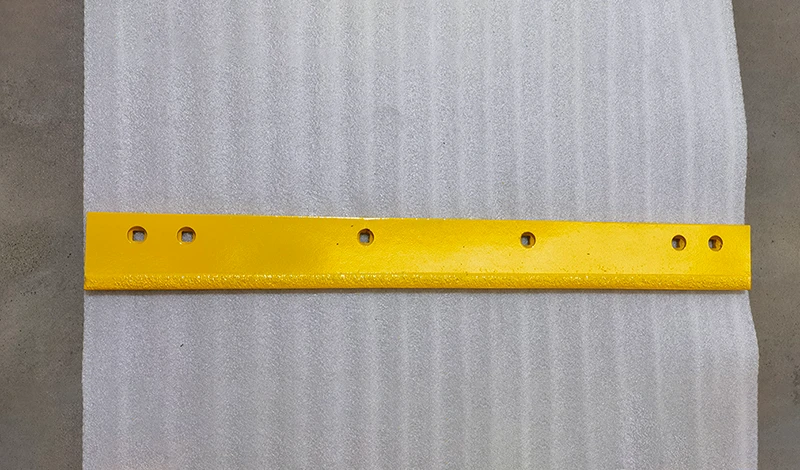
The fourth observation is the most useful one, because it isolates duty from design. Two identical machines doing the same task should consume parts at similar rates, and when they do not, the cause is worth finding before the parts are reordered. Material and test standards that a specification can reference are published by ASTM International and the American Society of Mechanical Engineers, with measurement practice published by the National Institute of Standards and Technology. Equipment conventions behind these components come from SAE International and the American Association of State Highway and Transportation Officials, and airside maintenance practice is documented by the Snow and Ice Management Association. The edge and insert range SENTHAI produces for these machines is described on the blade hub.
FAQ
Which components consume the most parts over a season?
Blade and edge assemblies by value, and brush or broom consumables by frequency. Hydraulic and control components sit behind them, and chassis and mounting wear appears only where another component is running out of balance.
What should be inspected before a season starts?
Edge condition and fixing torque, brush segment length and balance, hydraulic hoses and couplings, mounting points for cracks or elongation, and the electrical or control functions that govern blade angle and down pressure.
Why do some machines consume parts faster than identical ones?
Almost always because of duty or setting rather than the machine. A unit that runs the first pass, works a rougher surface or is set closer to the pavement will consume edges and brush faster than its twin, and the consumption record identifies it.
How should spares be held for an airport fleet?
Consumables held on site at the level last season’s consumption implies, and long-lead components either held centrally or scheduled for replacement before the season. Holding one of every item on every machine ties up capital without improving availability.
What does the maintenance schedule usually miss?
The connections between components. An out-of-balance brush loads a bearing, a worn edge changes what the broom has to remove, and a mounting that has started to move transfers load into the chassis. None of those appear on an interval list.
Send the machine list and last season’s consumption, and SENTHAI will map the wear parts per machine and name the components that should be held rather than ordered.