Two airports report the same friction value after the same storm, and one reopens while the other runs another pass. The number was identical; the surface condition behind it was not, and the difference was in what each report said about the contaminant and the method.
Numbers support a decision when they are reported with the conditions that produced them. This is what the measurement actually describes, how it is recorded, and where its limits sit.

What a friction record has to support
A friction record is kept for two audiences that want different things from it, and a report written for one is usually thin for the other.
The first is the operation itself, which needs to know whether the surface in front of it is ready and what to do next. The second is everyone who reviews the decision afterwards, from the aerodrome’s own safety management process to an inquiry, and they need to know what the surface was, how it was measured and what was done about it. A record that satisfies both is built from the same measurements, presented with the conditions attached.
Runway friction measurement: what the number describes
The number describes one point at one moment.
It reports the resistance between a moving element and the pavement under a stated set of conditions, and it is comparable between passes only when the device, the speed and the measurement points are held constant.
That framing matters operationally because it turns the reading into something that can be trended rather than argued over. A value taken with a different device, at a different speed, or along a different line is a different measurement, and comparing the two produces a conclusion that neither supports.
The second element is the contaminant. Friction loss on a runway comes from what is on the surface rather than from the pavement itself, and the same reading can correspond to a thin residue of loose snow, a polished film, or standing slush. Those three present very different risks, and the number alone does not distinguish them.
Why friction data drives clearing decisions
Friction data is what converts a judgement about “clear enough” into a decision with a basis.
It tells the operator whether the last pass produced a surface that meets the aerodrome’s own criteria, and it tells the next shift what the starting condition was. It also provides the evidence trail for the decision to reopen, which is the part that matters after the event rather than during it.
The practical value is in sequences. A measurement taken after each pass shows whether the clearing method is working on the contaminant present, and that is more useful than a single reading before reopening, because it separates a method that is working from a method that is being repeated.
Where the measurement fits in the clearing sequence
The measurement has a place in the sequence, and moving it changes what it can tell you.
Taking a reading before the first pass establishes the starting condition. Taking one after each pass shows whether the method is working on the contaminant present. Taking one only before reopening produces a decision point without the evidence that explains it.
- Measure the opening condition at the standard points, before any clearing pass.
- Clear, and record the machines, settings and materials used.
- Measure again at the same points, and record the contaminant left behind.
- Repeat the pass or change the method where the values still sit outside the criterion.
The fourth step is what makes the sequence iterative rather than procedural. A reading that falls outside the criterion is information for the next pass, not a reason to reopen on the assumption that the surface will improve on its own.
Measurement devices and methods
Devices differ in how they load the surface and in how the result is expressed, and each has a stated speed range.
The common families are a braked wheel drawn at a defined slip, a fixed-slip device that measures the drag on a test wheel, and a decelerometer that records the friction used to stop a vehicle. Each produces a value proportional to the surface’s resistance, and each is calibrated and used within its own speed range.
- Confirm the device and the calibration status before the measurement run.
- Run at the speed the procedure specifies for that device.
- Measure at the same points every time, so results can be compared.
- Record the contaminant and its depth alongside the value.
- Repeat the run after clearing rather than substituting judgement for the second measurement.
The fourth item is the one that makes the record usable by anyone who was not there. A value with a contaminant description and a temperature can be interpreted later; a value on its own cannot.
Reporting formats and thresholds
Reporting formats exist so that a value can be read against a criterion, and they work only when the conditions are stated with it.
Standards for surface condition reporting define how the contaminant is described and how the value is presented, and the aerodrome’s own procedures set the thresholds that apply. The two are different documents: the format makes the information comparable, and the threshold turns it into a decision.
| Item | Why it is recorded | What is lost without it |
|---|---|---|
| Measurement device and calibration | Makes values comparable between runs | Results cannot be trended across shifts |
| Point and lane measured | Shows which part of the surface was assessed | Coverage is assumed rather than known |
| Contaminant type and depth | Distinguishes loose from polished or standing | The number cannot be interpreted later |
| Surface temperature | Explains the clearing method’s behaviour | Shifts in reading are unexplained |
| Clearing method used before the reading | Links the result to the pass that produced it | Method effectiveness cannot be judged |
The fifth row is the one that connects the runway to the equipment in front of it. A record that names the blade setting and the pass pattern makes it possible to compare two clearing methods on the same conditions, which is how an equipment decision gets evidence behind it.
Effect of blade setup on surface results
Blade setup changes the surface, and the surface is what the device measures.
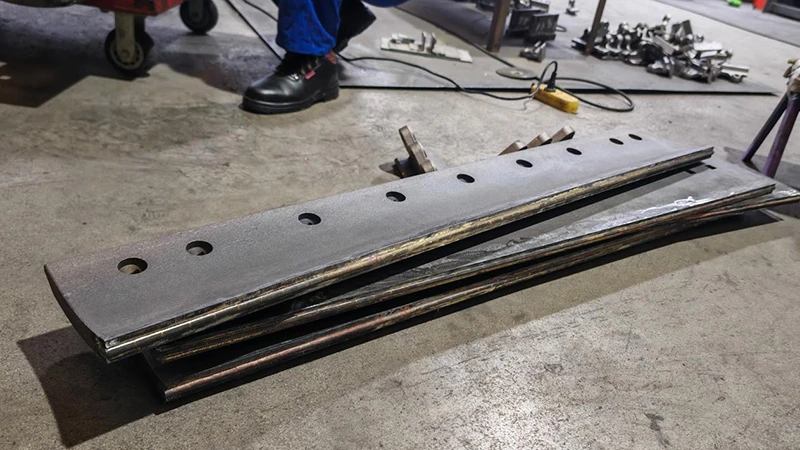
An edge running closer to the pavement removes more contaminant and leaves a different residual film than one running further off. Down pressure and blade angle change the same thing in a different way, and a change in edge material changes how the setting holds as the edge wears. Each of those appears in the friction record before it appears anywhere else.
The operational consequence is that a change of blade specification should be followed by a comparison of results rather than by an assumption. Where the two methods are measured on comparable conditions, the record shows which leaves the better surface and at what cost in edge life.
Recording after each event
The record after an event is what makes the next event easier, and it is worth structuring rather than accumulating.
A usable record covers the condition at the start of the event, the clearing sequence including settings, the measurements taken after each pass, and the decision to reopen with the basis for it. Together those four make a history that can be reviewed season to season.
- Opening condition: contaminant, depth, temperature and time.
- Clearing sequence: machines, passes, blade settings and materials applied.
- Measurements: device, points, values and the contaminant at each point.
- Decision: what was reopened, when, and against which criterion.
The third item is where the record most often thins out under time pressure, and it is the one that makes the rest useful. A sequence with no measurements is a narrative; a sequence with values at stated points is evidence.
Equipment decisions are easier to defend when the friction record already contains the comparison.
Where two clearing methods have been measured on comparable conditions, the difference between them is visible in the values rather than asserted. That is the case for changing an edge material, adjusting down pressure, or adding a machine to a formation, expressed in the terms the operation already uses.
The evidence is strongest when the comparison covers several events rather than one, because a single storm is not a representative sample. Building the comparison across a season is what turns a friction record into a procurement argument.
Limits of the numbers
The numbers are useful and they are narrower than they look.
They describe a point rather than a runway, at a moment rather than a condition, and they are produced by a device with its own characteristics. They do not measure how a specific aircraft type will decelerate, and they do not account for the variation an individual pilot will experience across the width of the surface.
That is why the number supports a decision rather than replacing one, and why reporting practice pairs it with a description of the contaminant. Standards for surface condition reporting are published through the aviation standards and regulatory framework, and the equipment conventions that determine the surface left behind come from SAE International and the American Association of State Highway and Transportation Officials. Material and test standards for the edges themselves are published by ASTM International and the American Society of Mechanical Engineers, with measurement practice published by the National Institute of Standards and Technology, and airside operational practice is documented by the Snow and Ice Management Association.
Questions to ask about a friction record
A record can be interrogated in a few minutes, and the questions are the ones that establish whether the values can be compared with anything else.
They apply equally to a record produced by the aerodrome’s own team and to one supplied as evidence in support of a decision.
- Which device was used, and was it within its calibration interval?
- At which points and in which lane were the readings taken, and were they the same as last time?
- What contaminant was present, and how was its depth described?
- Which clearing method and blade setting had been applied before the reading?
FAQ
How is friction measured on a runway in winter?
With a device that measures the resistance between a moving element and the surface, run at a defined speed and repeated at set points along the runway. The result is comparable between passes only when the device, the speed and the points are the same.
Does one reading describe a runway?
No. Friction varies along the length and across the width, and it changes with the contaminant, the temperature and the time since clearing. A single number is a point measurement, which is why reporting practice uses a set of points and a stated condition.
Can a blade setting change the measured result?
It can, and sometimes more than a change of weather does. A blade running closer removes more contaminant and leaves a different surface, so the measurement reflects the clearing method as well as the conditions, which is why the two are reported together.
What are the limits of friction numbers?
They are condition-dependent, device-dependent and point-dependent. They describe the surface at the moment and place of measurement, and they do not predict how an aircraft will behave, which is why they support a decision rather than replace it.
If you are comparing two edge specifications on the same runway, ask SENTHAI for the settings and wear data behind each one so the comparison can be run against your own friction record.