The blade that clears a runway in two passes is the wrong blade on an apron, and not because the material is different. On an apron the limiting factor is not the surface or the distance, it is the aeroplane parked thirty metres away and the stand equipment between the two.
Clearing a congested area is a different operating problem, and it changes the machine, the edge and the sequence. This is how the requirement is put together.
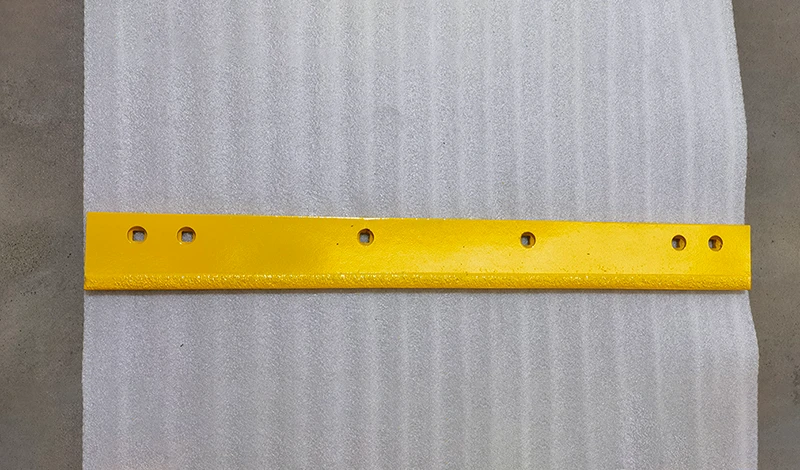
Apron snow clearing: what makes it different
The constraint is congestion rather than distance.
An apron is a set of small shapes separated by joints, markings and service pits, worked at low speed among aircraft and ground equipment, where a contact costs far more than an uncleared strip.
That environment pushes the specification in a different direction from runway work. Manoeuvrability matters more than width, keeping the machine outside stand clearances matters more than the number of passes, and an edge that will not damage an aircraft or a stand fitting matters more than the edge that wears longest.
The second consequence is that the sequence carries more of the result than the equipment does. Moving material in the wrong direction across a stand recreates the work that has just been done, and no blade specification compensates for that.
Space constraints and equipment size
Equipment size is set by the smallest space the machine has to work in rather than by the area to be cleared.
A wide carrier with a long blade is efficient across open pavement and awkward between stands. A compact carrier with a narrower blade takes more passes and is far easier to place accurately, which is the property that matters where a misjudged sweep has consequences.
The practical compromise is usually a smaller machine with a blade matched to the widest gap it has to work through, working a defined set of stands rather than the apron as a whole. That approach also simplifies the sequencing, because the machine’s route is fixed by the stands it serves.
Surface types and joint patterns
Apron surfaces are made of small units, and the joints between them are what the edge actually meets.
Concrete slabs with expansion joints, drainage grates, service covers and painted markings all interrupt the surface. An edge running across them meets a repeated series of edges rather than a continuous plane, which raises the local contact pressure and produces a wear pattern that is not uniform along the blade.
| Feature | Effect on the edge | What it favours |
|---|---|---|
| Expansion joints | Repeated local loading along the blade | An edge that tolerates interruption without chipping |
| Drainage grates and covers | Discontinuity and potential snagging | Protective mounting and clearance control |
| Painted markings | No mechanical effect, but a marking risk if scraped | Lower down pressure and a softer edge where markings matter |
| Service pits | Deep interruption in the surface | Operator awareness rather than edge specification |
The fourth row is the one that no specification can solve. A pit is an obstacle, and the response is a route and a training point rather than a blade.
Blade width and manoeuvrability
Blade width on an apron is chosen to fit the space, not to minimise the number of passes.
A blade wider than the working gap has to be angled sharply, which reduces its effective clearing width, increases the load on one end and makes the machine harder to place. A blade matched to the gap works at a flatter angle, clears more effectively and is easier to control with the machine’s own steering.
The mountings matter as much as the width. A blade that can be angled and offset quickly lets the operator work an awkward shape without repositioning the machine, which is the difference between two passes and four in a confined space.
Protecting aircraft and ground equipment
Protection is achieved by keeping the machine outside defined clearances, and the edge specification is the second layer rather than the first.
Where a stand clearance keeps the blade away from the aircraft, the edge material matters less. Where the geometry forces the machine closer, a rubber or composite edge limits the consequence of a contact, and the stand equipment itself has to be considered as an obstacle rather than as background.
The practical specification therefore names the clearance the machine has to keep, the areas where it is expected to work at the limit of that clearance, and the edge material for each. Those three items together are what the operator needs, and they are usually clearer than a statement that the apron is a congested area.
Chemical versus mechanical methods
Mechanical clearing and chemical treatment do different jobs on an apron, and the choice is usually about the residue rather than about the method.
Mechanical clearing removes the bulk and leaves a thin layer. Chemical treatment deals with what mechanical clearing cannot remove, such as a bonded film, and it introduces handling, storage and environmental requirements of its own. On an apron the sequence is normally mechanical first, with treatment applied where a stand or a service area needs a surface that mechanical work cannot produce alone.
| Method | What it removes | What it adds |
|---|---|---|
| Mechanical clearing | The bulk of the accumulation | Equipment, edge wear and a pass plan |
| Chemical treatment | A bonded residue or thin film | Storage, handling, and a record of what was applied |
| Combined sequence | Both, in stages | A decision about where each is permitted and when |
The third row is where most apron procedures actually sit, and it works when the boundaries are written down: which areas may be treated, which may not, and who decides when conditions change during an event.
Operator training for confined areas
Training on an apron is about judgement under close clearances rather than about machine handling alone.
The skills that matter are reading the space around the blade, recognising when the machine should stop and reposition rather than continue, and knowing which obstacles are flexible and which are not.
- Walk the apron and identify the fixed obstacles, marking them on a plan used by the clearing team.
- Train on the actual shapes the machine will work, not on an open area.
- Establish a rule for stopping and repositioning rather than continuing at an awkward angle.
- Include the stand equipment and ground support items in the obstacle list.
- Review incidents and near misses against the plan, and amend the plan rather than the driver.
The third item is the one that prevents most avoidable contacts. Continuing a pass at an awkward angle to save a reposition is the judgement that costs an aircraft panel, and a rule agreed in advance removes the decision from the moment.
Sequence planning
The sequence decides how much of the cleared material has to be moved twice.
Working outward from a stand toward a collection point, or along a line that pushes material into areas already being worked, keeps the material moving in one direction. Working toward a stand pushes it back into the space that has just been cleared, which is the pattern that produces repeated passes.
- Define the collection points and the direction material will be pushed toward them.
- Set the order of stands so each pass pushes material into an area already worked.
- Fix the machine’s route so it does not re-cross a cleared area to reach the next stand.
- Keep the clearance zones for aircraft and ground equipment on the plan and in the route.
The plan is worth revisiting after each event rather than once a season. An apron changes when stand allocations change, and a route that worked last winter may now cross a space that is no longer available.
What the apron edge has to tolerate
The apron edge has a different duty from a runway edge, and the difference is worth stating as a list before any material is chosen.
Each item below is a condition the edge will meet on a stand or a service area, and each points at a property rather than at a brand.
- Repeated interruption from joints, covers and gratings.
- Low speed and frequent angling, which concentrates load on one end of the blade.
- Occasional contact with stand equipment, where damage matters more than wear.
- Marking risk on painted surfaces where appearance has an operational meaning.
Read together, those items point towards an edge that tolerates interruption, holds up under angling and limits the consequence of contact. Equipment and fitment conventions for these machines come from SAE International and the American Association of State Highway and Transportation Officials, material standards from ASTM International and the American Society of Mechanical Engineers, with measurement practice published by the National Institute of Standards and Technology, and airside operating practice is documented by the Snow and Ice Management Association.
Where apron clearing goes wrong
Four failures account for most apron problems, and three of them are planning failures rather than equipment failures.
The first is using runway equipment because it is available, which produces a machine that cannot be placed accurately. The second is a sequence that pushes material toward a stand. The third is an obstacle plan that lists fixed structures but omits ground support equipment. The fourth is a blade specification chosen for wear life on a surface where congestion, not abrasion, sets the requirement.
Each is corrected before the season rather than during an event, and each is visible on a plan. The blade range SENTHAI produces across these carrier types is described on the blade hub.
FAQ
Why is apron clearing not just slower runway clearing?
Because the risk is different. On a runway the limit is surface condition and clearance; on an apron it is contact with aircraft, stands and ground equipment, and the area is broken into small shapes by joints and markings. The machine and the edge have to suit congestion rather than distance.
What edge material suits an apron?
A material that will not damage what it touches and that the team can inspect easily, which usually means a rubber or composite edge on machine-facing and stand areas, and a hardened or carbide edge only where the surface is open and the abrasion justifies it.
How many passes should an apron take?
As few as the shape allows, sequenced so that cleared material is pushed into areas already being worked rather than back across a stand. The pass plan matters more on an apron than the blade, because the wrong sequence recreates work as fast as it is done.
Send the apron plan, the stand clearances and the machines available, and SENTHAI will propose an edge and a sequence for each area of the apron.