A tire set carrying four hundred carbide studs puts four hundred contact points between the machine and the ice. The specification has to decide what each one is made of, how it is shaped, and how it is held in the rubber.
Those three decisions are made before a price is quoted, and they are the difference between a set that holds its grip for a season and one that sheds studs from the first week. This is the order in which an arena operator or an OEM buyer should work through them.
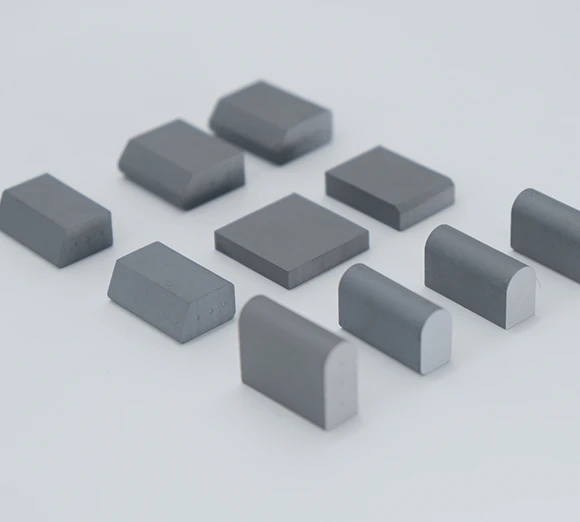
Why ice resurfacer tires are studded
A resurfacer works on a surface with almost no friction, and the studs are what replace it.
The machine has to move under control while its blade cuts a thin layer of ice and its wash water is drawn back into the tank. On a bare rubber tire over wet ice there is very little traction for either the drive or the steering, so the operating problem is not speed but control: keeping the blade tracking evenly and keeping the machine on the line the operator has chosen. Studs create mechanical engagement with the ice, which restores that control without changing the machine itself.
The consequence for the specification is that grip, not wear life, sets the minimum requirement. A stud set that grips but wears quickly is an operating cost; a stud set that lasts but does not grip has failed at its purpose.
Ice resurfacer tungsten carbide studs: what the specification has to fix
Count, tip geometry and retention decide the result.
Everything else in the specification follows from those three. A set with several hundred studs, such as a 400-stud configuration, spreads the machine’s load across many points, and the tire body has to hold them through the temperature swings of an ice rink.
The count is the first decision because it sets how much load each stud carries. The same machine on the same tire with fewer studs puts more force through each contact point, which increases both the grip per point and the rate at which the tips and the surrounding rubber wear. Geometry is the second decision, because the shape of the tip determines whether the stud bites or skates on the ice. Retention is the third, and it is the one most often left to the tire manufacturer without being written down, which is how a set arrives that matches the drawing and still loses studs.
Read in that order, the specification answers a single question at each step: how many points, what shape, and held how.
Stud count per set and what it changes
Stud count is a load-sharing decision, and the number only means something alongside the stud diameter and the tire size.
Doubling the stud count halving the load per stud is the simple version, and it holds well enough to reason with. What matters at the machine is that fewer, larger studs concentrate the grip into a small number of points, which can mark the ice surface and loads the rubber around each hole, while more, smaller studs spread the same grip across the contact patch and reduce local stress. The tire body has to accept the hole pattern either way, which is why the count is agreed with the tire supplier rather than chosen afterwards.
The pattern matters as much as the count. Studs placed on the shoulders behave differently from studs placed along the centreline, and a pattern that concentrates the grip where the machine steers will wear unevenly across the set. For an arena, that shows up as a tire with a ring of worn studs and a tread band that still looks new.
Tire body and stud interface
The tire body is half of the stud system, and the interface between the two is where most premature failures begin.
Rubber hardness, tread depth and the condition of the hole all affect how long a stud stays in place. A body that is too soft lets the stud move under load, which enlarges the hole and eventually releases the stud; a body that is too hard will not compress around the shank and grips the stud less well. The interface also has to survive the temperature range of a rink, where rubber that is pliable at room temperature behaves differently on a cold surface.
Where a set is supplied as a complete wheel, this is the manufacturer’s decision and the buyer’s only job is to record what was supplied. Where studs are fitted to an existing tire, the condition of the holes determines the outcome, and a worn or enlarged hole will not hold a new stud regardless of its geometry.
Stud geometry and carbide grade
Tip geometry sets how the stud engages the ice, and the carbide grade sets how long that engagement lasts.
A pointed tip concentrates pressure and bites quickly, which suits a machine that has to start and steer on polished ice. A blunter or chamfered tip spreads the pressure over a wider area, which grips less aggressively and wears more slowly on abrasive surfaces. Between those two sits the range of practical stud shapes, and the choice is made from the ice conditions the arena actually maintains rather than from a general preference.
The grade follows the same logic. Harder carbide grades resist abrasion and hold an edge longer, at the cost of toughness, while tougher grades absorb impact and resist chipping where the machine crosses door tracks, matting or a damaged surface. Grade selection, and the hardness and grain size behind it, is where a carbide supplier’s specification work is worth the most attention; the material side of that industry is represented by the International Tungsten Industry Association, and test methods for hardmetals are published by ASTM International.
Retention method in the tire
Retention is the property that decides whether a set survives the season, and it is specified in three parts.
The first is the shank and the hole: the shank diameter and the hole diameter have to interfere correctly so that the rubber grips the stud along its length. The second is the retention feature, which may be a collar, a shoulder, a knurled section or a flanged base, and its job is to resist axial pull-out. The third is the insertion method, because a stud pressed into a hole that was not prepared correctly will not hold even if both dimensions are right.
Because retention is a system property, it is testable before a set is accepted. A pull-out check on a sample stud, recorded with the insertion method and the rubber condition, gives a buyer something to hold the supplier to, and it turns a service complaint into a specification item. Reference measurement practice for dimensional verification comes from the National Institute of Standards and Technology.
Fitment by machine type
Fitment is decided by the machine, and the machine types differ in what the tire and stud set has to withstand.
The table below sets out what to confirm for each machine class before a studded set is ordered.
| Machine class | What to confirm | Why it matters to the stud set |
|---|---|---|
| Walk-behind and hand-guided units | Wheel size, drive type and operator weight over the drive wheels | Lower load per stud, so count and tip geometry can be lighter |
| Small ride-on units | Wheel size, axle load and turning circle | Turning loads act sideways on the studs and drive retention requirements |
| Full-size ride-on resurfacers | Axle load, tire size, standard stud pattern and drive configuration | Highest load per stud, so count, diameter and retention are specified together |
| Electric and battery units | Weight distribution and torque characteristics at start | Instant torque raises the load at the moment of engagement |
Equipment categories and machine design conventions for the wider industry are described by the Association of Equipment Manufacturers, and vehicle-level interface standards are published by SAE International.
Wear, replacement and inspection interval
A studded set wears in a predictable order, and inspecting to that order is what prevents a mid-season failure.
The first change is in the tip, which rounds and loses bite before it loses measurable length. The second is in the hole, which enlarges as the stud moves under load. The third is the tire body, which wears at the point where the studs sit. An inspection that records tip condition, stud retention and hole condition at set intervals will show which of the three is limiting the set, and that is the information needed to change the specification rather than to reorder the same item.
Replacement decisions follow the same order. Replace the studs where the tips have dulled and the holes are sound, replace the wheel where the holes or the body have gone, and treat a set that loses studs early as a specification problem rather than a wear problem.
Ordering and documentation
An order for a studded set goes wrong in the same few places, and a short sequence avoids all of them.
Work through the list below before the enquiry goes out, because each item is difficult to correct after the set has been built.
- Record the machine make, model and wheel position, and whether the set is supplied as a studded wheel or as studs to be fitted.
- State the tire size, the stud count and the stud pattern in writing, with a drawing or photograph of the existing wheel.
- State the tip geometry and the carbide grade requirement, including the ice conditions the arena maintains.
- State the retention method and, where it matters, ask for a pull-out check on a sample.
- Ask for the lot record, so that a later complaint about retention or tip wear can be traced to the batch it came from.
Where a specification goes wrong
Four errors account for most of the studded sets that disappoint in service.
- Specifying a stud count without the tire and the stud diameter, so the load per stud is unknown until the set is in use.
- Choosing a grade for wear life without considering the impact the machine takes at door tracks and matting.
- Leaving the retention method to the tire supplier without recording what was specified.
- Reordering by part number only, after the ice conditions or the machine have changed.
FAQ
How many studs does an ice resurfacer tire need?
The count follows the machine weight, the tire size and the amount of grip the operator needs, which is why sets are built in defined configurations such as a 400-stud pattern rather than as an arbitrary number. Changing the count changes the load each stud carries, so the count and the stud diameter are specified together.
Why use tungsten carbide for resurfacer studs rather than steel?
Carbide holds a sharp edge against ice for longer than hardened steel, so a stud keeps its grip through more operating hours. The trade-off is cost and brittleness, and both are handled through the tip geometry and the retention method rather than by changing the material.
What causes studs to pull out of a tire?
Pull-out comes from three sources: a hole that is too large for the stud shank, a retention feature that does not engage the rubber, and sideways loading when the machine is turned under grip. The fix is usually in the specification of the hole and the retention geometry rather than in the stud material.
Can a studded tire be repaired when a stud is lost?
A single missing stud can usually be replaced if the hole is still sound, which is one reason the retention method should be documented at the time of ordering. Where a group of studs has pulled out, the tire body has usually been damaged and the wheel is better replaced.
If a set is being specified for a specific machine, send the wheel dimensions, the stud count and the ice conditions and SENTHAI will confirm what can be produced and documented.