A fleet takes a bulk price on a year’s edges in September, stores them in a corner of the yard, and finds in January that two machines have been replaced with units running a different pattern. The rest of the stock is sound material that no longer fits anything, and the saving on the unit price is now a write-off. The bulk decision was made on the price and judged on the specification, which is the pattern this comparison exists to break.
It sets out what each strategy trades: unit price against carrying cost, availability against obsolescence, and working capital against exposure to lead time. It closes with the hybrid arrangements that most fleets actually run and a method for testing the decision on the fleet’s own numbers.
Why this decision is not only about price
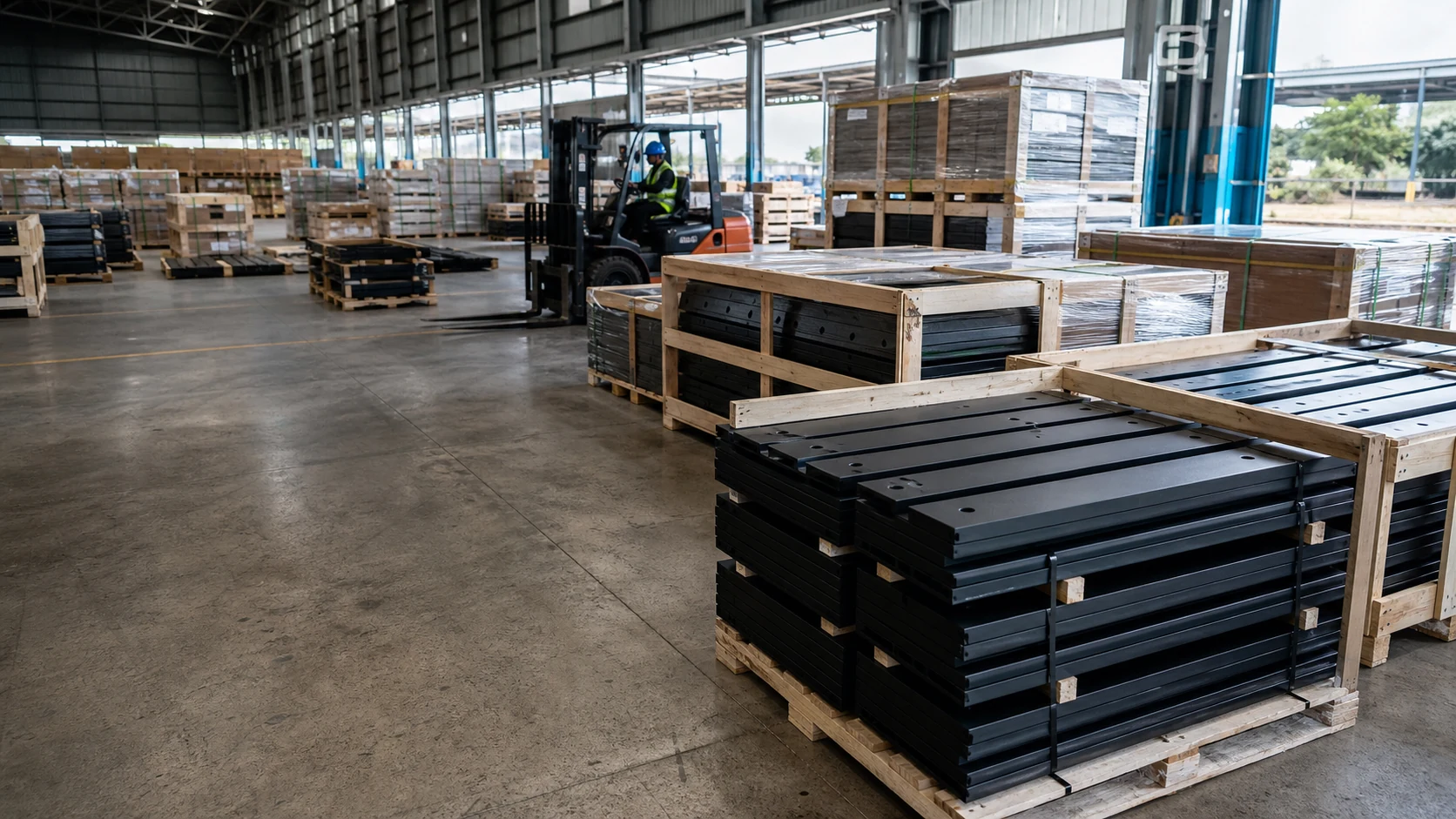
The price break is the visible part of the decision and the smallest part of the comparison. Buying a season ahead moves cost into the current year, occupies space, commits the fleet to a specification, and changes what happens when a machine fails mid-season and needs an edge that is not in stock.
Those effects are all real and none of them appears on the quotation. A fleet comparing a bulk price with a per-order price is comparing one line of a five-line decision, and the four it is ignoring are the ones that produce the awkward outcome above.
Bulk purchasing plow blades: what the two strategies trade
Bulk buys availability; just-in-time buys flexibility.
The trade is between holding the material and holding the option. A bulk purchase fixes a quantity and a price, and in exchange the fleet carries the storage, the capital and the risk that the specification moves.
A just-in-time arrangement keeps the capital and the space free, and in exchange the fleet depends on a supplier’s lead time in the weeks when that lead time is longest.
Which side of that trade suits a fleet depends on three of its own properties: how stable its specification is, how critical the parts are to keeping machines in service, and whether it has somewhere sensible to store them.
Price breaks versus carrying cost
The price break is quantifiable from the two quotations, and the carrying cost is quantifiable from the fleet’s own records once the components are named. Four of them belong in the comparison: the space the stock occupies, the capital tied up and the rate the fleet applies to it, the handling cost of moving and counting the stock, and the expected write-off from material that will not be used.
The fourth component is the one that decides the comparison in practice and the one fleets omit. It is not a hypothetical: a fleet that has changed machine models or specifications within the last few years has already incurred it, and the previous write-off is the best available estimate for the next one.
Lead time risk in winter
Lead time during the season is the risk that just-in-time arrangements carry, and it is larger than a catalogue figure suggests. A supplier’s lead time in September reflects low demand; the same supplier’s lead time in the week of a region-wide freeze reflects every fleet in the area ordering at once.
The fleet’s exposure is measured rather than assumed. Two records make it visible: the lead times actually experienced on orders placed during the season, and the number of occasions the fleet had to substitute, delay a change or take a machine out of service because a part was not available. Where the second is non-zero, the fleet is already paying for its stock policy in service failures.
Obsolescence when fleets change
Obsolescence is the cost that makes a three-year bulk purchase risky and a one-season purchase safe. It arises from three sources: machines replaced with units that use a different pattern, a specification change made on evidence during the period, and a route reassignment that makes a stored edge unsuitable for the duty it was bought for.
Two practices limit it. Buying bulk only for the specifications that are stable and shared across several machines, which is where a fleet’s standardisation work pays off. And confirming the quantity against a model that shows what happens if a specification change lands mid-period, rather than assuming the fleet’s requirements are fixed. Consolidating specifications before committing to a bulk order is the subject of the blade standardisation page.
Storage space and handling
Storage is a real cost and a real constraint. A year’s edges for a mid-sized fleet occupy space that has to be dry, off the floor and organised so a fitter can find the right pattern without a search. Space that does not exist becomes either a capital project or a stock pile in the weather, and the second option degrades the material it is meant to protect.
Handling is the smaller cost and the one that shows up in labour. Stock that is stored badly has to be re-measured before use, moved twice to reach what is needed, and counted more often. Organising it by pattern and labelling it against the machine it fits is what keeps the cost down, and it also protects the fleet from the fitting errors that similar-looking edges produce.
Working capital effects
Working capital is the cost of the bulk decision that finance functions count and operational teams often discount. A quantity bought early is cash spent in an earlier period than it needed to be, and the cost of that is whatever the fleet applies to capital, whether that is an explicit rate or the opportunity of not spending it elsewhere.
The size of the effect depends on the horizon. A purchase covering one season moves cash by weeks and is often not worth modelling. A purchase covering three seasons moves it by years and belongs in the comparison explicitly, which is why a multi-year bulk decision should be assessed through the same model as any other with a horizon.
Hybrid strategies that work
Most fleets end up with a hybrid, and the table below sets out the arrangements that are in common use.
| Arrangement | What is held | Suits |
|---|---|---|
| Critical-cover bulk | Full cover for the parts that stop a machine; the rest ordered as needed | Fleets with a small number of critical machines |
| Season-ahead bulk | One season’s requirement bought before the season | Stable specifications and predictable consumption |
| Call-off agreement | Quantity committed, stock held by the supplier | Fleets without storage but with material volume |
| Full just-in-time | Nothing beyond the current change | Short seasons, small fleets, rapid specification change |
The first row is the arrangement that most fleets arrive at, because it matches the actual risk: the exposure is not the total spend but the specific parts whose absence removes a machine from service.
Decision matrix by fleet size
Fleet size changes which strategy is workable, largely because of storage and capital rather than of price. A small fleet generally has neither the space nor the ability to absorb a specification change, which points towards just-in-time or supplier-held stock. A larger fleet has the space and the consumption to justify holding cover, and it can also negotiate a call-off arrangement on volume.
What does not change with size is the need to hold cover for the critical positions. A fleet of three machines with one that has no substitute has the same exposure as a fleet of thirty, and the answer for that one machine is to hold what it needs rather than to rely on a lead time.
How to test the decision on your own numbers
The comparison can be run in a season with a small amount of recording.
- Record the lead time of every order placed during the season, not only the price.
- Record every occasion a part was not available when a machine needed it, and what the fleet did.
- Record the storage and handling cost of the stock currently held.
- Compare the bulk price with the per-order price on the same specification, landed.
- Apply the fleet’s own capital rate to the difference in timing.
The second record is the one that changes the decision. A fleet that finds it has taken machines out of service twice in a season because a part was not in the store has established the cost of its current policy in the terms that matter, and it no longer needs to argue about the price break.
Implementing a hybrid
Moving to a hybrid is a scheduling exercise rather than a purchasing one.
- List the machines that cannot be substituted, and the parts each one needs.
- Set a stock level for those parts covering consumption over the season lead time.
- Move everything else to ordering as it is consumed, with a restock trigger rather than a date.
- Review the list when the fleet changes, since a machine that becomes substitutable releases its cover.
The fourth step is what keeps the arrangement accurate over several seasons. A critical-parts list that is never reviewed becomes a stock level for machines the fleet no longer runs. The level itself is set on the inventory planning page.
What changes the answer
Four changes move a fleet from one strategy towards the other, and each is worth reviewing before a bulk order rather than after.
- A fleet renewal programme, which raises obsolescence risk and argues for shorter commitments.
- A specification consolidation, which lowers it by reducing the number of patterns held.
- An increase in storage space, which lowers the carrying cost of holding.
- A longer or more severe season, which raises the value of availability and the cost of a stockout.
The first and fourth usually arrive together. A fleet renewing its machines during a run of severe winters is exposed on both sides, and the arrangement that suits it is short commitments for the parts that are changing plus critical cover for the ones that are not.
Where the risk actually sits
The comparison is often presented as a trade between price and storage, and the exposure that decides it is usually service. A bulk purchase that saves on the unit price and leaves the fleet unable to edge a machine in the worst week has not saved anything; a just-in-time arrangement that keeps the store room empty and takes a machine out of service twice in a season has cost more than the capital it freed.
Framing it that way makes the decision testable, because both outcomes are recorded in the fleet’s own service data. Procurement practice for public fleets is published by the National Association of Counties and the American Association of State Highway and Transportation Officials, equipment specification practice by the Association of Equipment Manufacturers and SAE International, and winter operations research by the Transportation Research Board.
SENTHAI manufactures plow edges, wear plates and carbide inserts in Rayong, Thailand, and supplies fleets and distributors against a specified pattern, which is what makes a bulk or call-off arrangement practical to set up against a known specification. Stocking arrangements that need the pattern and the supply position confirmed can be raised through the contact page.
FAQ
Is it cheaper to buy plow blades in bulk?
The unit price usually is, and the total sometimes is not. Bulk buying trades a lower unit price for storage, tied-up working capital and the risk that the specification changes before the stock is used, and those three have to be priced before the comparison means anything.
What is the main risk of just-in-time for winter parts?
Lead time during the season. A supplier’s lead time in a quiet month is not the lead time in the week every fleet in the region is ordering, and a fleet holding nothing depends on the second figure rather than the first.
What hybrid approach works for most fleets?
Bulk cover for the parts that stop a machine and just-in-time for the rest. The critical positions are held against a severe winter, and the parts that can wait are ordered as they are consumed, which limits both the capital tied up and the exposure.
Send the machines, the patterns they run and the lead times you have experienced. The SENTHAI engineering desk will confirm the specification and the supply position so the comparison runs on your own numbers.