A die that fails early is usually described as a material failure, and it is more often a setup failure that the material could not survive. Movement at a mounting, a misaligned working face or a coarser feed than the specification assumed will all end a die whose grade was correct.
(Last modified date: November 12, 2026)
Understanding where the life goes is the first step in specifying a replacement. This is the duty, the failure modes and the practice that extends the interval.
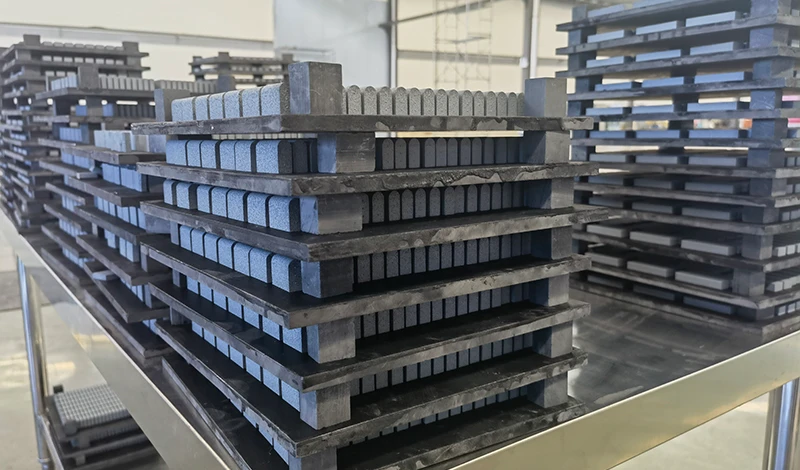
Carbide block dies: what the duty does to them
Three mechanisms act on a die at once.
Abrasion removes material from the working faces as the feed passes through. Impact from irregular pieces damages the faces locally. Thermal cycling, where the process heats and cools the tooling, works on the material and on the joint between the hard face and its body.
The balance is set by the feed rather than by the die. A consistent, smaller feed loads the faces mostly by abrasion, which is the condition a carbide face is designed for. A feed with a wide size range adds impact, and the die’s life becomes less predictable because the failures stop being gradual.
That is why the first useful measurement on a worn die is not how much material was removed, but where and how. The pattern identifies which of the three mechanisms dominated, and the specification follows from that rather than from the previous order.
Scrap retention in carbide die blocks: troubleshooting slug pulling
In stamping and piercing, “scrap retention” means keeping the slug or scrap inside the die until it falls clear. When retention fails, the slug is pulled back up with the punch, lands on the strip or die face, and marks parts or chips the carbide edge on the next stroke. The cause is usually not the carbide.
- Check clearance first. Clearance that is too large lets the slug spring free and ride up with the punch; too tight increases wear and burr.
- Check the die land. A land worn short or polished smooth after regrinds grips the slug less; the regrind record shows how much land is left.
- Look for vacuum and lubricant film. Heavy oil and a flat punch face can hold the slug by suction; venting or a punch with an ejector pin breaks it.
- Demagnetise. Tooling magnetised during grinding can lift steel slugs.
- Consider retention features. Die buttons and blocks with slug-retention grooves or relief geometry are made for this problem; specify them on the drawing rather than adding them after damage.
The counter-intuitive point is that a harder carbide grade will not cure slug pulling. Retention is a geometry and setup issue; the grade only decides how long the corrected geometry lasts.
Duty cycle in scrap processing
The duty cycle in scrap processing is variable in a way that a specification has to accommodate rather than assume.
Feed composition changes with what the yard buys, so a die that runs comfortably on one grade of material may be over-loaded by the next delivery. Duty also varies with the campaign: continuous running on a consistent feed produces gradual wear, while intermittent running with restarts produces more thermal cycling.
Those two variables are what make the record important. A plant that records the feed description alongside the die’s tonnage can tell whether a shorter interval was caused by the die or by what went through it, and that distinction decides the next specification.
Die geometry and material choice
Geometry and material are decided together, because the shape determines where the load arrives and the material determines how it responds.
Where the geometry concentrates contact at an edge, the material has to tolerate that local load. Where the contact is distributed across a face, abrasion resistance becomes the dominant requirement. A design change to a working face therefore changes the material that suits it, and the two should be reviewed together rather than in sequence.
| Feature | What it determines | Material implication |
|---|---|---|
| Working face profile | Whether contact is distributed or concentrated | Concentrated contact needs more impact tolerance |
| Face area and thickness | How much wear volume is available before replacement | Thicker faces extend the interval and cost more |
| Mounting interface | Whether the die moves under load | Any movement shortens life regardless of material |
| Support behind the face | Whether the hard material is backed | Unsupported hard material cracks rather than wearing |
The fourth row is the one that most often explains a premature failure. A hard face that is not fully supported behind it behaves as a thin plate under load, and it fails by cracking rather than by wearing, which looks like a grade problem and is not.
Wear patterns and failure causes
The wear pattern on a returned die identifies the cause with reasonable reliability.
Even material loss across a working face indicates abrasion-dominant duty and a specification that is working. Localised gouges or spalled areas indicate impact or an unsupported face. Cracking at the mounting, or fretting marks where the die seats, indicate movement rather than wear. Discolouration or cracking patterns across the body indicate thermal cycling.
Each of those points in a different direction. Localised damage suggests the feed or the geometry, mounting marks suggest the fit, and thermal patterns suggest the process rather than the die. Changing a grade in response to any of them addresses the symptom rather than the cause.
Refurbishment options
Refurbishment is worth considering before a die is scrapped, and it depends on whether what is worn can be restored.
The question is whether the wear is in a surface that can be re-machined or re-coated, and whether the body behind it still has the section to support the restored face. Where both are true, reconditioning restores the geometry at a lower cost than a new component.
- Inspect the body for cracks and for section loss behind the working face.
- Measure the remaining section against the minimum the design requires.
- Confirm the original specification, since a refurbished die cannot be restored to an unknown specification.
- Recondition or replace, and record which was done against the machine and the tonnage.
The third step is the one that stops refurbishment programmes. Without the original specification there is nothing to restore the die to, and the refurbished item becomes an unknown component in the plant’s wear inventory.
Cost per tonne processed
Cost per tonne is the comparison that reflects the plant, because it includes the interruption as well as the die.
The calculation is die cost plus change cost, divided by the tonnes processed before the wear limit. Refurbishment enters the same calculation as an option with a lower component cost and the same change cost, and the comparison between new and reconditioned is made on tonnage per unit cost rather than on price.
The figure also makes the value of a longer interval visible. On a plant where a die change stops the line, the solution that runs longer wins even at a higher price, and the calculation shows it without an argument about material preferences.
Specification essentials
A die specification is short when it is complete, and it should name the items the plant will check on delivery.
The essentials are the grade with its hardness and grain structure, the dimensions that control fitment, the flatness and finish of the working faces, the mounting interface with its tolerances, and the marking that carries the batch reference. The documentation set belongs in the same specification rather than in a separate conversation.
The interface tolerances are the ones that decide whether the die performs. A die that is within tolerance on its working faces and loose in its mounting will fail at the mounting, and the failure will be recorded against the material.
Maintenance scheduling
Scheduling die maintenance works when the interval is set from the plant’s own measurements rather than from the supplier’s expectation.
The sequence below builds that interval and keeps it current as the feed changes.
- Measure the working faces at set points at every planned stop.
- Record the tonnage processed since the last measurement.
- Establish the rate of loss and set the next inspection before the limit is reached.
- Note the feed description over the period, so a change in rate can be attributed.
- Review the interval whenever the feed mix changes materially.
The fifth step is the one that keeps the schedule useful in a yard where the incoming material changes. An interval set in one period of feed is not necessarily valid in the next.
What a die record should contain
A record per die, rather than per machine, is what allows two specifications to be compared.
The entries that matter are the component identification, the grade, the installation date and tonnage, the measurements at removal, the failure mode observed and whether the item was replaced or reconditioned. With those, a plant can answer the question of whether a change of grade actually helped.
- The component and grade identification, tied to a batch reference.
- The machine and position it was fitted to.
- The tonnage and hours run, with the feed description.
- The measurements and the failure mode at removal.
- The disposition: replaced, reconditioned or scrapped.
Where dies fail early
Early failure has a small number of causes, and the die itself is rarely the first one.
The patterns below are worth ruling out before a grade change is considered.
- Movement at the mounting, visible as fretting or as elongated fixing holes.
- Working faces that are not aligned, concentrating load on one side.
- An unsupported hard face, failing by cracking rather than by wear.
- A feed coarser than the specification assumed, producing impact damage.
The fourth item is the one that changes most often in a recycling yard, because the feed follows the market. Material and test standards that a specification can reference are published by ASTM International and the American Society of Mechanical Engineers, with measurement practice published by the National Institute of Standards and Technology. Equipment conventions come from SAE International, and industry practice is documented by the Association of Equipment Manufacturers.
FAQ
What wears carbide block dies?
Abrasion from the material passing through the die, impact from irregular pieces meeting the working faces, and thermal cycling where the process heats and cools the tooling. The balance between them depends on the feed and on how the die is mounted.
Can a worn die be refurbished?
Often yes, where the wear is at a working face and the body is sound. Reconditioning restores the geometry rather than the material, so it is viable when the remaining section is adequate and the original specification is known.
How should die life be measured?
In tonnes processed rather than in hours, against the same feed and settings. Cost per tonne then becomes the comparison figure, because it includes the change and the interruption rather than only the die.
Why do dies sometimes fail early?
Usually because of something outside the die: a mounting that allows movement, a feed that is coarser than the specification assumed, or a fit that leaves the working faces misaligned. The failure appears in the die and starts in the setup.
What causes scrap or slug pulling in carbide dies?
Usually excessive clearance, a worn or short die land, vacuum from lubricant and flat punch faces, or magnetised tooling. Fix the geometry and setup before changing carbide grade.
Send the die drawing, the feed description and the tonnage per set, and SENTHAI will respond with the grade, the geometry limits and the record to keep.