The argument against carbide on a grader is usually made on purchase price, and the argument for it is usually made on wear life. Neither answers the question, because the number that decides is the cost of grading a kilometre, and that includes the change that the purchase price does not.
The comparison below sets out where carbide wins, where it loses, and what a payback calculation actually needs.
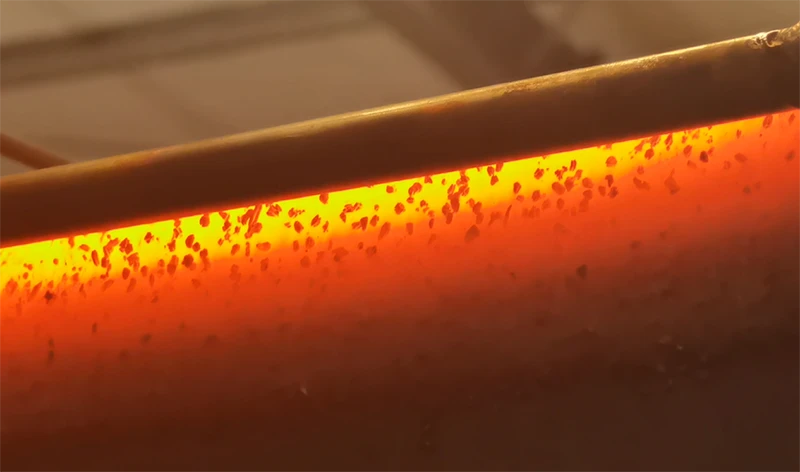
Carbide grader blades: what decides whether they pay
Two things decide whether carbide pays.
On a maintained gravel road, wear is continuous and concentrated at the edge, which is the condition carbide is designed for. On unbroken or rocky material, the same inserts meet impact and the advantage disappears as sections are lost.
The decision therefore begins with the road rather than with the edge. A fleet that runs both maintained roads and construction work will usually find that carbide pays on one and not on the other, and that a machine moving between the two needs its edge changed with the work.
Abrasion profiles on gravel roads
Gravel road grading produces an abrasion profile that is different from construction or haul road work.
The material is loose at the surface and compacted below it, so the blade works in two regimes across the same pass: cutting into the compacted layer and then moving loose material along the mouldboard. The edge therefore wears at the point where it enters the compacted layer, and that point moves along the blade as the operator steers.
The consequence is a wear band rather than a uniform loss of section, and a wear band is exactly what the insert arrangement on a carbide edge is designed to resist. That is the geometric argument for carbide on this duty, and it is visible on any returned edge from a gravel road.
Carbide inserts versus full steel edges
The two differ in where the hardness sits and in how they fail.
A steel edge carries a uniform hardness across its whole section, and it wears evenly until it reaches its limit. A carbide edge carries inserts at the contact line, so the resistance to abrasion is concentrated where the wear happens, and the body behind the inserts remains a steel that can be drilled, bolted and handled.
| Property | Full steel edge | Edge with carbide inserts |
|---|---|---|
| Abrasion resistance | Moderate, uniform across the section | High, concentrated at the contact line |
| Impact tolerance | Deforms and stays serviceable | Inserts can chip or be lost |
| Repair in a workshop | Can be built up and reused | Inserts replaced, or the section replaced |
| Purchase price | Lower | Higher |
| Changeout frequency | Higher | Lower, where the duty suits it |
The third row is the one that decides the comparison in most fleets. A workshop that already builds up steel edges has a maintenance model that suits steel, and moving to carbide changes the model as well as the part.
Effect on blade crown and surface finish
A harder edge cuts differently, and the difference shows in the shape of the road.
A carbide edge cuts more aggressively at the same down pressure, which brings more material to the surface and changes how quickly a crown forms. On a maintained road that can be an advantage, because the operator reaches the required shape in fewer passes. On a road where material is scarce, it can mean cutting into the base and losing the crown instead.
The practical response is to treat the edge and the setting as one decision. An operator moving from steel to carbide on the same road should expect to use less down pressure, and a fleet that specifies the material without stating that will find the first season’s results mixed for reasons that look like a material problem.
Grading speed and down-pressure
Speed and down pressure determine how much load reaches the inserts, and they are the settings an operator controls.
Higher speed covers more road per hour and increases the impact energy of anything the blade meets. Higher down pressure increases the cutting force and the load at the edge. Both increase the wear rate, and both increase the chance of an insert failure on a surface where obstacles are present.
The settings that suit carbide are therefore usually lighter on down pressure than the settings that suit steel on the same road. That is a training point rather than a specification point, and it is worth stating whenever a fleet changes material on a machine.
Expected life advantage
The life advantage of carbide is real and it is not a fixed multiple.
It depends on how abrasion-dominated the work is, how the machine is set, and whether the inserts survive. On a consistent gravel road with appropriate settings, the interval between changes extends substantially. On a route with frequent rock contact, the interval can be shorter than a steel edge’s because a chipped insert degrades the cutting line for the remainder of the section.
The honest way to treat the advantage is as a range that a fleet establishes for its own roads. A trial on one machine, measured in kilometres graded rather than in weeks, produces a figure the fleet can use; a general multiplier from a supplier does not survive contact with a specific route.
Conditions where carbide underperforms
Carbide is the wrong choice in four conditions, and each of them is recognisable before the order is placed.
The list is worth checking against the route before a fleet commits a machine to a carbide specification.
- Unbroken rock or material containing large stones that strike the edge.
- Construction grading where the blade is used to cut into compacted base material.
- Machines whose down pressure cannot be moderated by the operator.
- Operations where the workshop rebuilds edges rather than replacing them.
The fourth condition is the one that is usually overlooked, because it is organisational rather than technical. A fleet whose maintenance model depends on welding up steel edges will find carbide changes the workshop’s work, and that has a cost even when the part performs.
How to build a payback calculation
A payback calculation works when it is built from the fleet’s own figures and expressed as a formula rather than as an example with numbers borrowed from somewhere else.
The terms below are the ones that decide the comparison, and each can be measured or estimated by the fleet itself.
- Set P as the cost of the edge, and P2 as the cost of the alternative being compared.
- Set C as the cost of one changeout, including labour and the machine’s downtime.
- Set D as the distance graded per edge, measured for each specification on the same route.
- Calculate cost per kilometre as (P + C) / D for each, and compare the two results.
- Review the comparison over a full season, since a single trial may cover only one set of conditions.
The third term is the one that has to be measured rather than assumed, and it is the only one a supplier cannot provide. A fleet that records distance graded per edge already has the input for this calculation, and the comparison then takes a few minutes.
What a payback number needs to be credible
A payback figure is credible when its inputs are stated, and it is an assertion when they are not.
The inputs that matter are the distance measured, the changeout cost used and the conditions the trial covered. Without them, a figure cannot be checked by anyone else and cannot be updated when the route changes.
- The distance graded, measured on the same route and in the same season.
- The changeout cost, stated as a component rather than folded into the edge price.
- The conditions the measurement covered, including whether the road was maintained or being rebuilt.
- The number of edges included, since one trial edge is an anecdote and several are data.
Material and test standards that a specification can reference are published by ASTM International and the American Society of Mechanical Engineers, with measurement practice published by the National Institute of Standards and Technology. Equipment and fitment conventions come from SAE International and the American Association of State Highway and Transportation Officials, and road maintenance practice is documented by the Snow and Ice Management Association.
FAQ
What are carbide grader blades good for?
Continuous abrasive work on maintained gravel roads and on compacted snow or ice, where the wear is concentrated at the edge and the surface does not present rock or buried obstacles that would chip the inserts.
Are carbide grader blades worth the cost?
On the right road, usually. The question is answered by cost per kilometre graded rather than by purchase price, because the labour and downtime of a change are the same whether the edge is cheap or expensive. On a road where inserts chip, the advantage disappears.
Do carbide edges damage a gravel road surface?
They cut more aggressively than a steel edge, which affects how much material is brought to the surface and how the crown forms. That is a setting question as much as a material one, and it is the reason down pressure and pass count are specified with the edge.
Send the road type and the machine, and SENTHAI will say whether a carbide edge is likely to pay on that route and what to record to test it.