A concrete saw segment and a plow edge both carry a hard material at the point of contact, and only one of them can be diamond. The saw runs in continuous contact with an abrasive material and never meets a shock; the plow edge meets curbs, rails and buried obstacles every shift.
That difference in loading, rather than the difference in hardness, is what decides which material belongs where. The sections below work through the comparison in the order it should be made.
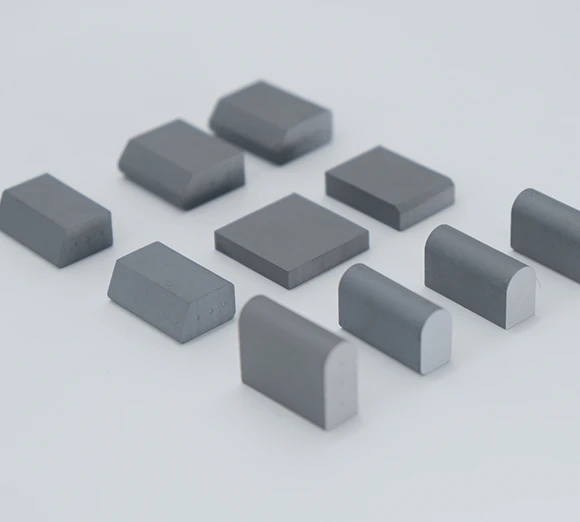
Carbide vs diamond blade: what the comparison is really about
Diamond is harder; carbide is tougher and more repairable.
The choice follows the material being cut and the way the tool is loaded: diamond for continuous abrasive contact where nothing impacts the edge, carbide where the edge has to survive interrupted cuts and shock.
The comparison is easy to get wrong because both materials are described by hardness, and hardness is only the first filter. A material can be harder and still be the wrong choice, because it cannot be brazed into position, cannot be resharpened economically, or cannot survive the load path between the tool body and the work.
The second filter is the manufacturing route. Carbide is produced as inserts of controlled shape that are brazed or clamped onto a steel body. Diamond appears as a coating on a substrate, as grit in a matrix segment, or as a solid compact, and each of those forms constrains the geometry it can be made into.
Hardness and wear mechanisms
Diamond is the harder material, and it resists the wear mechanism that dominates continuous cutting.
Against sliding abrasion and against the polishing that a fine abrasive produces, diamond wears more slowly than any carbide grade. Against impact and against the fracture that follows a shock, the advantage disappears, because a harder material has less capacity to deform before it fails. Hot hardness adds a second consideration: carbide retains its hardness at temperatures where steel would have softened, and diamond has its own temperature limits above which it degrades.
| Mechanism | Carbide | Diamond |
|---|---|---|
| Sliding abrasion | High resistance | Highest resistance |
| Impact and shock | Tolerates a defined load | Fails readily; brittle at the edge |
| Edge retention | Good, and can be re-ground | Very good until it fractures |
| High temperature | Retains hardness to high temperature | Degrades above its own limit |
The third row matters on tools that are re-sharpened rather than replaced. A carbide edge can be ground back and returned to service; a diamond tool that has lost its cutting structure is usually either dressed or replaced, and dressing is a specialist operation.
Impact tolerance differences
Impact tolerance is the property that separates the two applications most clearly.
Diamond behaves as a very hard but brittle material, which is acceptable in a tool that is fed into the work at a controlled rate and unacceptable where the edge meets an uncontrolled load. Carbide is also brittle relative to steel, and it is markedly more tolerant than diamond, particularly in the tougher grades with higher binder content.
The consequence for a wear edge is the mounting design rather than the material choice alone. Where carbide is used on equipment that meets obstacles, the inserts are usually protected by the body geometry and supported so that the load path runs through compression rather than tension. A diamond element in the same position would have no equivalent protection available.
Cost per tool and per cut
The purchase price difference is large, and the useful comparison is cost per unit of work rather than cost per tool.
Diamond tools cost substantially more to make, because the material itself is expensive and the manufacturing routes are more specialised. Carbide is produced in volume with established pressing and sintering processes, and inserts can be replaced on a body that stays in service. That difference in repairability changes the comparison in favour of carbide on any tool where partial replacement is possible.
| Cost element | Carbide | Diamond |
|---|---|---|
| Material and production | Moderate; established volume processes | High; specialised routes |
| Tool body | Steel body stays in service; inserts are replaced | Often replaced with the cutting element |
| Resharpening or dressing | Grinding with diamond tooling is routine | Specialist process, or replacement |
| Failure cost | Losing an insert is a partial loss | Fracture usually ends the tool |
The fourth row is the one that decides the comparison on rough applications. A carbide edge that loses inserts keeps working with the remaining ones until it is changed; a diamond cutting structure that fractures stops cutting.
Material suitability
What is being cut or cleared decides more than the tool’s own properties.
Diamond belongs against hard, abrasive and relatively consistent materials: concrete, asphalt, stone and refractory products, where the contact is continuous and the tool is guided. Carbide belongs where the material is variable, where the tool meets interruptions, or where the edge is used as a wear surface rather than a cutting surface, which is the case on plow edges, grader blades and bucket edges.
The distinction is also about what happens when the material changes. A tool used across mixed conditions will meet an interruption eventually, and the material that survives interruptions is the one to specify for that work.
Equipment compatibility
Compatibility decides feasibility before cost is considered.
Carbide inserts are brazed or bolted to steel bodies, in patterns that follow published fitment conventions, and they can be replaced with the same tooling the machine already uses. Diamond elements generally need a purpose-built mounting: a matrix segment, a brazed compact or a coated tip designed for the specific holder.
That is why retrofitting diamond onto a machine designed for carbide edges is rarely practical. The holder, the load path and the replacement procedure are all built around the insert, and changing the material changes all three.
Safety and handling
Both materials carry handling requirements, and they differ in kind.
Carbide is brittle and its dust is a workplace hazard, so grinding it produces a controlled-waste stream and a requirement for extraction; a chipped insert is also sharp and is often lost in the material being cleared. Diamond tooling is harder still and fails more dramatically when it fractures, which is why diamond sawing and drilling operations use guarding and controlled feed rates.
For a fleet, the practical safety difference is repairability. A carbide edge can be inspected, an insert replaced and the edge returned to service in a workshop; a diamond element that has failed is normally removed from service entirely.
Decision guidance
The decision resolves in four questions, and the first two usually settle it.
Is the contact continuous or interrupted? Is the tool fed at a controlled rate or does it meet whatever is under the snow? Can the cutting element be replaced on a body that stays in service? And is the comparison being made per tool or per unit of work? A diamond tool wins where the first two answers are favourable and the work volume is high; carbide wins in every other case.
The comparison only becomes close in a narrow band: continuous abrasive contact, controlled feed and very high utilisation. Outside that band, one of the two materials is clearly unsuitable, and the analysis can stop.
Where diamond is the wrong answer
Diamond fails in three situations that are common in industrial wear.
Each of the following is a case where the hardness advantage is irrelevant because something else ends the tool’s life first.
- Any application where the edge meets buried obstacles or interrupted cuts.
- Any tool that has to be resharpened in a workshop rather than returned to a specialist.
- Any machine whose holder and fitment were designed around a replaceable insert.
Material and test standards for both material families are published by bodies such as ASTM International and the measurement practice by the National Institute of Standards and Technology.
Where carbide is the wrong answer
Carbide is the wrong answer in three equally common cases, and they are the mirror image.
Hardness is the deciding property in these situations, and carbide does not reach it.
- Continuous cutting of very hard, very abrasive material at controlled feed rates.
- Applications where the temperature at the contact point exceeds what the binder can tolerate.
- Operations where the tool cannot be changed frequently enough to make a shorter interval acceptable.
Where the choice is genuinely close, the deciding factor is usually the maintenance model rather than the material. Fitment conventions and equipment practice that shape these decisions are published by the American Association of State Highway and Transportation Officials and SAE International, with sector buying practice documented by the Snow and Ice Management Association and the Association of Equipment Manufacturers. The carbide insert range SENTHAI produces is described on the carbide inserts page.
FAQ
Which is better, diamond or carbide?
Neither, in the abstract. Diamond is harder and wears more slowly in continuous contact with abrasive material; carbide is tougher, cheaper to make and can be used where the edge takes interrupted loads. The material being cut decides between them.
Are carbide blades worth the cost?
Where the service is predominantly abrasive and the edge does not meet shock loads, yes, because the interval between changes is longer and the labour saved is part of the return. Where the edge chips, the higher purchase price buys a shorter interval rather than a longer one.
Will a carbide edge cut through steel?
Carbide will machine steel in a cutting tool, where the tool geometry, the speeds and the cooling are controlled. As a wear edge it is not used to cut steel, because the loads and the heat of that contact are outside what a brazed insert is designed to survive.
Send the application and the failure pattern, and SENTHAI will say whether a carbide grade, a tougher insert or a different material altogether belongs on the tool.