A fleet that specifies the plow first and the spreader second ends up with a route cleared faster than it can be treated. A fleet that specifies the spreader first ends up spreading material onto snow that the plow should have removed.
The two configurations look similar on a specification sheet and behave differently on the road, because the components of a snow removal system are coupled: each decision removes options from the next. Working through them in the right order is what keeps a procurement programme from buying a set of parts that does not add up to a system.
What the system has to do before anything is purchased
Every component in the system exists to serve one of four functions, and a procurement list that does not map onto them will contain gaps.
The functions are: break the bond between ice and pavement, move the material off the carriageway, keep the remaining surface from refreezing, and get all of it to the right place at the right time. Each function has a component group behind it, and the groups interact. A plow that clears to bare pavement reduces the material the spreader has to place; a spreader calibrated to a rate the route does not need wastes the material the store was built to hold.
Writing the four functions at the top of the specification is a small discipline with a large effect. It makes the trade-offs visible, because a decision that improves one function usually changes the load on another.
Vehicle platforms and attachments
Carrier vehicles decide what the rest of the system can be, because mounting, hydraulic capacity and payload are set at that point.
A platform has to carry the plow, the spreader, the material and the hardware that connects them, and the mounting convention decides which attachments are available off the shelf. Front, underbody and wing positions place different loads on the frame and the hydraulics, and a platform specified for a front plow only may not accept a wing without changes to the hydraulic circuit and the frame. Standards for the equipment mounted on these vehicles, including the electrical and control interfaces, are published by SAE International.
The decision that eliminates the most wrong choices is the return-to-base assumption. A fleet working from one yard with long routes needs capacity and speed; a fleet working from several satellite stores can run smaller platforms. That single question sets the platform class, and the component list follows from it.
Cutting edges and wear parts
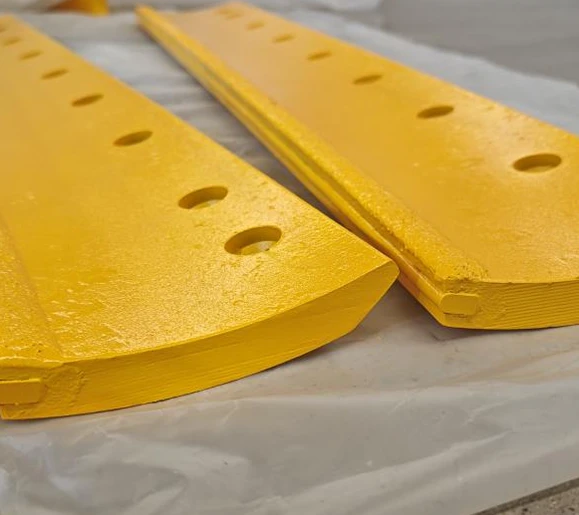
The cutting edge is the component in contact with the road, so it decides the quality of the clearing pass and the rate at which the rest of the system wears.
Edge specification runs across three variables: the material at the road surface, the abrasiveness of the route and the level of service the network requires. A carbide edge holds an edge longer on abrasive and high-speed routes, a steel edge keeps its purchase price low on low-demand routes, and a rubber-flex or segmented edge follows a profile that a rigid edge would mark. Bolt pattern and thickness have to match the moldboard, which is why the edge and the plow body are usually specified in the same document. The range SENTHAI manufactures is set out under carbide snow plow blades.
Where the decision goes wrong is at the second order. A fleet buys a long-life edge for the mainline, then puts the same edge on the entrance plows where the operating hours are a fraction of the mainline and the cost per lane kilometre is several times higher. Matching edge to duty cycle is worth more than matching edge to network average.
Material spreading systems
The spreading system decides how much of the material purchased in the autumn actually reaches the road.
Its components are the hopper or tank, the conveyor or auger, the spinner or spray bar, and the controller that links vehicle speed to application rate. The controller is the part that determines whether a rate is a specification or an intention, because a fixed auger setting applied at variable speed produces a rate that varies with the route. Liquid systems replace the spinner with a spray bar and add tanks, pumps and a method of producing or receiving brine.
Two specification questions matter. The first is the range of application rates the unit can hold across the fleet’s speed range, because a unit that cannot apply a low rate accurately will over-treat every short event. The second is whether the controller records what was applied, since a spreading system that reports its own rate turns the treatment log into data rather than recollection.
Communication and dispatch
Dispatch is a component of the system rather than an office function, because it decides when each unit moves and which route it takes.
At its simplest, dispatch is a route plan, a call-out procedure and a radio. At its most developed, it is automatic vehicle location feeding a live map, a task assignment layer, and a treatment record built from spreader telemetry and vehicle position. The intermediate step that delivers most of the value is smaller than it appears: a defined route list with a priority order, a record of what was applied, and a way for the operator to report a condition back to the supervisor.
The specification question here is what the dispatch layer has to produce rather than what it has to contain. If the answer is a treatment record that can be reviewed after an event, then the requirement is a data path from the spreader controller and the vehicle position into one record, and everything else is optional.
Storage and materials handling
The store is part of the winter system because material that has taken on moisture does not spread at the rate the rule assumes.
A working store keeps the product dry, keeps it off the ground, allows a loader to reach it in the dark, and has a hard surface that does not turn into the first problem of the event. Capacity follows from the route plan: peak demand per event, the number of events the network expects between deliveries, and the lead time from the supplier. Handling equipment, from the loader to the conveyor or the dump pit, is what converts stored tonnes into loaded spreaders within the call-out time.
The design question that catches fleets is access. A store that a loader can reach in daylight can still be unusable in a night event with drifted snow across its apron, so the store apron belongs in the same clearing plan as the roads.
Maintenance and workshop support
Workshop capacity decides how much of the fleet is available on the night a full call-out is needed.
The consumables are the cutting edges, wear parts, hardware and hydraulic components, and the planned work is the edge change, the hydraulic check and the spreader calibration. None of it is technically difficult, and all of it competes for the same hours as the winter call-out itself. Planning the replacement cycle so that edge changes happen at set intervals rather than when the edge has failed is what keeps the workshop ahead of the season.
The measure to watch is the number of units that fail the pre-event check rather than the number of repairs completed. A unit that leaves the yard and loses an hour on the route has cost the network more than the repair would have.
Components of a highway snow removal system: the decision order
The components resolve into a sequence.
Start from the level of service the network has to deliver, because that sets the clearing quality and the number of passes, and it fixes the platform class the fleet has to buy.
From there the chain runs in one direction. The platform fixes the attachments the fleet can mount, the attachments fix the edge specification and the spreader capacity, and the spreader together with the route plan fixes the store capacity and the workshop workload. Dispatch sits across all of it, carrying the route, the rate and the record.
Three decisions are genuinely hard to reverse once made, and every other choice is downstream of them. Those are the platform class, the store location and capacity, and the mounting and bolt conventions that the fleet standardises on. A fleet that takes those three seriously can change edges, spreaders and controllers later without rebuilding the programme. A fleet that takes them lightly will meet all three again in every subsequent season.
Agency guidance on these systems and their operation is published by the Federal Highway Administration and the American Association of State Highway and Transportation Officials.
Where systems break down
System failures are rarely component failures, and they cluster in the interfaces between components.
- An edge specified for a different moldboard, which arrives with the correct bolt pattern and the wrong thickness.
- A spreader whose minimum accurate rate is above the rate the route rule requires, so every light event is over-treated.
- A store that reaches capacity in a two-event week, forcing a delivery at the worst hour.
- A dispatch layer with no record of what was applied, so the programme cannot be reviewed or defended.
Balancing the components against each other
Every component group can be improved at the expense of another, and the balance is what a procurement programme is actually buying.
The table sets out the main trade-offs in the direction they usually run.
| If you invest here | This improves | This comes under pressure |
|---|---|---|
| Longer-life cutting edges | Clearing quality, fewer edge changes, lower cost per lane kilometre | Higher unit price and a larger consumable inventory up front |
| Higher-capacity platforms | Route coverage per hour, fewer units for a mainline | Manoeuvrability on entrances, and a single breakdown covers more route |
| Accurate spreader control | Material use, and a treatment record that can be reviewed | Controller cost and calibration time |
| Larger or additional stores | Fewer deliveries and fewer interrupted events | Capital cost, and a larger quantity of material to manage |
Specification checklist for procurement
A specification that answers the items below can be quoted without a round of clarification, which shortens the tender and reduces the risk of a substituted part.
- Level of service per route class, with the number of passes it implies.
- Platform class, mounting position and hydraulic and electrical interfaces.
- Cutting edge dimensions, thickness, bolt pattern and material, with the wear part defined separately.
- Spreader capacity, the range of accurate application rates and whether the controller records them.
- Store capacity, access and apron clearing, and the handling equipment assumed.
- Consumable quantities per season and the workshop hours assumed for them.
Spare parts and consumable planning
The consumable plan is what keeps a fleet operating in February, and it is derived from the same numbers as the route plan.
Work from the number of events the network expects, the kilometres covered per event, and the wear rate of the edge on the abrasiveness of the route. That produces a quantity of edges and hardware, which converts into an inventory holding and an order lead time. The step that is usually missing is the second order: a fleet plans the season, runs out in the middle of it, and then accepts a substitute part from whichever supplier can deliver.
Where a fleet buys edges on a seasonal contract, the specification should name the material, the dimensions and the bolt pattern rather than a part number alone, so that a substitute can be assessed against a requirement instead of a description. Test methods for the materials behind those requirements are published by ASTM International, and measurement practice comes from the National Institute of Standards and Technology. Operational practice for the wider programme is covered by the Snow and Ice Management Association.
Fleet standardisation across platforms
Standardisation is worth most where it reduces the number of parts a workshop has to hold, and worth least where it forces a route to use the wrong machine.
The components that repay standardisation are the consumables and the interfaces: cutting edges, hardware, mounting plates and bolt patterns. The components that do not are the carrier vehicles, which should follow the routes they serve. A fleet with a common edge specification across mixed platforms can move stock between depots during an event, which is the value of the exercise; a fleet that standardises the whole platform ends up with a machine that is wrong for part of the network.
Cost structure over ten years
The ten-year cost of a winter system is dominated by items that are not on the purchase order, which is why a component-level price comparison rarely predicts the outcome.
The costs that persist are the consumables, the labour, the material and the maintenance, and the capital items are amortised across them.
| Cost group | Behaviour across ten years |
|---|---|
| Cutting edges and wear parts | Recurring and proportional to kilometres covered and route abrasiveness |
| De-icing material | Recurring and sensitive to the accuracy of the spreading system and to clearing quality |
| Carrier vehicles | Capital, then replacement cycles, with resale value where the mounting is standard |
| Labour and dispatch | Recurring, and reduced where the route plan and the record are reliable |
| Stores and workshops | Capital and fixed, and the item most often under-planned |
Written as a formula, the comparison is ten-year cost = capital (C) + consumables per season (K x seasons) + material (P x R x N x seasons) + labour and maintenance. Where two configurations are close on the first term, the one with the better clearing edge and the more accurate spreader control usually wins on the second and third.
FAQ
What equipment is needed for snow removal on a highway network?
The system needs carrier vehicles with the right mounting and hydraulic capacity, plow bodies and cutting edges, a spreading unit with a calibrated controller, a material store that keeps the product dry and handleable, a workshop that can turn edges and repair hydraulics, and a dispatch layer that assigns routes and records what was applied.
What are the main components of a plow?
The moldboard or blade body, the cutting edge and its wear parts, the push frame and mounting, the hydraulic system that lifts and angles the blade, and the trip or protection mechanism that lets the blade ride over an obstruction. The cutting edge is the part that touches the road and the part that is replaced.
What are the parts of a snow plow called?
The body is the moldboard, the working part at the road is the cutting edge, the supports behind it are wear plates or shoes, the frame that carries it is the push frame, and the mechanism that trips on impact is the trip edge or the trip spring assembly. Bolt patterns follow conventions set by the plow manufacturer.
Is it cheaper to buy one large unit or two smaller ones?
It depends on the route rather than on the unit price. Two smaller units cover more entrances and narrow sections and carry less risk when one is off the road, while one large unit clears a mainline faster and costs less per lane kilometre on a long route. Splitting the fleet usually reflects the network, not the budget.
How should a fleet decide which components to standardise?
Standardise the consumables and the interfaces, which are the cutting edges, the hardware and the mounting and bolt patterns. Leave the carrier vehicles to match the routes they serve. Standardising edges across a fleet reduces inventory and makes a mid-season change a stock movement rather than a purchase order.
If a fleet specification is being rewritten for the next season, send the route classes and the platforms and SENTHAI will set out the edge and hardware list that matches the clearing quality you need.