Two machines can accept the same nominal tire size and behave completely differently on the same studded set, because size describes the wheel and not what the machine does to it.
Compatibility is decided by three things that a part number does not carry: the load the wheel carries, the way the machine drives it, and the clearance available around it. Checking those before the order is the difference between a set that performs and a set that is returned.
Why fitment fails even when the part number matches
Most fitment failures are not dimensional errors; they are mismatches in what the machine asks of the wheel.
A wheel that meets the size specification can still be wrong on load rating, which shows up as a soft or distorted tire rather than as a missing part. A stud pattern that fits the tire can still be wrong for the drive arrangement, which shows up as uneven wear rather than as a failure to fit. Clearance is the third case, and it is the one that damages something else: a stud that touches a guard or a hydraulic line at full lock will be found after the damage rather than before it.
The reason these survive a part-number check is that the part number is derived from a machine family rather than from a specific machine. Within a family, builders change axle load, drive configuration and body clearance between versions, and the studded set has to follow the machine rather than the family.
Machine classes and wheel sizes
The machine class sets the range of wheel sizes and the load the set has to carry.
| Class | Typical wheel arrangement | What the studded set has to handle |
|---|---|---|
| Walk-behind and hand-guided units | Small wheels, low axle load | Light load per stud, more sensitive to pattern than to count |
| Compact ride-on units | Small to medium wheels, tight turning circle | Sideways load in turns, so retention rather than grip sets the limit |
| Full-size ride-on resurfacers | Large wheels, high axle load, driven rear or all-wheel | Highest load per stud, requiring count, diameter and retention to be specified together |
| Electric and battery units | Similar sizes, different weight distribution | Instant torque at start, which loads the studs at engagement |
Equipment categories for the wider industry are described by the Association of Equipment Manufacturers, and interface conventions for machine-mounted equipment by SAE International.
Tire dimensions and load ratings
The dimensional side of compatibility is the easy half, and it is still worth writing down completely.
What has to match is the rim diameter and width, the overall tire diameter, the section width, and the load rating or the ply equivalent the machine requires. The load rating is the item most often omitted, because it is on the sidewall rather than in the machine manual and because it seems irrelevant on a machine that moves slowly. On a resurfacer it is not: the axle load is high relative to the speed, and a tire that deflects more than the original changes the contact patch and the angle of every stud in it.
Two further dimensions decide whether the studded set behaves like the original: the rolling circumference, which affects nothing on a slow machine but matters if the unit uses speed sensing, and the tread depth available for the studs to sit in. A tire with shallow tread has less material around each stud, which is a retention question rather than a fitment one.
Ice resurfacer tire compatibility: what to verify before ordering
Compatibility is three checks: wheel, load and drive.
A wheel that matches on diameter can still be wrong on load rating, and a stud pattern that fits the tire can still be wrong for the way the machine drives. Verifying all three before the order is cheaper than discovering the mismatch when the set is fitted.
The three checks are sequential rather than independent. Wheel dimensions and rim profile have to match first, or nothing else matters. Load rating and weight distribution come second, because they set the load each stud will carry. The drive arrangement comes third, and it decides where the pattern should concentrate grip: on the driven wheels for propulsion, and on the steering wheels for control.
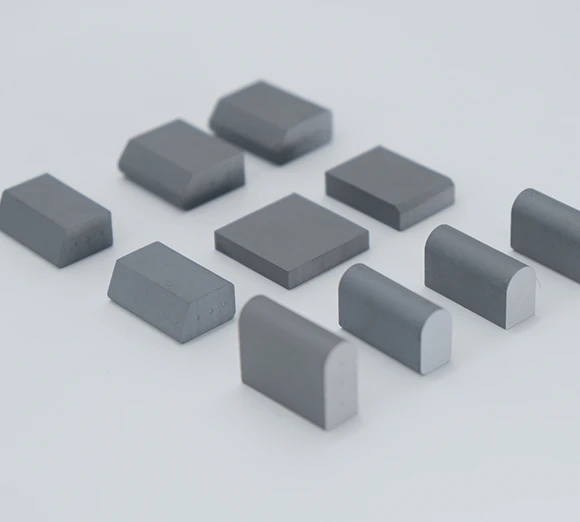
Where a machine is fitted with studded wheels on one axle only, the balance of the machine changes, and that is worth confirming before the order. The carbide insert range shows the same principle on wear parts for snow equipment: the specification follows the load and the motion rather than the nominal part size.
Stud patterns per tire design
The stud pattern is a design decision that follows from the tire construction and the contact patch.
A tire with a defined tread block pattern has natural positions for studs, and a pattern that ignores those positions puts studs into the grooves rather than into the blocks, where the rubber around the hole is thinner. A pattern designed from the contact patch instead places studs where the machine actually transfers load, which is usually the centre and the shoulders for a drive wheel and the shoulders for a steering wheel.
Two practical rules follow. Keep the pattern symmetrical across the tire, because an asymmetric pattern wears unevenly and makes the machine pull. And keep the stud spacing consistent, because a gap in the pattern is a region where the neighboring studs carry more load and wear faster.
Drive system considerations
The drive system decides where grip has to be, and the answer is not always all four wheels.
On a machine with a single driven axle, the studs on the driven wheels carry the traction load and the studs on the steered wheels carry the direction changes. On an all-wheel-drive unit, the same stud pattern has to serve both, which typically argues for a slightly wider distribution and a retention specification that anticipates the higher combined load. Hydrostatic drives with fine speed control put less shock into the studs than a mechanical drive engaged at full torque, which matters to the grade selection.
Grade selection and drive loading are connected closely enough that test methods for hardmetals are worth knowing, and those are published by ASTM International.
What to inspect on the existing wheel
Before ordering a replacement set, inspect the wheel that came off the machine, because it carries the fitment information no catalogue has.
Work through the checks below on the worn set rather than on the machine.
- Measure the actual rim diameter and width rather than trusting the marking, which may have been superseded.
- Record the stud count and measure the spacing between studs at several points around the tire.
- Note where the wear is concentrated, since a ring of worn studs identifies where the machine transfers load.
- Measure a sample of holes to establish whether the tire body can be reused at all.
- Photograph the wheel on the machine at full lock, to record the clearance that has to be preserved.
The photograph is the item most often skipped and the one that prevents the most expensive mistake, because it is the only record of the clearance the new set has to work within.
Interchangeability cautions
Interchangeability between two machines or two suppliers is where the assumptions usually fail.
- A set quoted against a machine family may not suit a specific machine within it, because axle load and drive configuration change between versions.
- A studded wheel that fits a machine may not clear a guard, a flap or a hydraulic line at full steering lock.
- Two tires with the same dimension can differ in load rating, which changes the deflection and the stud angle in service.
- A second-source set with a different stud pattern will not wear like the original, which distorts the replacement interval built from the first set.
Fitment checklist
The checklist that prevents most returns fits on one page, and it is worth completing before any enquiry goes out.
| Item | What to record | Evidence that it is right |
|---|---|---|
| Wheel dimensions | Rim diameter and width, tire section, overall diameter | Measured on the worn wheel, not read from a catalogue |
| Load rating | Axle load per wheel and the rating of the original tire | Sidewall marking compared with the machine data |
| Stud pattern | Count, spacing and position relative to the contact patch | Measured on the worn set, with the wear pattern recorded |
| Drive arrangement | Which wheels drive, which steer, and the drive type | Confirmed against the machine rather than the family listing |
| Clearance | Space at full lock and at full travel | Photograph taken on the machine with the set fitted |
Reference practice for the dimensional measurement behind these checks comes from the National Institute of Standards and Technology.
Documentation to request
The documentation request is short, and it is what makes the next order a repeat rather than a new project.
Ask for the drawing of the wheel and the stud pattern, the dimensions that are inspected on each lot, the grade identification for the studs, the retention method used, and the lot marking that ties the delivery to its production record. With those five, a fitment question can be answered against the record rather than from memory, and a second order can be compared with the first without re-measuring the machine.
The material behind the studs is part of that record, because a grade that is not identified cannot be repeated in a second order. The tungsten carbide supply chain and the role of the material in wear parts are described by the International Tungsten Industry Association.
FAQ
Can I use the tire size alone to order a studded set?
No, because the size describes the outside of the wheel and not what the machine does to it. Two machines can take the same nominal tire size with different axle loads, different drive arrangements and different clearance around the studs, and those three decide whether the set works.
What happens if the stud pattern does not match the machine?
The set will fit and it will grip unevenly. Studs concentrated away from the drive or steering contact patch wear faster, and a pattern that places studs where the body flexes can enlarge the holes and release them earlier than the rest of the set.
Is a wider tire always better for traction on ice?
Not on ice, where grip comes from pressure at the stud rather than from contact area. A wider tire spreads the same machine load over a larger footprint, which lowers the load per stud unless the stud count or the stud diameter is increased to compensate.
Do studded sets need clearance checks?
Yes. Studs add height and width to the wheel, so clearance has to be confirmed at full steering lock, at full suspension travel and against any guard, mud flap or body panel that sits close to the tire.
If a studded set is being ordered for a specific machine, send the wheel measurements, the machine details and a photograph of the worn set and SENTHAI will confirm compatibility before the order is placed.