A grader edge is chosen in three places: at the machine, where thickness and bolt pattern are fixed; at the work, where the profile and the material are decided; and at the workshop, where the method of rotation and replacement decides how much life the edge actually delivers.
Get one of the three wrong and the edge either fails early or costs more per kilometre graded than the material justified. This is how the three are worked through.
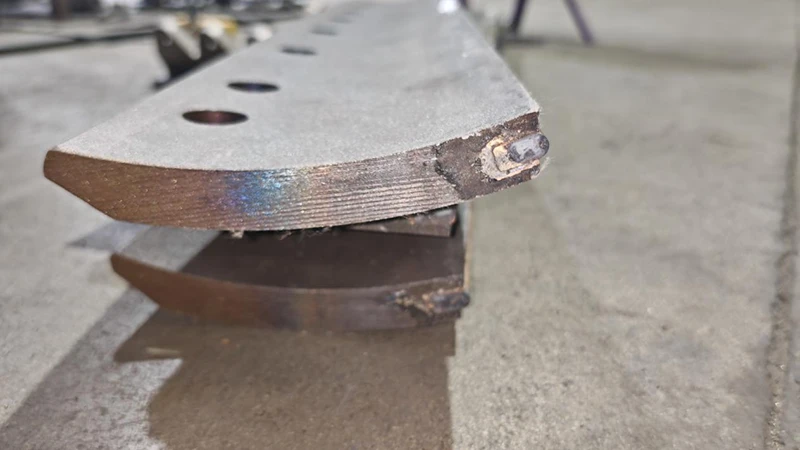
What the grader duty actually asks of an edge
A grading edge is not doing one job, and the reason selection goes wrong is usually that only one job was considered.
The same blade cuts material, moves it along the mouldboard, spreads and levels it, and in winter may cut compacted snow or ice. Cutting loads the edge in one way, spreading it in another, and the surface determines whether abrasion or impact dominates.
That combination is why a fleet usually runs more than one specification across the same machines. A grader that spends most of its time maintaining a gravel road has a different duty from one that finishes a construction subgrade, even when the machines and the mountings are identical.
Grader blade cutting edge: the trade-offs that decide
Four properties trade against each other on a grading edge.
Hardness resists abrasion and reduces impact tolerance. Section thickness extends the interval and increases the load on the machine. Profile determines how the material flows across the blade, and the bolt pattern determines whether the edge fits at all.
The trade is made in that order because each one constrains the next. Accepting a harder grade means accepting a lower tolerance of impact; choosing a heavier section means checking what the mouldboard and the circle can carry; selecting a profile means knowing whether the machine is cutting, mixing or finishing.
Two of the four can be adjusted later. The pattern cannot, and a pattern that is specified from a photograph or from a tape measure rather than from a layout is the most common reason a delivered edge does not fit.
Duty cycles and edge loads
The duty cycle decides which wear mechanism dominates, and that is what the material choice responds to.
Road maintenance on gravel or snow produces abrasion with some impact from loose stones and frozen surfaces. Mine haul road maintenance produces heavier abrasion with more frequent contact with rock at the edge. Construction finishing produces lower speed and lower abrasion, but more of the work happens at the end of the blade where the load concentrates.
Each of those produces a characteristic wear pattern: even wear along the edge for road work, concentrated wear at the leading end for construction, and impact damage for haul road work. Reading the pattern on a worn edge is the most reliable way to decide what the next one should be.
Straight versus curved and serrated profiles
Profile is chosen for how the material behaves at the blade, not for the wear it produces.
A straight edge cuts cleanly and leaves a flat surface, which is what finishing work requires. A curved profile rolls the material as it moves, which helps mixing and helps keep the material on the mouldboard. A serrated edge concentrates load into the teeth, which cuts compacted and hard material more effectively and leaves a rougher surface behind it.
| Profile | Best for | What it gives up |
|---|---|---|
| Straight | Finishing, level spreading, snow | Cutting ability in hard or compacted material |
| Curved | Mixing, moving larger volumes | Flat finish, and more load on the circle |
| Serrated | Compacted gravel, ice, hard shoulders | Smooth finish, and teeth that can break if abused |
| Segmented | Machines where part of the blade wears first | More fixings and a wider joint to maintain |
The fourth row is a departure from the other three, because it is about how the edge is built rather than how it cuts. A segmented arrangement lets a worn section be replaced on its own, which changes the replacement cost even though the material is the same.
Thickness and bolt pattern by machine class
Thickness and pattern are set by the machine and by the load the operator applies, and neither should be guessed.
A heavier class of grader generally carries a thicker edge and a deeper bolt pattern, and it also has the hydraulic capacity to load it. Putting a thicker edge on a lighter machine adds weight without adding cutting force, and it can overload the circle and the mouldboard fixings rather than improving grading.
The pattern has to be taken as a layout: hole positions relative to the ends and to the centre of the section, not as a hole pitch. Two edges with the same pitch and different end offsets are different parts, and the mistake only appears when the blade will not sit straight on the machine.
Carbide-tipped options for gravel and ice
Carbide inserts change the economics of a grading edge, and they change it only where the wear is concentrated and predictable.
On gravel roads and on ice, the abrasion is severe and continuous, which is the condition carbide suits: a hard insert on the contact line outlasts a steel edge by a margin that often pays for the difference in price. On a surface that presents rock or buried obstacles, the same insert can chip, and a chipped insert degrades the contact line for the rest of the section.
The practical decision follows the surface rather than the budget. A grader working a maintained gravel road is a candidate; the same machine when it is moved to a construction site with unbroken material is not.
Reading the wear pattern on a returned edge
A worn edge carries the evidence of what it was asked to do, and reading it takes less time than analysing a specification.
The pattern shows which end of the blade did the work, whether the material was abrasive or mixed, and whether the load was steady or interrupted. Those three answers usually settle the material question on their own.
- Note where the edge is thinnest, and how far that point sits from the leading end.
- Check whether the wear is even along the section or concentrated in a band.
- Look for chipping or cracking, which indicate impact rather than abrasion.
- Compare the pattern with the route the machine worked, and record the conclusion with the edge.
The fourth step is what turns one worn edge into a decision for the next order. A fleet that records the pattern along with the measurement builds a picture of each machine’s duty that a specification alone cannot provide.
Wear measurement on graders
Wear measurement on a grader edge is simple enough to do in a yard, and it converts a judgement into a plan.
The useful measurement is the remaining depth of the edge measured at set positions along the blade, recorded against the machine and the date. The positions should include the points that wear first, which on a grader are usually the leading end and the area where the machine spends most of its time working.
Two measurements are enough to establish a rate, and a rate is what makes the next replacement predictable. A fleet that measures at every service interval will reach the replacement point deliberately rather than during a job.
Rotation and replacement practice
Rotation is the cheapest way to extend edge life, and it depends entirely on the fixings being in a condition that allows it.
Turning an edge end for end distributes wear across a longer section, and rotating between positions on a multi-section blade does the same. Both require the bolts to come out cleanly, which is why the fixings and their condition are part of the edge specification rather than an afterthought.
The practice that makes rotation work is a record. An edge whose position and measurement history is known can be rotated at the right moment; one that is fitted without a record is usually replaced when it fails, which is the most expensive way to manage it.
Cost per kilometre graded
Cost per kilometre graded is the comparison that reflects the work, because it includes the changeout and the downtime rather than only the part.
It is calculated from the cost of the edge plus the cost of the change divided by the distance the edge graded before it reached its wear limit. That single figure makes the trade between a cheap edge changed often and an expensive one changed rarely visible, and it is the number a fleet can use to compare a steel specification against a carbide one on its own roads.
The figure also absorbs the effect of rotation, because a rotated edge grades further before replacement. That is why rotation policy and material selection are usually decided together rather than separately.
Specifying an edge for a fleet
A specification that covers several machines is easier to maintain when it is written per position rather than per grader.
The essentials are the pattern as a layout, the section thickness and length, the material specification with its hardness range, the profile, the fixings, and the measurement record that should be kept. Standards that those items can reference are published by ASTM International and the American Society of Mechanical Engineers, with measurement practice published by the National Institute of Standards and Technology.
The equipment conventions behind the pattern come from SAE International and the American Association of State Highway and Transportation Officials, and fleet practice in road maintenance is documented by the Snow and Ice Management Association and the Association of Equipment Manufacturers.
- The pattern as a layout, taken from the machine rather than from a worn edge.
- The thickness and length the machine class is rated for.
- The material and hardness range, with the verification method.
- The profile, matched to the work the machine actually does.
- The fixings, and the measurement record that supports rotation.
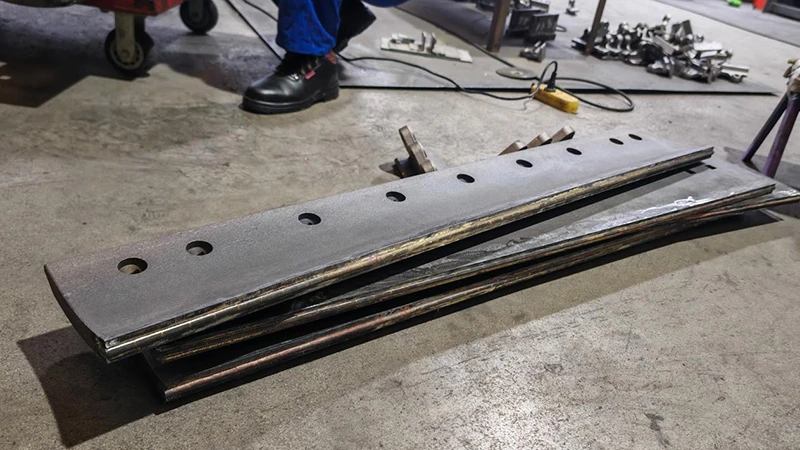
FAQ
What are grader cutting edges made of?
Most are a medium-carbon or boron-treated steel, supplied either through-hardened or with a hardness produced during rolling. Edges with carbide inserts are used where abrasion is severe and the surface does not present obstacles that would chip the inserts.
What types of cutting edge are used on graders?
Straight edges for general grading, curved or serrated profiles for cutting and mixing, and segmented edges where part of the blade has to be replaced without removing the whole section. The choice follows the work rather than the machine.
How heavy is a grader cutting edge?
It varies with the machine class, the edge thickness and the length of the section, which is why handling is part of the specification. An edge that is difficult to lift safely in the workshop will be changed less often than it should be.
When should a grader edge be replaced?
On measured wear rather than on hours or on appearance. Measuring the remaining edge depth at the points that wear first gives a replacement decision that can be planned, and rotation between positions can extend the interval before replacement is needed.
Send the machine, the pattern and the surface the grader maintains, and SENTHAI will recommend the profile, the section and the material for each machine in the fleet.