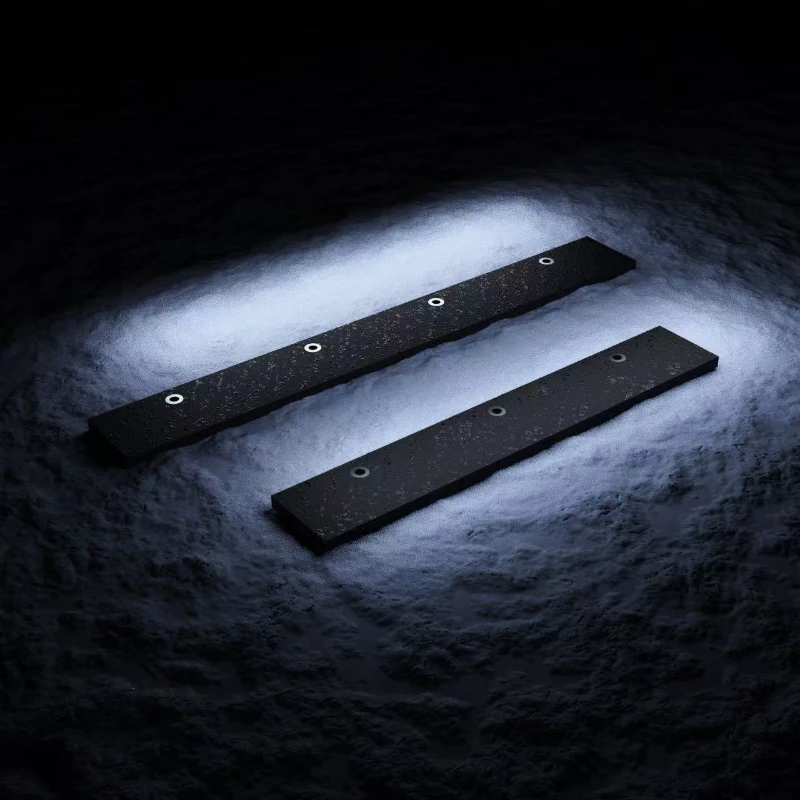
A blade comes into the workshop for a routine edge change and the fitter finds the body behind the edge has worn through in two places, both along the middle of the working width. The edge was replaced on schedule twice before that and the wear was never visible, because the plate that would have shown it was never fitted and the body was only ever measured at the ends, where it was still sound.
This is a field Q&A rather than a specification sheet. It covers what a wear plate actually protects, how thickness and material change the trade, how the plate interacts with a carbide edge, how to set a replacement interval from measurements, and the questions that get asked most often about fitting one.
What wear plates protect
A wear plate protects the blade body rather than the cutting edge, and the distinction is the reason the part is often left out of a specification. The edge is designed to wear and is replaced; the body behind it is not, and once it has worn through, the repair is a welding job or a new blade rather than a part change.
Wear reaches the body when the blade is run at a lower angle than the design intends, or when the surface is abrasive enough that material passes the cutting edge rather than being cleared by it. Once that happens, the loss is concentrated where the blade does the most work, which on most routes is the middle of the working width. That position is also the one least likely to be inspected, since a walk-around check tends to look at the ends.
Plow blade wear plate: what the plate is actually doing
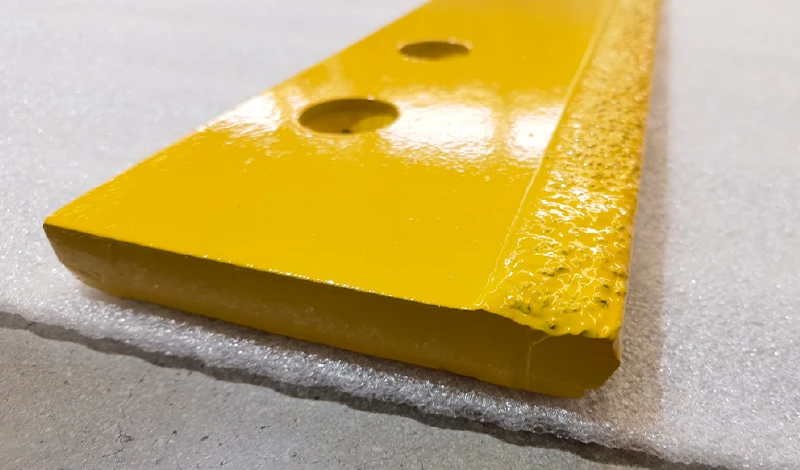
A wear plate protects the body behind the edge.
Functionally it is a sacrificial layer: a plate of abrasion-resistant material bolted to the blade body in the path of the material that would otherwise reach it. That converts a body repair into a part change, and it puts the wearing surface at a place where it can be measured at every service.
A second function, less obvious and sometimes more valuable, is that a plate stiffens the assembly behind the cutting edge, which changes how the edge is supported under load.
Those two functions are why the plate belongs in the specification rather than in the accessories list. Deciding to add one after the edge has been specified changes the support the edge gets, and the two parts should be chosen against the same route description.
Thickness options and trade-offs
Thickness trades life against weight and fixing load, and the useful figure is the one that outlasts the interval between edge changes rather than the one that lasts the longest in isolation. A plate that survives several edge changes has to be replaced less often, which matters; a plate so thick that it changes how the assembly loads its fixings is a different proposition.
Material choice moves alongside thickness and is often the more effective lever. An abrasion-resistant steel plate of moderate thickness usually outperforms a mild steel plate of greater thickness on the same duty, because the mechanism on a plow blade is abrasion rather than impact. Where impact is present — a route with regular raised ironwork — a thicker but softer plate can be the better answer, since it deforms instead of cracking.
Interaction with carbide edges
A carbide edge and a wear plate are not independent parts; the plate sits behind the edge and changes what the edge is supported by. Two effects follow. The plate changes the clearance between the cutting line and the body behind it, which affects how material flows past the edge rather than being trapped against it. And it changes the stiffness of the assembly, which affects how load is shared between the edge and the body at the point where the edge is bolted on.
The practical consequence is that a fleet changing from a plain body to a plated one should expect the wear pattern on the edge to change, at least in the first season. That is not a fault in either part; it is the assembly behaving differently, and it is why the two should be specified together rather than one after the other.
Measurement and replacement triggers
Replacement is decided by measurement against the minimum the assembly allows, taken at the point of greatest loss. The table below sets out what to measure and what each result means.
| Measurement | Result | Action |
|---|---|---|
| Remaining thickness at the worst point | Above the minimum the assembly allows | Record and continue |
| Remaining thickness at the worst point | At or below the minimum | Replace the plate before the body is exposed |
| Wear spread across the width | Even along the working width | The setup matches the route; use the rate to set the interval |
| Wear spread across the width | Concentrated in the middle or at one end | Check blade angle and mounting before ordering parts |
| Body condition beneath the plate | Pitting, deformation or contact marks | Inspect the body before refitting a new plate |
The last row is the one that catches a problem the plate has been hiding. A plate that has been moving on its fixings will leave polished or pitted marks on the body underneath, and refitting a new plate over that condition repeats the movement.
Fastener and fit considerations
A plate is only as effective as its fixing, and the sequence below is the one that keeps it seated.
- Check the body surface where the plate will seat, removing scale or high spots that would stop it lying flat.
- Confirm the bolt pattern matches the edge and the body together, since the plate is sandwiched between them.
- Torque in a sequence that works outwards from the centre, so the plate is not pulled to one end.
- Re-check the torque after the first shift, because the assembly beds in exactly as an edge does.
The second item is the one that causes most fitting problems. A plate that does not share the edge’s pattern must either be drilled to suit or excluded from the assembly, and a plate made to a slightly different pattern will fit at one end and not the other.
Cost per season comparison
The comparison between fitting a plate and leaving the body exposed is a cost per season rather than a price comparison, and it has three inputs. The plate and its fitting time. The edge wear rate, which may change. And the cost of a body repair or replacement, spread over the seasons it would otherwise have lasted.
The comparison is decided by how much body wear the route produces rather than by the plate price. On a route where the body is measured at every service and shows no loss, the plate is an additional part and an additional fixing load with nothing to protect. On a route where the body shows wear between edge changes, the plate is buying back a much larger cost. The wider framework for this kind of comparison is set out on the total cost of ownership page.
When to omit a wear plate
There are three conditions under which a plate is not worth fitting. Where the route produces no measurable body wear, because there is nothing for the plate to protect. Where the machine is at its limit for blade weight, since the plate adds mass at the front of the assembly. And where the assembly is already at the end of its life, because a plate fitted to a body that will be replaced next season does not repay its own fitting.
Each of those is established from records rather than judgement, which is the reason the plate decision belongs with the measurement routine rather than with the purchase list.
Three wear plate myths
Three beliefs about wear plates recur often enough to change what fleets buy.
- That a plate removes the need to measure the body. It does the opposite: the body has to be inspected whenever the plate comes off.
- That a thicker plate always lasts longer in service. It lasts longer in thickness terms, and it also adds weight and fixing load that can shorten something else.
- That fitting a plate protects the cutting edge. It protects the body; the edge still wears at the rate the surface dictates.
The third is the most common misunderstanding and the one that leads to disappointment. A fleet expecting longer edge life from a plate is measuring the wrong part, and the honest expectation is a longer body life with the edge unchanged.
Setting a replacement interval from your own records
The interval is set from the measurements rather than from a supplier’s estimate. Record the remaining thickness at each service along with the number of events the blade has worked, and the rate of loss becomes visible after a season. From that rate, the point at which the minimum is reached can be predicted, and the plate can be ordered into a planned service rather than discovered during one.
Two details make the record usable. Measure at the same positions each time, so the readings compare. And note the surface the machine worked, because the same plate on two routes produces two different rates and a single fleet average hides both. Measurement practice for the edge and the body together is described on the blade wear measurement page.
What to record
Four entries make the plate decision repeatable across seasons.
- The plate thickness at fitment and at removal, measured at the same positions.
- The number of events between those measurements, so the rate has a denominator.
- The condition of the body beneath the plate, including any marks indicating movement.
- The edge specification in use, since the plate and the edge are one assembly.
The fourth item is what links the plate record to the edge record, and keeping them together is what allows a change in one to be interpreted against the other. Material specifications for abrasion-resistant plate are published through ASTM International and ISO, and fleet maintenance practice through the Snow and Ice Management Association and the Transportation Research Board.
SENTHAI manufactures carbide and rubber-flex plow edges, wear plates and inserts in Rayong, Thailand, with the edge and the body protection confirmed together against the route. Network-level guidance on winter maintenance is published by the Federal Highway Administration, and assemblies that need the plate and the edge specified as one can be discussed through the contact page.
FAQ
Do plow blades need wear plates?
They need one where the blade body is exposed to abrasion behind the cutting edge. A body that is being worn down between edge changes is costing more than a plate would, and a body that only ever sees the edge contacting the road does not need the extra part or the extra fasteners holding it.
Is a thicker wear plate always better?
Thicker plates last longer and add weight and cost, and they increase the load the fixing has to carry. The useful thickness is the one that outlasts the interval between edge changes without making the assembly heavier than the machine was designed for.
Does a wear plate change how a carbide edge performs?
It can, because the plate changes the material behind the cutting edge and therefore how much support the edge has. Where a plate is fitted, it should be part of the assembly specification rather than an addition, so the edge and the plate are decided together.
How do I know when a wear plate needs replacing?
By measuring it against the minimum thickness the assembly allows, at the same service interval as the edge. Plates usually wear unevenly, so the measurement should be taken at the point of greatest loss rather than at the end where the plate is still sound.
Why does a wear plate wear faster in the middle?
Because the middle of the working width does the most work. On a crowned road the centre contacts first, and on a route with wheel-track compaction the middle of the blade is where the surface is hardest. That pattern is normal and is the reason the measurement is taken at the worst point.
Send the blade pattern, the edge specification and the body measurements between edge changes. The SENTHAI engineering desk will confirm whether a plate belongs in the assembly and what thickness suits the route.