The call that ends a private label experiment tends to arrive in February. Four sizes have not moved, the one size that does move is out of stock, and the packaging run that made the line economic is now the reason the range cannot be adjusted until spring.
None of those problems is a manufacturing problem. They are range, stock and commitment decisions taken in the autumn, and this is the sequence that gets them right.
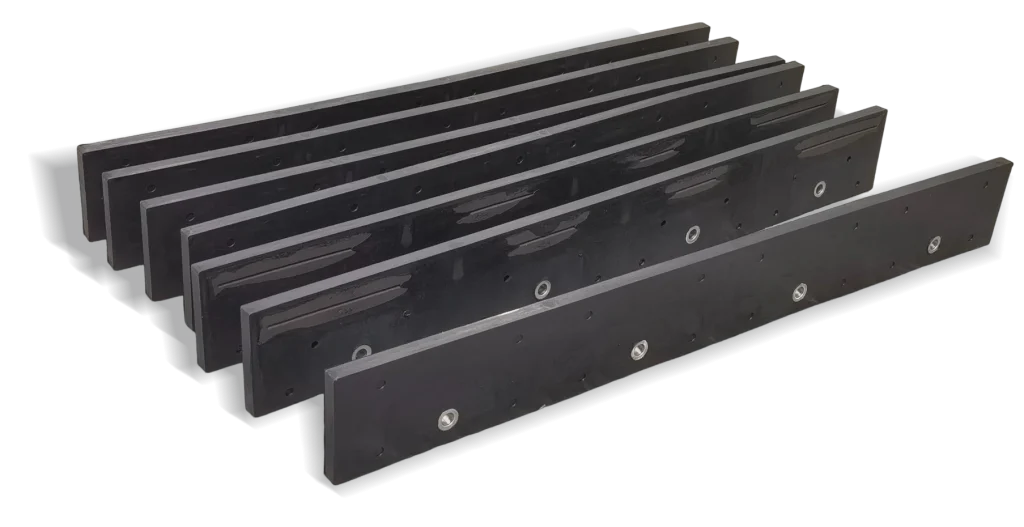
Private label snow plow blades: what the first season decides
A private label blade line is a range decision first.
The product is a standard catalogue edge; what the buyer actually builds is the size mix, the packaging and the terms behind it. Get the mix wrong and the brand never earns a second order, however good the artwork looks.
Private label sells on availability rather than on product difference. A customer buys the line because it fits the machine in the yard and because the dealer has it on the shelf the week the blade wears out. That leaves two failure modes, both of them visible from the size list: a range so broad that no size is stocked deep enough to serve, and a range so narrow that the customer’s second machine cannot be supplied at all.
Everything that follows works backwards from that. The range sets the packaging commitment, the packaging sets the minimum order, and the minimum order sets the working capital. A brand line is a stock plan with a logo on it.
Where a brand line fails in its first winter
Three failures account for most first seasons, and none of them is caused by the blade itself.
The first is a range copied from a supplier’s catalogue rather than from the local machine population. A catalogue is organised by product family, not by the machines a distributor actually sees, so a range built from it will contain sizes nobody nearby runs and omit the one a neighbouring fleet needs every year.
The second is a packaging commitment that outruns demand. Printed cartons are produced in print runs, and if the brand commits to branded cartons on eight sizes before any of them has sold, the working capital is locked into the slowest part of the range.
The third is stocking depth spread evenly. Winter demand is not evenly distributed, and a line holding four pieces of eight sizes will run out of the one that matters while the other seven sit on the shelf.
Product range decisions for a first line
A first range should be short enough to stock properly and wide enough to cover the machines the brand expects to see in its first two winters.
The practical way to build it is to work from the machines rather than from the catalogue. List the plow and grader models in the sales territory, note the edge length and bolt pattern each one takes, and group the models that share an edge. That produces a size list with a reason attached to every line, and it usually shows that a handful of sizes cover most of the population.
Cover the mount types rather than the lengths where the choice is forced. A line covering a front plow, an underbody and a wing in the common sizes is more useful to a contractor than one mount in eight lengths, because the second and third machines are usually a different mount rather than a different length.
Leave the long tail to special order, which keeps the range honest and the inventory convertible. Buyers who want to go deeper than a single catalogue can move individual sizes to a custom programme, described on the custom blade page, while the rest of the line stays catalogue.
Branding on edges, packaging and documents
Branding a private label line means deciding where the name appears, and the three locations have different costs and different permanence.
On the product, marking is stamped, cast or laser-applied and lasts as long as the blade. On the packaging, the name appears on a carton, a sleeve or an applied label, all of which are replaceable at the next order. In the documents it appears on the packing list, the installation sheet and the warranty card, which is the cheapest to change and the one a fleet clerk actually files.
The decision that matters is whether the brand is permanent enough to justify permanent marking. A distributor still testing whether the line will work should keep marking on the packaging, because a branded edge ordered in the wrong grade cannot be sold as an unbranded one.
Part numbering deserves the same care. A scheme mirroring the supplier’s internal numbers makes cross-referencing easy but leaves the brand dependent on that supplier; a scheme built from the fitment, the length and the mount survives a change of manufacturer, which is the change a growing line is most likely to make.
Quality specification to lock in
The specification behind a private label line should be written down and attached to the order, because the buyer’s name is on the product and the buyer carries the complaint.
Six things are worth naming explicitly, and each has a way of being checked when a delivery arrives rather than when a customer complains.
| Item | What to state | How it is checked |
|---|---|---|
| Edge dimensions | Length, width, thickness and tolerance | Measured against the reference drawing on receipt |
| Bolt pattern | The layout itself, not only the pitch | Trial fit on a machine, or a gauge plate |
| Material and grade | Steel specification and insert grade where applicable | Material declaration with each lot |
| Insert retention | Joining method and the inspection applied to it | Joint inspection result recorded per lot |
| Marking | Where the brand appears and what it says | Visual check against the approved sample |
| Documentation | The exact documents inside each shipment | Packing list reconciliation |
The second row causes the most returns. A bolt pattern described only as a pitch is ambiguous the moment hole sizes or edge offsets change, and the customer discovers the difference with the plow on the ground. Fleet bolt-pattern conventions reference the standards published by the American Association of State Highway and Transportation Officials, and the routine used to verify a delivery is set out on the quality control page.
Volume commitments and minimum order quantities
Volume commitments in a private label programme are usually two separate numbers wearing one label, and mixing them up is what makes a first order look impossible.
The first is the production lot: the quantity the plant runs to make the item economically. The second is the packaging commitment: the print run, the carton minimum or the label quantity. The production lot scales with the range and the second number scales with the number of branded lines, which is why the same product can be ordered in a small quantity under a plain carton and a much larger one under a printed carton.
Packaging is therefore the constraint a new brand should negotiate first. A plain carton with an applied label, or a single sleeve design that fits several sizes, removes most of the fixed quantity from the first order and leaves room to correct the range in the second season.
Warranty policy that can be defended
A warranty on a wear part is a statement about workmanship, not about life, and writing it that way is what makes it defensible.
Wear is the product’s job. An edge worn to its limit has performed correctly; an edge that cracked, delaminated, lost an insert or arrived undersize has not. A policy that separates those two categories can be honoured consistently, and it gives the dealer a script rather than an argument.
Three elements make a claim process workable: a definition of failure that names the defects covered, a claim route with a named party responsible for inspection and a decision window, and a statement of who pays freight in each direction. The terms SENTHAI publishes are set out on the warranty and shipping page, and they are a reasonable template for the language a brand line should carry.
Marketing claims and what to avoid
Claims are the cheapest part of a brand to write and the most expensive to defend, which is why the safe ones are usually the specific ones.
A claim that compares life, such as a multiple of a competitor’s service life, needs test data the brand probably does not have and cannot reproduce on demand. A claim that describes a specification, such as a stated carbide grade, a measured hardness range or an in-house joining process, is verifiable from the supplier’s documents and survives a challenge.
Comparative advertising rules differ by market and are enforced, so the wording should be reviewed before it goes into a catalogue. Guidance on substantiating claims is published by the United States Federal Trade Commission, the technical standards a claim can reference come from ASTM International and the SAE standards programme, and trade definitions across the winter maintenance industry are published by the Snow and Ice Management Association.
Choosing a manufacturing partner for a brand line
The supplier behind a private label line is chosen for consistency rather than for the product, because the product is already defined.
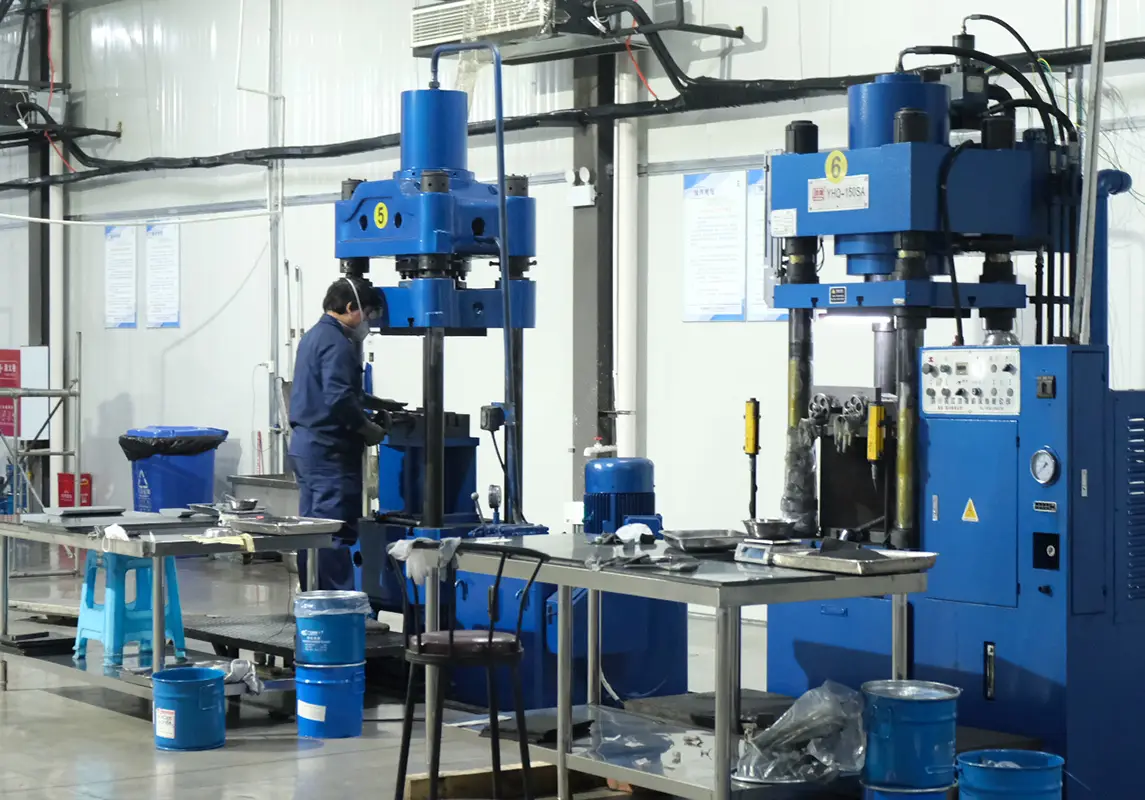
Four checks separate a partner from a source. The first is whether the key processes are performed in house, since a supplier that subcontracts the joining step has less control over the part of the product most likely to fail. The second is whether lot documentation exists as a routine output rather than as a special request, because the brand’s own quality claims depend on it.
The third is whether the supplier will accept a branded programme at the quantity the brand can actually commit to, including a plain-carton start. The fourth is whether the same partner can take a size to a custom specification later, so the range does not have to be split across suppliers as it grows. A plant with pressing, sintering, brazing and inspection on one site covers all four, and the process chain is described on the factory page.
The launch sequence from sample to first stocking order
The launch has an order to it, and following that order is what keeps the first season reversible.
- Approve a physical sample against the size list, with the bolt pattern trial-fitted.
- Confirm the written specification, including the documentation set, before pricing.
- Order a trial quantity in the launch sizes, using plain packaging if the range is not yet proven.
- Sell the trial, and record which sizes move and which sit.
- Cut the range to the sizes with demand and set the reorder point for each.
- Upgrade packaging and product marking on the proven lines only.
The fifth step is the one that gets skipped because it feels like admitting a mistake. Cutting a size that does not sell is the cheapest correction available, and it is only possible while the packaging is still plain and the stock is still liquid.
Terms that keep the line viable in year two
The second year is decided by three terms, and each can be written into the supply agreement while the volumes are still small.
The first is a price review mechanism: how often prices are reviewed, what triggers a review, and what evidence supports it. A programme with no review clause ends up renegotiating under pressure mid-season. The second is replenishment lead time and its effect on the reorder point, since a line that cannot be restocked inside a season has to be stocked deeper than its sales justify.
The third is change control on the specification. A supplier that improves a product without telling the brand has changed what the brand sells under its own name, and the brand will discover it from a customer. A written change process, with an approval step before a modified product ships, is the cheapest protection available, and model supply terms are published by the International Chamber of Commerce.
FAQ
How many sizes should a first private label range carry?
Start with the sizes the machines in your own customer base actually run, and expect that to be a short list. A first range of six to ten fast-moving sizes usually beats a full catalogue, because the packaging run and the stock investment both scale with the number of lines rather than with the volume.
Does private label mean the product has to change?
No. The blade is a standard production item and only the branding changes, which is what keeps the model cheap to start. What the buyer controls is the range, the packaging, the part numbering and the documentation set, not the profile or the carbide grade.
Who owns the brand and the artwork?
The buyer owns the artwork it supplies and should own the trademark it registers. The manufacturer owns the product design and any production tooling, including print plates made for the packaging. Confirming that split in writing prevents a dispute later over who may sell the marked product to whom.
How should a private label warranty be worded?
Define the failure the warranty covers and the period, and state that normal wear is excluded. Wear parts are expected to wear; a warranty that promises life instead of workmanship invites claims it cannot answer. The claim route also needs to name who inspects, who decides and who pays the freight.
Can packaging be changed after the first order?
Yes, but the cost sits with whoever ordered the print run. Cartons, sleeves and printed labels are made in minimum print quantities, so a reprint before the stock is used carries a set-up charge that a plain carton with an applied label avoids entirely.
Send the size list you intend to launch with and the machines it has to cover. SENTHAI will confirm which sizes can start on plain packaging, what the branded packaging commitment would be, and what lot documentation travels with each shipment.
This article is one step in the Sourcing Carbide Wear Parts Guide, which covers the technical pack, supplier selection, landed cost and supply risk.