Two slabs poured in the same year, on the same street, behave differently by the end of their third winter. One shows light scaling at the apron and nothing else; the other has a spalled edge over the reinforcement and a permanent rust stain down the face.
The difference is rarely the age of the concrete or the brand of salt. It is drainage, edge clearance and how much chloride the surface was asked to hold, and all three of those are decided by the site rather than by the supplier. This is the order in which a facility should work through them.

How freeze-thaw and chlorides attack concrete
Concrete fails in winter through two mechanisms that arrive together and are often blamed on one another.
The first is freeze-thaw. Water in the capillary pores expands as it freezes, and repeated cycles at the surface flake away the cement paste, which is why damage clusters on aprons, steps and anything that holds moisture. Air entrainment is the standard defence: the American Concrete Institute treats the air-void system as the primary resistance to freezing and thawing in a hardened mix.
The second is chloride attack. Dissolved chloride in the pore water depresses the freezing point of the water in the slab, so more of the pore water stays liquid and can migrate, and it also drives the corrosion of embedded steel once it reaches the reinforcement. Corrosion products occupy a larger volume than the steel they replace, so the slab lifts, cracks and spalls from the inside. The Portland Cement Association describes the same sequence in its guidance on de-icing salts and concrete.
Where the two overlap is where the worst damage appears: a cold, wet surface holding chloride, freezing and thawing repeatedly without ever drying out.
New concrete and the first winter
A slab in its first winter is more vulnerable than the same slab five years later, because the cement paste is still gaining strength and still holds more free moisture.
Standards and trade guidance commonly advise avoiding de-icing chemicals on young concrete through the first winter, and the reason is mechanical rather than bureaucratic. The mature paste is denser, the surface is harder and the pore structure admits less water and less chloride, so the same treatment that marks a new slab may leave an old one unchanged.
The practical consequence for a facility manager is that the first winter sets the baseline. If a new apron or a new walkway is going to be treated with chloride anyway because it is a public entrance, the specification should say so at handover, together with the curing and sealing regime that goes with it. Discovering the requirement in January leaves only mechanical clearing as an option.
Set the surface inventory before the season
The programme starts with a written list of surfaces, because the rules that follow are different for each one.
Walk the site in autumn, in daylight, and record what is actually there rather than what the drawings say. Work through the site in the order below and keep the result as a single document that the winter crew can read.
- List every surface that is treated: entrances, aprons, walkways, ramps, loading areas, service yards.
- Note the material for each one, and mark any slab younger than two winters.
- Note how each surface drains, where water stands, and where meltwater runs to.
- Mark the areas that are shaded or that sit under a drip line, since they refreeze first and thaw last.
- Record the acceptable level of service: bare and wet, or bare and dry, or a walking surface only.
What to check after this step is that the list is short enough to act on. A programme with thirty surface categories will be ignored at three in the morning; eight to twelve areas with clear names will be used.
Match the chemical to the surface type
Chemical choice follows the inventory, and the deciding variables are the temperature band, the material and the exposure.
On a sound, air-entrained, well-drained slab above roughly minus ten degrees Celsius, sodium chloride remains the least expensive option that works. Below that, a magnesium or calcium chloride product holds performance where sodium chloride has stopped, at a higher material cost. On natural stone, on older slabs with visible reinforcement and on metal fixings, the driver is corrosion rather than melting rate, and the chemistry with the lowest chloride load per square metre is the one that limits the damage.
Two rules follow. Do not spread a stronger product as a substitute for clearing, because the extra chloride arrives on the surface without a matching reduction in ice. And do not use one rule for the whole site, because the apron that holds water and the ramp that drains freely are not the same risk.
The environmental side runs in parallel with the structural one. Chloride that leaves the slab reaches soil and watercourses, and the Environmental Protection Agency records the freshwater effects of chloride loading for sites that drain to a stream or a planting bed. Where that exposure exists, the rate matters twice: once for the slab and once for what the meltwater carries away.
Make mechanical clearing the first defence
Every kilogram of ice removed mechanically is a kilogram that does not have to be melted, and that is the single largest lever on a concrete programme.
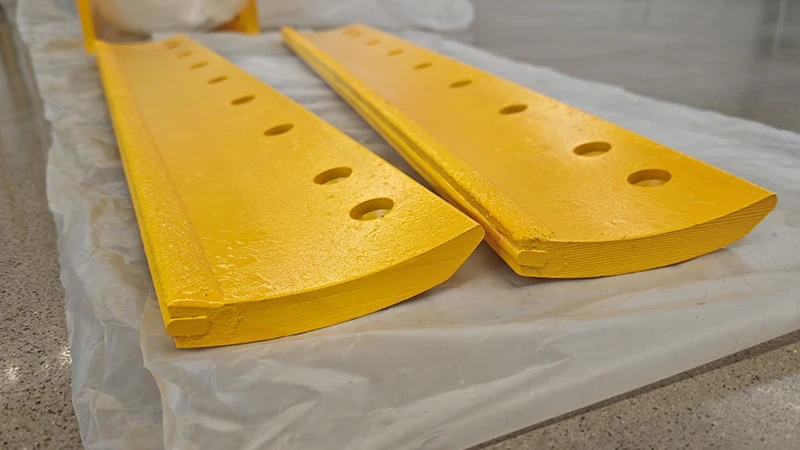
For a large apron the tool is a loader or utility plow, and the part of the tool that touches the concrete is the edge. A hard steel edge on a slab with a raised aggregate or a new surface marks it, while a rubber-flex or similar compliant edge follows the profile without cutting into it. That trade-off between clearing performance and surface protection is the subject of a separate SENTHAI note on carbide snow plow blades, and the same principle applies to the flexible edges used on pedestrian equipment.
Down-pressure and blade angle matter as much as the edge material. Enough pressure to clear, and no more, with a pitch that scrapes rather than digs, is what keeps a slab out of the repair budget.
De-icing damage concrete: what the specification should say
The specification decides the outcome.
For each surface in the inventory, the winter specification should name the material allowed, the application rate for the forecast temperature band, the equipment permitted, and the level of service that counts as complete. Anything short of that leaves the decision to whoever is holding the spreader.
Written that way, the document does two jobs. It tells a contractor exactly what to apply and where, which removes the argument about whether a surface was treated properly, and it creates a record that can be compared season against season. If scaling appears on one apron and not on another, the record shows the difference.
The rate matters more than the product name for a second reason. Chloride loading is a quantity, and a slab is harmed by the total chloride it holds over a winter rather than by the brand of the bag that delivered it. Reducing the number of applications, or the rate per application, is progress even when the chemistry stays the same.
Control drainage and refreeze
Meltwater that stays on the slab is the next application waiting to happen, so drainage belongs in the winter programme and not only in the civil drawings.
Clear the inlets and channel drains before the first event rather than during it, and check that the fall on each apron actually reaches an outlet. Where water has to cross a walkway to reach a drain, the walkway will refreeze first, and that is a case for changing the drainage rather than adding material.
Refreeze control is also where the order of operations shows. Clearing the bulk snow before it is walked into the surface, treating early with a small quantity rather than late with a large one, and removing the slush before the overnight drop all reduce the chloride the slab holds and the number of freeze-thaw cycles it sees.
Document conditions and damage for liability
Records serve two audiences, and both of them matter more than they appear to at the time.
The first is the claim that arrives after a fall. A dated record of the surfaces treated, the material and rate used, and the surface temperature at the time is the evidence that the site operated a reasonable programme. The second is the maintenance budget: photographs of the same three or four fixed locations each autumn are what turns a repair request into a measured deterioration curve rather than an opinion.
Keep the two records together. Application logs without surface photographs show effort, and photographs without application logs show only the result.
The measurement conventions behind those records come from ASTM International, which publishes the test methods used to judge de-icer effects on hardened concrete, and from the National Institute of Standards and Technology for reference measurement practice. Winter service documentation and site-level practice are covered by the Snow and Ice Management Association, and agency-level treatment practice by the American Association of State Highway and Transportation Officials.
Cost of getting the order wrong
The cost comparison is not salt against salt; it is the cost of a programme against the cost of a repair.
The terms below are the ones that move, and the reason the sequence matters is that the cheapest item at the top of the list changes what the expensive items at the bottom cost.
| Item | Driven by | Effect on the others |
|---|---|---|
| De-icing material | Rate, number of applications, temperature band | Falls when mechanical clearing improves |
| Clearing labour and equipment | Level of service, area, number of events | Rises with better service, but reduces material use |
| Slab repair and replacement | Drainage, air entrainment, chloride load over time | Set years earlier by the specification and the drainage |
| Slip claims and cleaning | Level of service, records, entrance design | Reduced by documented application and prompt clearing |
Written as a formula, the annual position is programme cost = material (P x R x N) + clearing labour + repairs + claim exposure. Sites that cut the first term usually transfer it to the third and fourth, which are an order of magnitude larger.
Mistakes that force a restart
The failures that force a programme back to the beginning are recognisable, and most of them are decisions made in the autumn.
- Treating the whole site to one rule, which over-doses the free-draining areas and under-treats the ones that pond.
- Buying a chloride-free product as a complete answer while leaving the drainage and the clearing unchanged.
- Sending a steel edge onto a young slab because it clears faster than the compliant alternative.
- Keeping no record of rates and temperatures, so nothing can be compared the following season.
FAQ
Is there an ice melt that is safe for new concrete?
No de-icing chemical is risk-free on a slab that is still gaining strength, which is the first winter or two after placement. The defensible approach is mechanical clearing with a soft or flexible edge, minimal chemical use, and a written record of what was applied.
Which ice melt is safe for concrete in general?
It depends on the concrete, the drainage and the exposure rather than on a single product. Chloride-free options remove the corrosion driver but not the freeze-thaw driver, so a well-drained, air-entrained surface treated sparingly will always outperform a ponding slab treated with any product.
Does sand or grit avoid the damage entirely?
Abrasives avoid adding chloride, and they create their own problem, because the material stays on the surface, has to be swept, and blocks drains if it is washed into them. They also do nothing to break the bond between ice and slab, so the slab still sees freeze-thaw cycles.
Is it worth sealing a slab before winter?
A penetrating sealer that reduces water and chloride ingress can help on a sound, well-drained slab, and it will not rescue one that ponds. Sealers also wear under abrasive traffic and need reapplication, so they belong in the maintenance plan rather than in place of one.
If a site needs to clear a slab more thoroughly without cutting into it, send the surface type and the equipment and SENTHAI will set out which edge profile suits the job.