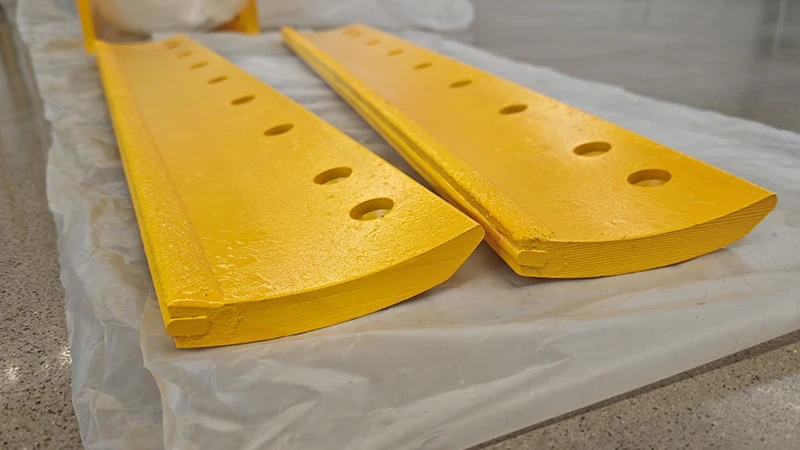
A 3.6 m plow edge carries a full row of insert positions, and the decision to reinsert or replace it turns on the condition of the steel underneath those positions rather than on the inserts themselves. Fleets that price the two options by comparing insert cost against edge cost are comparing the smallest part of each number.
This decision path works through the sequence a fleet actually faces: establish the condition thresholds that separate the two options, price both on the same basis, confirm the workshop can carry the rework, account for downtime, and only then release the money. Each step eliminates a class of wrong answer before the next one is reached.
What the decision actually turns on
Three inputs decide the outcome, and only one of them is about the inserts. The condition of the steel decides whether the edge can carry a new row. The condition of the pattern decides whether that row will sit where the design intends. The remaining life in the assembly decides whether the work will be spent on something with a season left in it.
Reading those three in that order matters, because each one can end the decision on its own. An edge with a bowed mounting line fails the first test regardless of how good the inserts are. An edge with elongated fixing holes at several positions fails the second. An edge that is sound in both respects but has been run for several seasons passes both and still needs the third question answered.
The reason fleets get this wrong is that the first two tests require a measurement and the third requires a record, and both take longer than looking up a parts price. The measurement is a straight-edge check along the mounting line and the pattern; the record is the wear measurement taken at removal, which is why the inspection routine at the end of the season decides what happens in the summer.
Replace inserts or whole edge: the condition thresholds
Reinsert while the steel and the pattern are still sound.
The practical threshold has three parts. The mounting line has to be straight along its full length when checked on a flat surface. The fixing pattern has to hold the hardware without elongation across several consecutive positions.
The pocket or seat grooves also have to be in a condition that will support the inserts they are about to receive. Where all three pass, reinserting is the cheaper path by a wide margin.
Two further conditions push the decision the other way even when the steel measures well. Where the edge has already been reinserted once and the second set failed earlier than the first, the base has been through a thermal cycle it was not designed for and the next set is unlikely to do better. Where the pattern has been repaired locally in previous seasons, the load distribution along the edge is no longer what the drawing describes, and the next failure will be in the repaired section.
Cost comparison per metre
Comparing the two options on cost per metre rather than per edge keeps the comparison honest when different edge lengths are in service. The table below sets out the elements each path carries.
| Cost element | Reinsert path | Replacement path |
|---|---|---|
| Inserts | Full row of inserts for the length | Full row, already fitted |
| Base plate | Retained | Replaced |
| Workshop labour | Removal, preparation, refitting and inspection | Removal and refit |
| Downtime | Set by the rework route and its queue | Set by the supplier’s lead time |
| Residual risk | Carried at the reworked joints | None beyond normal wear |
The third and fifth rows are where the comparison is usually decided, and the fourth is where it is usually mis-stated. A reinsertion that requires a controlled thermal cycle and a joint inspection is a workshop job, not a fitter’s job, and the queue for that work is part of the cost. Fleets that price the parts and the hours but leave out the queue reach a conclusion that does not survive the first busy month.
Workshop capability requirements
Whether the reinsert path is available at all is a capability question rather than a preference, and the three capabilities below are the ones that decide it.
- Bonding equipment able to reproduce the original joint, with the temperature and pressure recorded rather than estimated.
- Measurement equipment for the straight-edge and pattern checks, since the threshold test is a measurement rather than an opinion.
- A record system that ties each reworked edge to the inserts fitted, their batch reference and the measurements taken.
Where any of those is missing, the honest answer is that the rework goes back to the supplier or the edge is replaced, and pretending otherwise produces a blade that fails in the weather when there is no time to deal with it.
Downtime and scheduling effects
Downtime is the element that most often reverses the parts comparison, and it has to be priced in the same units as the rest of the decision. The relevant question is not how long the work takes but whether it can be done in a planned window. A reinsertion scheduled in a quiet month costs the workshop hours; the same work scheduled during a storm costs the route.
That is why the comparison should be run with the calendar in view. A replacement edge on the shelf is available when the failure happens; a reinsertion with a three-week queue is not, whatever it costs. Where the fleet intends to use the reinsert path, the way to make it work is to bring the edges in at the end of the season rather than at the start of the next one, so the rework queue never competes with the weather.
Handling damaged base plates
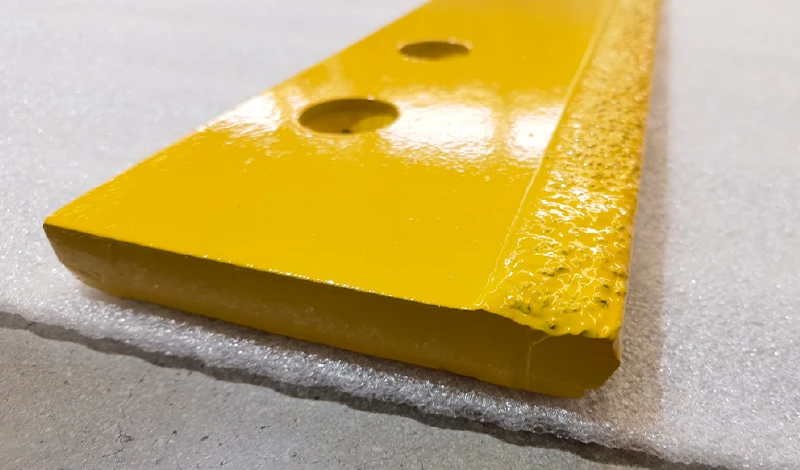
Base plate damage is the condition that most often ends a reinsertion programme, and it is worth being specific about which damage can be lived with. Elongated fixing holes at one or two positions can sometimes be resolved by changing the hardware rather than the plate, provided the surrounding pattern is sound and the wear measurement shows the edge has life left.
Damage that changes the geometry is a different matter. A bowed mounting line, a distorted pocket pattern or a plate that has been locally repaired in a previous season all change the load distribution along the whole edge. New inserts in a distorted plate will load unevenly, wear unevenly and produce a failure pattern that looks like a grade problem, which is how a fleet ends up replacing inserts twice and blaming the material. How to read that uneven wear is set out on the wear pattern page.
Warranty and traceability effects
A reinserted edge sits in a different position from a new one if something fails later, and the difference is worth writing down before the work is ordered.
- The manufacturer’s coverage on the original assembly does not extend to the reworked area.
- A later failure at a reworked joint is the reworking party’s work, whether that is the fleet or the supplier.
- Recording the inserts fitted and their batch reference is what allows any remaining claim on the rest of the edge to be argued.
- Where the edge goes back to the supplier, the written position on the reworked section should be agreed in the order rather than after a failure.
The fourth item is the one that saves an argument. It costs one paragraph in a purchase order, and it settles the question of who carries a second failure before anyone has an incentive to disagree about it. Batch records of the kind that make this workable are described on the quality control page.
Rotation as a third option before either decision
Before committing to either path, it is worth checking whether the wear distribution justifies rotating the edge instead. An edge whose inserts wear unevenly along the working width can sometimes be moved to a different position on the machine or reversed where the design allows it, which spreads the wear and extends the interval before the decision is needed at all.
The check requires only the wear measurement taken along the edge, which is the same record the decision is built on. Where the wear is concentrated at one end, rotation converts a reinsertion into a delay; where the wear is even along the length, rotation achieves nothing and the decision stands. Where an edge has been rotated already and still wears at one end, the cause is in the machine or the fitment rather than the edge.
Decision tree
Running the tests in this order resolves the question in a few minutes and produces a record of why the answer came out the way it did.
- Measure the mounting line for straightness on a flat surface and record the result.
- Check the fixing pattern for elongation at several positions, not only the worst one.
- Inspect the seat or pocket condition against the drawing tolerance.
- Where all three pass, price reinsertion against replacement per metre, including the queue.
- Where any of the three fails, move the edge into the replacement decision and record the reason.
The fifth step is what makes the programme manageable over several seasons. A fleet that records why each edge was retired eventually has a distribution rather than a series of individual judgements, and the pattern that emerges usually points at one machine or one route rather than at the material. Maintenance management practice for records at this level is published by the Federal Highway Administration, and the wider cost context by the American Association of State Highway and Transportation Officials and the National Association of Counties.
SENTHAI manufactures carbide inserts and plow edges in Rayong, Thailand, with the insert row and fixing pattern confirmed against the drawing before production, so a replacement edge arrives matching the one it supersedes. Fleet-level maintenance practice is published by the Snow and Ice Management Association, equipment specification practice by the Association of Equipment Manufacturers, and winter maintenance research by the Transportation Research Board.
Where the failure pattern suggests the steel rather than the inserts is the limiting factor, the causes of insert loss and how to trace them are set out on the insert loss page, and edges that need their condition assessed against a drawing can be reviewed through the contact page.
FAQ
Isn’t replacing inserts always cheaper than a new edge?
Only while the steel is worth reinserting into. Once the base plate is bowed, the fixing holes are elongated or the pocket pattern has moved, new inserts go into an edge that will still fail, and the labour is spent twice. The comparison is between two complete outcomes, not between two parts prices.
Do partially worn inserts have to be replaced all at once?
No, but a mixed row behaves differently from a uniform one. A single new insert set among worn neighbours stands proud, takes the impact first and wears faster than the row around it. Where the wear spread is small, replacing the whole row costs less than replacing the outlier twice.
Can a damaged base plate be repaired before reinserting?
Some conditions can be corrected and others cannot. Elongated fixing holes in a few positions can sometimes be resolved with hardware changes, but a bowed mounting line or a distorted pocket pattern changes the load distribution along the whole edge and is usually beyond economic repair. The measurement decides which case applies.
Does reinserting affect the warranty position?
It changes who carries the risk at the reworked section. The manufacturer’s coverage on the rest of the assembly is unaffected, but a reworked area sits in a different position if a later claim arises. Recording the inserts fitted, their batch reference and the measurements taken is what keeps that position arguable rather than assumed.
Send the edge length, the wear measurement along the row and the condition of the fixing pattern. The SENTHAI engineering desk will confirm whether the steel will carry a new insert row and what the replacement would need to match.
This article is one step in the Carbide Insert Selection and Replacement Guide, which covers grade, geometry, spacing, fitment tolerance and the replace-or-re-plate call.