The roads that ice first are not the coldest ones on the route. They are the bridge, the shaded cutting, the section under the tree line and the approach where meltwater crosses the carriageway after the temperature has already dropped.
(Last modified date: November 12, 2026)
Timing follows from that. The treatment that prevents a bond has to be on the surface before the surface reaches freezing, which means the decision is made from a forecast and a pavement temperature trend rather than from what the crew can see at the time. This is the order in which to build that routine.
Road icing in one minute: three readings that predict it
- Pavement temperature at or below 32°F (0°C), which can happen while air temperature is still above freezing.
- Pavement temperature at or below the dew point, which means moisture from the air can deposit as frost or black ice.
- Freeze point of the surface solution close to pavement temperature, which means earlier treatment has been diluted.
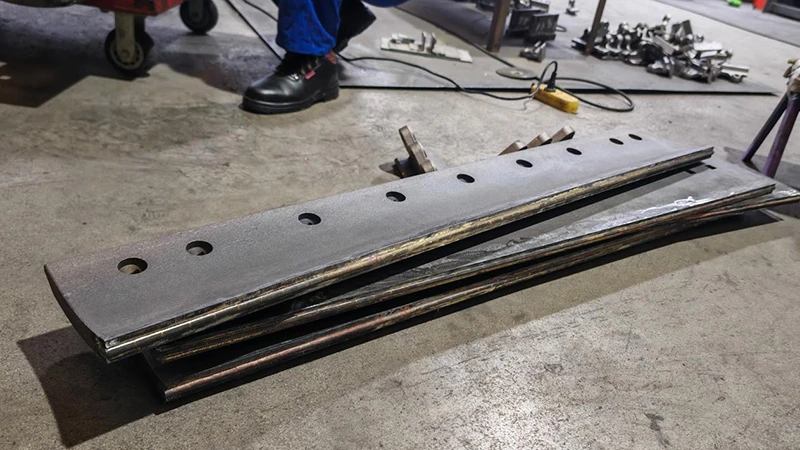
Pavement sensors on road weather stations report these values; the U.S. FHWA describes them in its road weather surveillance guidance. Sensor types are covered in winter road maintenance sensors. Anti-icing has to go down before precipitation or frost; once ice is bonded, plow first with a suitable edge such as a packed ice carbide kit.
Conditions that create black ice
Black ice forms when a thin film of water freezes on the pavement, and the conditions that produce it are a small, recognisable set.
The most common is a drop in pavement temperature across the freezing point while moisture is present, either as rain, as drizzle, as fog or as meltwater from an earlier event. A clear, calm night after a wet day is the classic pattern, because the surface radiates heat away and cools faster than the air above it. The second pattern is warm air over a cold surface, where moisture condenses onto pavement that is already below freezing.
What makes the hazard difficult is that the layer is thin, transparent and local. It forms where the surface is coldest rather than where the air is coldest, and it is invisible from a vehicle. The three locations that produce the majority of reports are bridges and elevated structures, shaded sections that never see the sun, and low points or crossings where water runs and then stands.
Forecast inputs that matter
The inputs that decide a treatment window are pavement temperature, its trend, the moisture that is available and the wind.
Air temperature alone is the weakest of the four, because the surface is what freezes. Pavement temperature and its direction of travel tell you how much time remains before the surface reaches the freezing point, which is the number the decision turns on. Moisture tells you whether there will be anything to freeze, and wind matters in both directions, because it mixes the air and slows radiative cooling on a calm night while driving spray onto a surface on an exposed route.
Forecast and observation products covering temperature, wind and precipitation are published by the National Weather Service, and the road weather programme that turns those products into route-level guidance is described by the Federal Highway Administration. What a fleet needs from both is the timing band and the confidence, rather than a single number.
Anti-icing windows before precipitation
The anti-icing window is the period before the hazard forms, and it closes earlier than most crews expect.
Work through the sequence in this order, because each step changes the answer for the next one.
- Read the pavement temperature and its trend for each route segment, not the air temperature for the region.
- Identify when the surface is forecast to cross the freezing point, and treat that time as the deadline rather than the forecast start of precipitation.
- Check for moisture already present, including residual meltwater from the previous event, because that water only has to freeze rather than to arrive.
- Choose the material and rate from the temperature at the time of application, using a liquid or pre-wetted product where the surface is close to the limit of a solid.
- Apply before the deadline, allowing for the time the route takes, and record the surface temperature at the moment of application.
Step five is the one that decides whether the window was actually met. A route that takes four hours to complete has to start four hours before the surface is due to reach freezing, which is a planning problem rather than an application problem.
Bridge decks and shaded areas
Bridges and shaded sections are not variations on the rest of the route; they are different sites that need their own timing.
A bridge deck loses heat from its underside as well as its top, so it cools faster and stays colder for longer than the adjoining approach embankment, which is warmed from below by the ground. Shaded sections behave in the same direction for a different reason, because they miss the daytime solar gain that resets the surface temperature elsewhere. The result is that the treatment which works on the open carriageway can be applied too late on the structure that sits inside it.
The practical response is to treat bridges and known shaded sections first, or as a separate pass with their own rate, and to record them separately in the treatment log. Where a route is instrumented, a station on the structure is worth more than a station on the open road.
Treatment records and verification
Records are what turn a treatment decision into something the fleet can review and improve.
For each event, the record should carry the route segment, the pavement temperature and trend at the time of application, the material and rate, the time of application, and the observed outcome afterwards. Those five items are enough to answer the two questions that follow every winter: whether the treatment went on soon enough, and whether the rate was right for the conditions.
The verification side is often skipped. A short drive along the treated route once the hazard window has passed, with the surface temperature recorded at the same points, shows whether the material held. Without it, a programme repeats the same rate indefinitely and cannot tell a timing failure from a rate failure.
The cost of treating late
Treating late changes the job rather than the schedule, and the difference is measured in material and in hours.
Prevention puts a film between the pavement and the ice, so a modest rate of material holds a route for hours. Once the ice has bonded, the same surface requires enough material to break the bond, more passes to distribute it, and a mechanical pass to remove what remains, all of it at a time when the network is at its busiest.
Written as a formula, the comparison is cost per event = material (P x R) + passes x hours + treatment time x route hours, and the late case raises all three terms at once. The other cost is exposure: the hours between the bond forming and the route being cleared are the hours in which the incident risk sits on the road.
Road icing prediction: building the decision routine
Road icing prediction narrows the window, not the risk.
A forecast gives a probability and a timing band for a hazard at a given point, and the operational decision is what to do inside that band. The gap between the two is made up by the pavement temperature trend, the surface state and the material still on the road from the previous event.
A workable routine has three parts. A written rule that maps the pavement temperature trend and the moisture forecast to a material and a rate, so the decision does not depend on a supervisor’s memory. A defined deadline for each route, calculated backwards from the forecast crossing point and the route duration. And a post-event check that records whether the treatment held, which is what allows the rule to be adjusted before the next season rather than during it.
The rule should also say when not to treat. A surface that is dry and warming, with no moisture forecast, does not need material, and a routine with no such row converts every forecast into an application.
The order of operations on the night
Once the rule is written, the night itself follows a fixed order, and holding to it is what keeps the deadline achievable.
Load and calibrate before the window opens rather than during it, because a spreader calibrated in the yard applies the rate the rule assumes. Then work the priority order below, which places the fastest-cooling surfaces ahead of the general carriageway.
- Structures and elevated sections, treated as their own pass with their own rate.
- Known shaded sections, low points and drainage crossings.
- Priority routes and gradients, in the order the network plan sets out.
- The remainder of the network, if the window allows, before the surface reaches freezing.
After the pass, the record goes in before the shift ends, while the surface temperatures are still known rather than reconstructed the following day.
Mistakes that put a shift behind
The routine fails in the same few ways each winter, and each one is avoidable in advance.
- Waiting for visible ice, which means the bond has already formed and prevention is no longer possible.
- Treating the whole route to one rate, which under-serves the bridge and over-doses the open carriageway.
- Starting a long route after the window has opened, so the first segment is treated on time and the last is not.
- Leaving the treatment record to the end of the shift, when the surface temperatures can no longer be recalled accurately.
Winter service practice for commercial and municipal operations, including documentation of treatment decisions, is published by the Snow and Ice Management Association and the American Association of State Highway and Transportation Officials. Test methods for the materials involved come from ASTM International.
FAQ
Can roads still be icy at 40 degrees?
Yes. An air temperature of 40 degrees Fahrenheit describes the air, not the pavement, and a surface that lost heat overnight can sit below freezing while the air above it has already warmed. Bridge decks and shaded sections are the usual places where this shows.
At what temperature do roads get icy?
Ice forms when the pavement surface reaches freezing, which can happen with an air temperature several degrees above it. Moisture, a clear sky and a light wind matter as much as the thermometer, so the practical answer is to watch the surface reading and its trend rather than a single air temperature.
Are roads icy at 34 degrees?
They can be, particularly on a bridge, in a shaded cutting or where meltwater has run across the carriageway while the surface was still below freezing. At that temperature the refreeze risk is the one to watch, because the water is already on the road and only the surface needs to fall.
When should anti-icing treatment be applied?
Before the precipitation arrives and before the surface reaches freezing, so that the material is already in place when the hazard forms. Applying after the ice has bonded to the pavement turns a prevention job into a removal job, which needs more material and more time.
What causes road icing when it is not snowing?
Frost and black ice form when the pavement is at or below freezing and at or below the dew point, or when meltwater refreezes on bridges and shaded sections.
If a route keeps needing a second pass inside the freezing window, send the route profile and the equipment and SENTHAI will set out where the blade specification is slowing the first pass down.