A scraper’s cutting edge and the liners behind it protect the same machine in two different ways. The edge breaks the bond with the ground, and the liners take the sliding abrasion that follows the material through the bowl. Specifying one and leaving the other is how a fleet ends up repairing structure.
The decisions run in a sequence, and each one is made from the duty rather than from the parts list. This is that sequence.
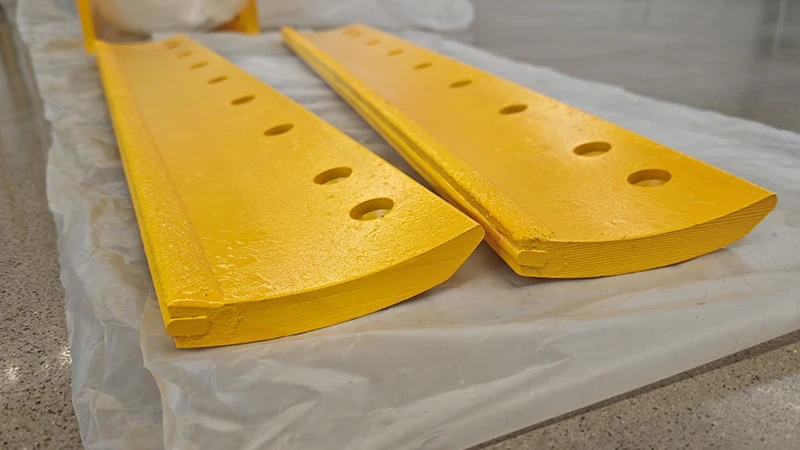
Scraper blades: what the selection turns on
Three variables decide the specification on a scraper.
The material being moved decides the wear mechanism, the machine’s duty cycle decides how much of that wear happens per hour, and the maintenance model decides whether the answer is a replaceable part or workshop work.
The variables usually point in the same direction. A fleet moving abrasive sand or gravel cuts through wear parts quickly, which favours replaceable protection that can be changed in a shift. A fleet moving softer material with plenty of workshop capacity can afford to build up surfaces and use the time between overhauls differently.
What the sequence prevents is a specification that optimises one surface while leaving another to wear into the structure. On a scraper, the bowl floor and the apron are usually the expensive surfaces, and the cutting edge is the cheap one.
Scraper cutting edge duty
A scraper cutting edge works under a different load from a loader edge, and the difference shapes the material choice.
The edge is pushed into the ground and lifts the material as the machine moves, so it carries a cutting load across its full width rather than a digging load at a few points. The wear is therefore more even than on a bucket, and the impact is generally lower because the machine is moving into undisturbed material with a continuous cut rather than loading broken rock.
That combination favours an edge with good abrasion resistance and moderate toughness, and it makes even wear the property to design for. It also means the edge’s condition can be assessed from a straight measurement along its length rather than from a careful inspection of individual points.
Bowl and apron wear surfaces
The bowl and apron are where the material slides, and sliding is what consumes them.
Material entering the bowl is dragged along the floor and past the sides, and the apron controls how it is released. Those surfaces see continuous abrasion at a pressure lower than the cutting edge’s but over a much larger area, which is the condition that makes liner protection worthwhile.
| Surface | What it is exposed to | Protection that suits it |
|---|---|---|
| Cutting edge | Cutting load across the full width | Hardened edge section, replaced on measurement |
| Bowl floor | Sliding abrasion over a large area | Replaceable liner plates |
| Bowl sides | Sliding abrasion with some impact at the top edge | Liner plates, with heavier protection at the lip |
| Apron | Material passing during discharge | Liner plates sized to the apron geometry |
| Ejector or push-off face | Sliding contact during discharge | Liner plates, replaced when worn through |
Read as a set, the table shows why liner programmes are usually specified as a package. Protecting the floor and leaving the apron bare simply moves the wear to the next surface and the repair to the workshop.
Wear liner materials and thickness
Liner material is chosen for abrasion resistance, and thickness is chosen for how long the fleet wants the interval to be.
Abrasion-resistant plate is the common answer, in a thickness that reflects the severity of the duty and the acceptable replacement interval. Heavier plate lasts longer and adds mass; thinner plate is easier to handle and is replaced more often. On a surface where access is difficult, the heavier option is usually the better trade because the labour dominates the cost.
The attachment method is part of the material decision. Bolted liners can be replaced individually and rotated, while welded liners give a continuous surface with no fixings in the material path. Which suits depends on the surface and on how the fleet maintains it.
Replaceable versus hardfaced options
Replaceable liners and hardfacing solve the same problem in different ways, and the choice follows the maintenance model.
A replaceable liner is a part change: it can be planned, it takes a known amount of time, and it returns the surface to a known thickness. Hardfacing is workshop work that rebuilds the existing surface, and it requires a procedure, a suitable alloy and control of the heat input.
| Consideration | Replaceable liner | Hardfaced surface |
|---|---|---|
| Where the work happens | In the field or a workshop bay | In a workshop with welding equipment |
| Interval predictability | High: thickness at replacement is known | Depends on the procedure and the operator |
| Effect on the base surface | Protects it while fitted | Becomes the surface, and can be reapplied |
| Cost driver | Plate, fixings and labour | Alloy, labour and machine downtime |
Fleets with workshop capacity often use both, on different surfaces: replaceable liners where access is good and thickness is easy to measure, hardfacing where the geometry is awkward and a bolted plate would be difficult to fit.
Inspection intervals by hours
Inspection intervals work when they are set from the fleet’s own wear rate rather than from a default period.
The sequence below establishes that rate and turns the inspection into a planning tool.
- Measure the liner thickness at the same points on each surface at every service.
- Record the hours run against the measurement, not only the date.
- Establish the rate of loss per hundred hours from two consecutive measurements.
- Set the next inspection at the point where planning a change is still possible.
- Note any surface wearing faster than the others, and check the material flow that explains it.
The fifth step is the one that reveals a design or operating issue rather than a materials one. Where one apron or one side of a bowl wears faster than the other, the material is not flowing as the machine was designed for, and no change of plate corrects that.
Downtime cost avoided
The value of a liner programme appears in the downtime it prevents rather than in the wear it resists.
A planned liner change takes a known number of hours and happens between jobs. The same wear reaching the structure turns into a fabrication repair, which takes longer, needs a workshop and arrives without warning. The difference between the two is the number the programme is built on.
It also explains why heavier liners often win on cost even though they cost more. The comparison is between plate and a repair, and the repair carries the machine’s idle hours as well as the welding.
Specifying replacements
A specification for replacement liners and edges is easiest to maintain when it is written per surface.
The items below are the ones a supplier needs, and the ones that prevent a delivered part from requiring modification on site.
- The surface the part protects, and the machine it belongs to.
- The pattern and fixing arrangement, taken from the machine rather than a worn plate.
- The plate thickness and material, with the hardness range required.
- The edge section and profile, where the item is a cutting edge.
- The documentation that should travel with the delivery.
Where liner protection is placed wrong
Liner programmes fail in the same three ways, and each is visible before the plates are ordered.
The patterns below are the ones worth checking against a proposed liner layout.
- Protection fitted where wear is expected rather than where the worn surface shows it occurs.
- Fixings placed in the material path, where they wear faster than the plate they hold.
- Coverage that stops short of a transition, leaving the adjacent surface to wear into the structure.
The third item is the most expensive. A liner that ends a short distance from a corner or a joint protects the area that was easy to cover and leaves the area that decides the repair.
Matching the liner to the machine
The machine sets the geometry and the material sets the grade, and neither should be decided from the other.
Plate thickness has to be compatible with the fixings and with the clearance the machine needs, and the pattern has to come from the surface being protected rather than from the plate being replaced. Material and test standards that a specification can reference are published by ASTM International and the American Society of Mechanical Engineers, with measurement practice published by the National Institute of Standards and Technology. Equipment conventions come from SAE International and the American Association of State Highway and Transportation Officials, and manufacturer practice is documented by the Association of Equipment Manufacturers.
FAQ
What are the different types of scraper blade?
There are two distinct families: the cutting edge on an earthmoving scraper’s bowl, and the replaceable blades used in hand tools and finishing work. This article deals with the machine cutting edge, which is specified by the same logic as any other earthmoving wear part.
What does a scraper blade do?
On a machine it cuts and lifts material into the bowl, and it is the part that has to break the bond between the material and the ground. That is why its duty is dominated by cutting load rather than by sliding abrasion alone.
Are replaceable liners worth it compared with hardfacing?
They answer different maintenance models. Replaceable liners are a parts change that can be planned and performed quickly, while hardfacing is workshop work that extends the life of the existing surface. Fleets with workshop capacity often use both, on different surfaces.
How often should wear liners be inspected?
On hours, with the interval set by how fast the surfaces wear rather than by a default. Measuring the liner thickness at the same points each time shows the rate, and the rate is what tells the fleet when the next change is due.
Send the machine, the surfaces and the material being moved, and SENTHAI will propose an edge and liner package sized to the duty and the maintenance model.