The route that took six hours in December takes nine in February, and nothing about the equipment has changed except the edges. Same trucks, same operators, same 40 kilometres of road.
What changed was the rate at which each pass removed material, which is the number capacity planning runs on. A route estimate built from last season’s timings will be wrong in the direction that hurts, and this is how to build one from the terms that actually move.
What production rate means in practice
Production rate is the distance of road a machine can treat in a unit of time at a defined level of service, and every word in that definition changes the answer.
Distance per hour is the base measure, but it means little unless the level of service is attached. A machine that clears a lane and leaves a residue travels faster than one that has to clear to bare pavement, and the second machine is doing more work with the same equipment. The definition also has to state the storm it applies to, because the number of passes a route needs grows with accumulation and with the way the snow bonds to the surface.
The practical version of the definition therefore has three parts: a distance, a service level and a storm condition. An agency that states its capacity without the second and third is describing a best case, which is why capacity estimates built that way tend to be met in a light winter and missed in a real one.
Inputs: width, speed, passes and deadheading
Four terms produce the route estimate, and each one can be measured rather than assumed.
Blade width, combined with the overlap the operator leaves between passes, gives the effective swath. Working speed is set by the surface, the traffic and the machine, and it falls as conditions deteriorate. The number of passes depends on the storm and the service level, and it is usually one and a half to two passes across a two-lane road once overlap and windrow handling are counted. Deadheading is the time spent travelling to and from the route and between sections, and it is the term most often left out of an estimate because it produces no visible work.
The four terms interact rather than add. A wider blade reduces the number of passes for the same road but lowers the speed the machine can hold, and a second pass after a heavier accumulation costs more time than a slower single pass through the same depth. That is why capacity planning is a calculation rather than a rule of thumb.
The machine side of the calculation, including the conventions for equipment mounted on winter service vehicles, is published by SAE International.
Snow plow production rates: the four terms that decide capacity
Capacity is width times speed, less passes and deadhead.
A plow removes a swath as wide as its blade, at the speed the surface allows, so the base rate is a simple product. What reduces it in practice is the number of passes a storm requires and the deadhead distance between the route and the yard.
Written as a formula, the route time is hours = (lane kilometres x passes) / (effective swath x working speed) + deadhead hours, with the service level deciding the number of passes and the surface conditions setting the working speed. Every term in that expression is measurable from a fleet’s own records, which is what makes the estimate defensible.
The useful property of the formula is that it shows which lever is worth pulling. On a long rural route, working speed and deadhead dominate, so adding a wing or a wider blade helps. On a short urban route with a low working speed, the number of passes and the traffic dominate, so a better cutting edge that removes more in one pass is worth more than a wider blade.
Storms versus service levels
The same route has several different capacities, one for each combination of storm and service level, and planning against a single number hides that.
A light continuous snowfall may be handled in a single pass with a light application of material afterwards. A heavy wet snowfall needs two passes, a slower working speed because of the weight being pushed, and a different treatment because the surface beneath is wet rather than dry. A freezing rain event is different again: the accumulation is small and the treatment is slow, because the objective is to prevent a bond rather than to push material aside.
The practical structure is a small table of route times by condition, built from observation after the first season. That table is what allows a supervisor to decide at three in the morning whether the network is completable, and it is the document that converts a capacity plan from a budget line into an operating instruction.
Equipment reliability effects
Reliability reduces capacity in a way that a rate calculation does not show, because the loss is in availability rather than in speed.
The measure to use is the fraction of the fleet available at the start of an event. Two units out of twelve is a sixteen per cent loss of capacity before the first kilometre is plowed, and the shortfall lands on the routes those units were assigned to rather than being spread evenly. Planned maintenance and pre-event checks are therefore capacity measures rather than workshop housekeeping, and the number to track is the count of units that fail a pre-event check.
The second reliability effect is unplanned repair during an event. A hydraulic failure or a lost edge takes a unit out at the moment when the network is at its busiest, and the recovery time includes finding the unit, moving it and repairing it. Fleets that record this separately usually find it accounts for a meaningful share of the hours they had attributed to weather.
Blade condition as a capacity variable
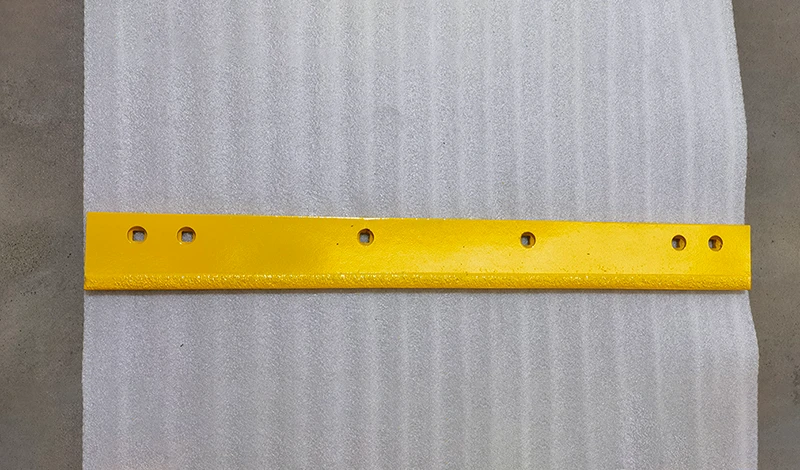
The cutting edge is a capacity component, not only a wear part, because it decides how much material each pass removes.
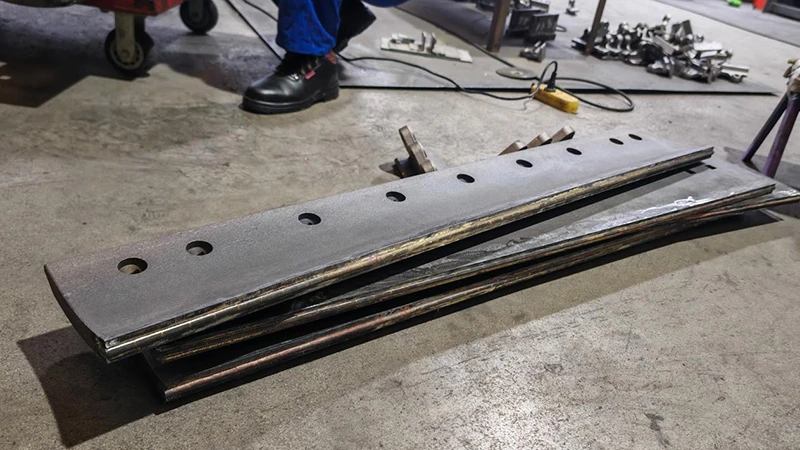
A worn or rounded edge rides over packed snow instead of cutting it, which leaves a layer that has to be removed by a second pass or melted with material afterwards. Both of those cost route hours. A carbide edge that holds its profile through a season keeps the single-pass assumption valid for longer, and the effect on route time is often larger than the difference in edge price.
Two measurements make the effect visible. Record the number of passes actually made per route per event, and record the edge condition at the start of each event. Where passes rise as edge wear increases, the capacity loss is attributable to the edge rather than to the storm, and the replacement interval can be set from that evidence. The edge options and their profiles are set out in the carbide snow plow blade range.
Worked capacity example
A worked example makes the arithmetic concrete, and the numbers below are placeholders to be replaced with a fleet’s own measurements.
Follow the sequence to build a route estimate from the four terms.
- State the route: total lane kilometres to be treated, including shoulders if they are cleared.
- Record the effective swath, which is the blade width less the overlap the operator leaves.
- Record the working speed the route actually supports in the conditions being planned for.
- Set the number of passes for the storm and service level, and multiply by lane kilometres.
- Add the deadhead time to reach the route from the yard and to return.
- Divide the distance to be covered by the product of swath and speed, then add deadhead, to give route hours.
The result is a single number for one route in one condition. Running it for each route produces the network total, and comparing that total against the shift length is what identifies whether the network can be completed within one cycle or needs a priority order.
Planning for extreme events
Capacity planning is most valuable in the case where the network cannot be completed, and that case needs a policy rather than an estimate.
| Term | Behaviour in a heavy event | What it means for the plan |
|---|---|---|
| Effective swath | Roughly constant, but windowing reduces it | Wider equipment helps less than expected |
| Working speed | Falls with depth, weight and visibility | The largest single loss in capacity |
| Passes | Rises with accumulation and bonding | Doubling passes halves the route rate |
| Deadhead | Rises where the route itself is congested | Repositioning costs more than travel from the yard |
Two decisions belong in the plan before the event. The first is which routes are treated first when the network cannot be completed, stated as a published priority order rather than as a judgement made in the cab. The second is what is deferred, because a plan that does not name what will not be done is not a plan. Public agency practice for these decisions is documented by the American Association of State Highway and Transportation Officials and by the Federal Highway Administration, and commercial site practice by the Snow and Ice Management Association.
The severity record that sets the expected event frequency comes from the observed conditions for the area, which are published by the National Weather Service.
What changes capacity fastest
Ranked by effect per unit of cost, the levers are not the ones a capital budget usually reaches for first.
- Edge condition, which protects the single-pass assumption at a small fraction of a machine’s cost.
- Availability, because a unit that fails a pre-event check removes capacity before the event begins.
- Deadhead, which can be cut by repositioning equipment ahead of a forecast event.
- Route design, because a route that turns back on itself adds distance without adding treated road.
Rate questions buyers ask
Three questions recur in pricing conversations, and each one needs the conditions attached before a number means anything.
The first is what the going rate for plowing is. Rates are quoted per event, per hour or per season, and the three are not comparable without the service level and the event definition, because a per-event price with a low trigger and a generous service level is a different contract from the same headline rate with the opposite terms. The second is the profitability of a plowing business, which is decided by contract structure rather than by market rate: a fixed seasonal fee earns more in a mild winter and can lose money in a severe one, and per-event billing does the reverse. The third is how long it takes to clear a given area, which is the capacity calculation above and cannot be answered from a general figure.
The defensible answer to all three is the same: build the rate from the route capacity, the equipment and labour per pass, and the material the route needs, and state the conditions the number assumes.
Costing a route from its capacity
Once route hours are known, costing the route is a short sequence, and it produces a figure that can be defended in a tender.
Work through the terms below in order.
- Route hours per event, from the capacity calculation for the conditions being priced.
- Equipment cost per hour, including ownership, fuel, maintenance and the consumable edges and studs.
- Labour cost per hour, including overtime and call-out provisions.
- Material cost for the event, from the rate the service level requires.
- Event frequency expected across a season, from the agency’s own severity record.
The result is a cost per event and a cost per season that rest on measured terms. Beside it belongs the sensitivity that matters most to the contract: what happens to the cost if the number of events is twice the expectation, which is the question a fixed-fee contract has to survive.
| Term | What moves it | What the fleet controls |
|---|---|---|
| Route hours | Working speed, passes, deadhead and edge condition | Edge specification, pre-event positioning, route design |
| Equipment cost per hour | Machine class, fuel, maintenance interval | Fleet mix and the maintenance interval itself |
| Consumable cost | Edge wear rate, stud wear, hardware replacement | Edge material and the replacement interval |
| Material cost | Service level, temperature band, clearing quality | The number of passes and the edge condition |
Contract structures that price capacity
How a contract prices capacity decides who carries the risk of a severe season, and the choice is explicit rather than technical.
A fixed seasonal fee prices the capacity itself and transfers the event-count risk to the contractor, which is why it is defensible only when the fee is built from a capacity calculation and a severity record. Per-event pricing transfers the risk back to the client and rewards a fast route, which changes the incentive to keep edges and equipment at their best. Hourly pricing sits between the two and is most common where the scope cannot be defined in advance.
Whichever structure is used, three items belong in the document: the service level, the event definition that triggers work, and the capacity the contractor is expected to deliver. Without the third, the contract prices an intention; with it, a shortfall can be measured and a severe season can be handled as a commercial question rather than a dispute. Operational practice for these arrangements is covered in the material published by the Snow and Ice Management Association.
FAQ
How long does it take to plow a kilometre of road?
It depends on the number of passes, the working speed and the blade width, and on the deadhead distance to reach the route. The estimate that matters is built from those four terms for the specific road rather than taken from a general figure for plowing.
What is the going rate for plowing snow?
Rates are quoted per event, per hour or per season, and the three are not comparable without the service level and the event definition. A defensible rate is built from the route capacity, the equipment and labour per pass and the material, and it is stated with the conditions it assumes.
Does blade wear reduce route capacity?
It does, because a worn edge leaves more material behind, which forces a second pass or a heavier chemical application. That converts directly into route hours, which is why edge condition belongs in the capacity calculation rather than only in the repair budget.
How should capacity be planned for an extreme event?
Plan for the event that the network cannot complete within one shift, and decide in advance which routes are treated first and which are deferred. That decision is a policy choice, and making it before the storm is what keeps an extreme event from turning into an unplanned one.
If a capacity plan depends on how much a single pass removes, send the route classes and the equipment and SENTHAI will set out the edge specification that suits the surface and the service level.
This article is one step in the Snow Plow Blade Selection Guide, which works the whole decision in order — surface, position, size, geometry and material — through to the written specification.