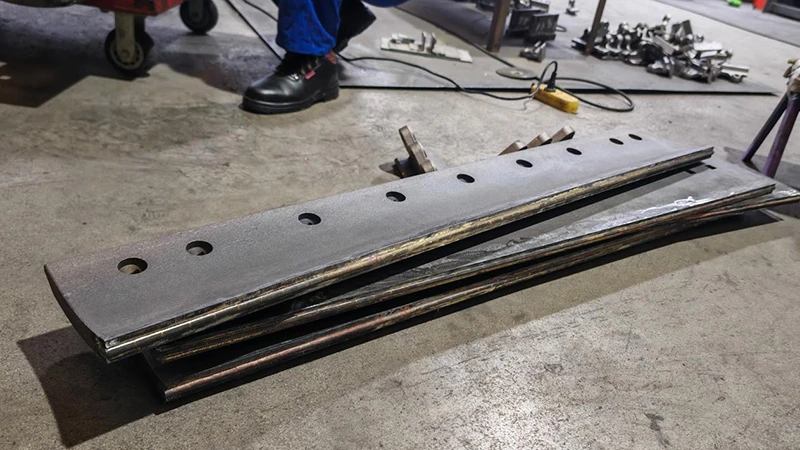
Two edges are quoted for the same machine. One is a plain medium-carbon steel at a moderate hardness; the other is a boron-treated edge at a higher hardness for a modest premium. On clean pavement the second lasts measurably longer, and on a shoulder full of gravel it can be the one that cracks.
Grade selection is a trade between hardness, toughness and the way the edge will be repaired. The sections below set out how the levers move, in the order they should be considered.
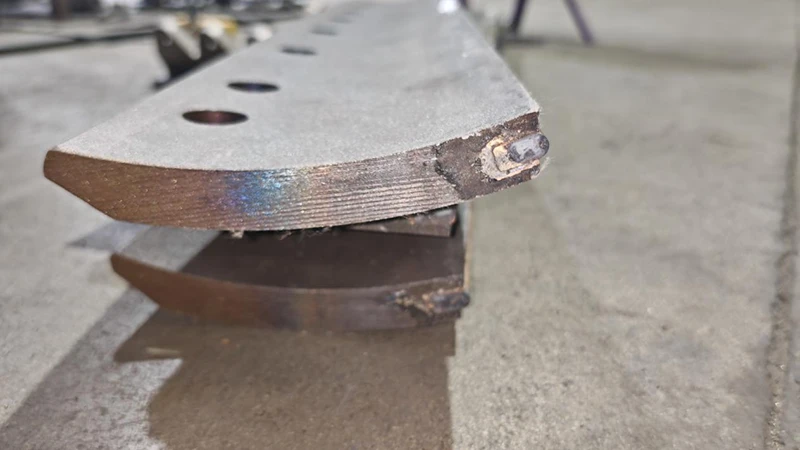
Plow edge steel grade: what the trade-offs decide
The grade decides the balance between wear and impact.
Carbon content and hardenability set how hard the steel can be made, weldability decides whether it can be repaired, and cost per hour of service decides whether the harder grade is worth its price.
The three interact rather than trade cleanly, which is why a selection made on hardness alone tends to disappoint. Raising hardness reduces the steel’s capacity to absorb an impact without cracking. Raising carbon to reach that hardness reduces weldability at the same time. And the harder the material, the more the repair strategy matters, because a chipped hardened edge is harder to restore than a worn soft one.
The other lever is the design rather than the material. A thick section with a small exposed edge behaves differently from a thin section, and a bolt-on edge removes the welding question entirely. Where the grade choice looks impossible, the design usually has more room in it than the metallurgy does.
Carbon content and hardenability
Carbon sets the ceiling on hardness and determines how easily the steel reaches it.
A low-carbon structural steel cannot be hardened meaningfully, which is why it is used for the structure rather than the wearing surface. A medium-carbon steel can be hardened and tempered, and the depth to which it hardens depends on the section size and on the alloying or micro-alloying additions that determine hardenability. Boron is the addition most used in this application, because it raises hardenability at a low cost.
| Family | What it offers | Where it falls short |
|---|---|---|
| Low-carbon structural steel | Weldability and toughness | Very limited wear resistance |
| Medium-carbon steel | Heat treatable to a useful hardness | Needs a procedure to weld; toughness falls as hardness rises |
| Boron-treated carbon steel | Higher hardness from the mill process | Still a carbon steel; impact limits remain |
| Abrasion-resistant steel | High hardness for severe sliding wear | Cost, and limited tolerance of impact and repair |
The third row explains why boron grades are common on plow edges. Raising hardenability lets a mill deliver a harder edge without the buyer arranging a heat treatment, which suits a consumable part produced in volume.
Through-hardening versus surface hardening
Where the hardness sits in the section decides how the edge behaves when it is loaded.
A through-hardened edge is hard across the section, which resists wear anywhere the surface is removed and leaves little capacity to absorb an impact. A surface-hardened edge keeps a tougher core, which bends rather than cracks under an obstacle, while the wearing face still resists abrasion. The second is usually the better compromise on a mixed route, and the first is appropriate where the surface is consistently abrasive and obstacles are rare.
The distinction has to be stated on the drawing because the grade name does not carry it. Two edges from the same grade with different hardening depths are different products, and only one of them matches the application.
Boron and abrasion-resistant grades
Boron grades and abrasion-resistant steels both raise hardness, and they do it in different ways with different consequences.
Boron is added in small quantities to a carbon steel to raise hardenability, which allows a harder product to be produced through the normal mill route. Abrasion-resistant steels reach their hardness through alloying and controlled processing, designed for sliding abrasion in mining, quarrying and similar service, where the material is often used as a liner rather than as a structural part.
For a plow edge, a boron-treated carbon steel is usually the practical choice, because it delivers higher hardness while remaining a steel that can be cut and drilled with normal shop practice. An abrasion-resistant plate is used where the wear is severe enough to justify the cost and where the part is not expected to absorb impacts.
Weldability and repair practice
The repair question belongs in the grade decision, because a fleet that welds its edges needs a grade that accepts welding.
A higher-carbon or higher-hardness edge requires preheat, a controlled heat input and attention to cooling, and even then the welded area loses hardness locally and wears faster than the rest of the blade. The procedure below is the order that keeps a repair from becoming a failure point.
- Confirm whether the grade is weldable at all, from its carbon content and hardness.
- Preheat the area around the joint to the temperature the procedure requires.
- Use a filler matched to the base material, and control the heat input to limit the hardened zone.
- Cool under cover rather than in a draught, so the weld area does not harden too quickly.
- Inspect the repair before the edge goes back into service, and record it against the machine.
Where a fleet cannot run that procedure in a yard, the better answer is usually a design change rather than a material change: a bolt-on edge removes the welding entirely and makes the replacement a parts decision rather than a fabrication one.
Cost per tonne versus cost per hour
The price of the steel is a poor guide to the cost of the edge, because it excludes the labour and the downtime that replacement consumes.
A harder edge that lasts twice as long saves a full changeout, which is the same work regardless of what the material cost. That is why the comparison belongs per hour of service, and why the same grade can be economic on one route and wasteful on another.
| Condition | Effect on the harder grade | Effect on the softer grade |
|---|---|---|
| Clean, abrasive pavement | Fewer replacements; cost per hour falls | More frequent replacement and labour |
| Gravel and mixed shoulders | Risk of chipping, which ends the interval early | Tolerates impact; wears faster but predictably |
| Route with buried obstacles | Failure becomes event-driven rather than wear-driven | Deforms and stays usable in most cases |
| Fleet with in-house welding | Repair cost rises and is not always successful | Repair is routine and inexpensive |
The fourth row is the one that changes the answer for many municipal fleets. Where the workshop can repair a softer edge cheaply, the harder one has to win by a larger margin to be worth buying, and where the fleet replaces rather than repairs the calculation moves the other way.
Choosing a grade for each position on the machine
Position on the machine changes the answer more than the machine itself does.
A front plow on a highway route runs at speed on a relatively consistent surface, where abrasion dominates and a harder edge earns its cost. An underbody blade runs closer to the surface and takes more continuous abrasion, which also favours hardness. A wing, a shoulder edge or a loader blade meets gravel and obstacles, where toughness matters more and a moderate hardness is often the right answer.
That is why a fleet can reasonably hold two or three grades rather than one. Standardising on a single grade simplifies purchasing and it also means that some positions are running a material chosen for a different job.
What to specify on a drawing
The drawing has to carry the properties, because the grade name alone leaves the delivered condition open.
- The grade and the standard it is defined by, with the condition of supply.
- The hardness range and how it is to be verified, including where the reading is taken.
- The thickness and the profile, with the tolerances that affect fitment.
- The bolt pattern as a layout rather than as a pitch.
- The certificate or test record required with the delivery.
The second item is the one that turns a grade into a specification. A hardness range with a stated verification method can be checked on arrival; a grade name alone cannot. Material standards that the drawing can reference come from ASTM International and the American Society of Mechanical Engineers.
How to compare two quotes
Two quotes for the same edge are comparable only when the grade, the hardness and the delivery basis are the same on both.
The comparison below is the order that prevents a cheaper offer from winning on a specification difference rather than on a price difference.
- Check that both offers name the same grade and the same condition of supply.
- Check the hardness range, and whether either offer states a verification method.
- Check the thickness and the profile against the drawing rather than against the price.
- Add the changeout labour to each offer, using the interval each grade is expected to run.
- Ask what happens if the hardness is below the range on arrival.
The fifth question is worth asking because the answer reveals whether the hardness is a specification or a description. A supplier who answers with a test method and a remedy is selling to a specification; one who answers with an assurance is selling a product.
Where grade choice is overthought
Three cases attract more analysis than they need, and in each of them a different decision solves the problem.
Where the route is mixed and unpredictable, no single grade is optimal, and the practical answer is usually to pick one that tolerates impact and accept the wear rate. Where the edge is failing at the fastenings rather than at the wearing surface, the grade is not the cause. And where the interval between changes is set by the season rather than by the wear, a harder grade changes nothing.
Each of those is a design, a maintenance or a planning question rather than a metallurgy question. Fleet practice in this area, including how programmes balance grade decisions against changeout logistics, is documented by the Snow and Ice Management Association, with fitment conventions published by the American Association of State Highway and Transportation Officials and SAE International, and equipment manufacturing practice by the Association of Equipment Manufacturers. The edge range SENTHAI produces across these grades is described on the carbide blade page.
FAQ
What steel are plow cutting edges usually made of?
Most are a medium-carbon steel or a boron-treated carbon steel, supplied either in a hardened condition or with the hardness produced by the rolling process. Abrasion-resistant steels appear where the service is severe enough to justify them.
Is a harder edge always the better edge?
Only while the surface is abrasive and free of obstacles. On rough roads, a very hard edge can chip or crack where a slightly softer one would deform and keep working, so the hardness that suits clean pavement is not the hardness that suits gravel.
Why does welding a hardened edge cause problems?
Heat from welding changes the hardness of the steel beside the weld and can leave a brittle zone that cracks. On a hardened edge the repair also removes the hardness locally, so the repaired area wears differently from the rest of the blade.
Does a boron grade need heat treatment?
Not necessarily at the buyer’s end. Boron raises hardenability, so a mill can produce a harder edge directly from the rolling process, which is why boron grades are common in this application. What has to be confirmed is the hardness range delivered rather than the route used.
What should be specified when ordering a steel edge?
The grade and the standard it is defined by, the hardness range and how it is to be verified, the thickness and the profile, the bolt pattern as a layout, and the certificate or test record that should travel with the delivery.
Send the route the fleet runs and the current failure pattern, and SENTHAI will recommend a grade and hardness range for each position, with the properties stated on the drawing rather than implied by a name.