A supplier with more in-house steps is not automatically the better one. What matters is which steps are in house, because only some of them decide whether the delivered product is what the specification called for.
That distinction turns a vague preference for integrated manufacturers into a set of questions that can be asked, answered and verified against a lot record. This is where integration actually pays, and where it does not.
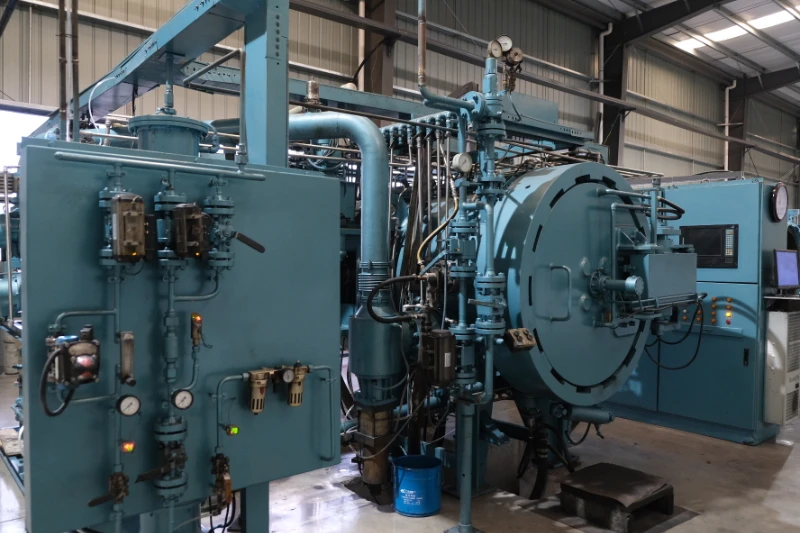
Vertical integration wear parts: what in-house control buys
Integration buys control of the steps that decide quality.
Those are the steps where a defect cannot be inspected out later: powder handling, pressing, sintering and the joining step, all of which share one batch reference when they happen on one site.
The value is not the building or the equipment list. It is that a single party holds the process record for each step, and can therefore answer a question about a delivered part with evidence rather than with a reference to a third company. Where a step is subcontracted, the buyer’s question has to travel one further and the answer arrives one step removed.
The second thing integration buys is change agility. A grade adjustment, a profile change or a fitment modification touches several stages; when they are on one site, the change is a decision, and when they are spread across suppliers it is a project.
What vertical integration has to mean
Integration means owning the process steps that create the product’s critical properties, not owning everything.
A manufacturer that presses, sinters, joins, finishes and inspects on one site is accountable for the whole chain of properties a buyer relies on. A manufacturer that presses and finishes but buys sintered inserts has, in practice, outsourced the step that decides hardness, grain structure and density, and the accountability for those properties sits with its supplier.
Raw materials are the exception at the other end. Almost nobody mines tungsten or makes carbide powder, and buying powder to a specification is normal and not a gap in integration. The line is drawn where a process step determines a property the buyer is specifying.
Steps commonly outsourced
Three steps are commonly subcontracted, and the reason is usually capital intensity rather than capability.
Sintering requires furnaces and the process engineering to run them, and it is the step most often bought in as finished inserts or sent to a specialist. Brazing is sometimes subcontracted where the volumes do not justify an automated line. Coating and other finishing operations are often outsourced because the equipment is shared across many industries. Pressing and mechanical finishing are kept more often, because a press is cheaper than a furnace and the tooling is specific to the product.
| Step | Why it is often outsourced | What the buyer loses |
|---|---|---|
| Sintering | Furnace capital and process engineering | Direct control of density and grain structure |
| Brazing and joining | Automation cost at low volume | Control of the joint, which decides insert retention |
| Coating and finishing | Shared equipment across industries | Visibility of the finishing conditions |
| Powder and raw material | Upstream supply chain by nature | Little, provided the incoming batch is declared |
The last row is what separates normal supply from a gap in control. Buying powder to a specification is standard practice; buying an already-sintered insert means the sintered properties are no longer produced under the seller’s process.
Traceability benefits of one roof
Traceability is where integration shows up most clearly, because a batch reference only travels as far as the process does.
Where every step happens on one site, a batch reference links the incoming material, the pressing run, the furnace cycle, the joining record and the final inspection. Where a step is subcontracted, the reference links to a delivery from another company, and the record for the process itself sits outside the manufacturer’s system.
The practical difference appears in a claim. With an integrated chain, a returned part resolves to a material batch and a set of process records. With a partly subcontracted chain, the same part resolves to a supplier’s certificate for the step that mattered, which is evidence about a shipment rather than about the process that produced the piece.
Lead time and change agility
Lead time is affected by integration in two ways, and only one of them is about speed.
The first is the queue. A step performed in house is scheduled by the manufacturer; a step subcontracted is scheduled by another company with its own customers, and it arrives with its own lead time and its own changeover behaviour. In the buying window, that difference is what decides whether a late change can be absorbed.
The second is what a change costs. Adjusting a grade, a profile or a fitment on an integrated line is an internal decision with an internal cost. On a partly subcontracted chain, the same change requires the manufacturer to renegotiate with a supplier, which usually means a minimum quantity and a lead time, and often means the change is refused.
Cost structure effects
Integration moves cost rather than removing it, and the direction depends on volume.
Where the volume is sufficient to keep a furnace or a joining line busy, owning the step removes a supplier’s margin and a handling cycle, and lowers the total cost. Where the volume is not sufficient, the fixed cost of the step is spread across too few units, and the buyer pays a premium instead of a saving.
That is why integration is a statement about a product line rather than about a company. A manufacturer can be genuinely integrated on a high-volume range and buy in for a specialised one, and both decisions can be correct. The buyer’s question is which situation applies to the item being quoted.
Risk of over-integration
Over-integration is a real cost, and it is usually invisible in a quotation.
A manufacturer that brings a step in house without the volume to support it prices that decision into every unit. A manufacturer that integrates a step it cannot run as well as a specialist produces a worse product at a higher cost, and the buyer sees only the second of those effects in the price. The failure mode is a supplier that is proud of its process chain and unable to explain which parts of it earn their keep.
The reverse risk is under-integration: a supplier that subcontracts the joining step and can neither describe nor control it, which is the case that matters most for a carbide edge. The question to ask is therefore not how much is in house, but whether the steps that decide the specified properties are among them.
Questions to ask a manufacturer
Five questions separate an integration claim from an integrated process, and all five can be answered from a lot record.
- Which process steps are performed on site, and which are subcontracted, named by step rather than in general terms?
- For the steps that are subcontracted, who performs them and what record comes back with the goods?
- Does a single batch reference run through the whole chain, and can it be quoted from the delivered part?
- Which step does the manufacturer consider the critical one for this product, and what is recorded there?
- What happens to a change request, and how many parties have to agree before it can be implemented?
The fifth question is the one that exposes a partly subcontracted chain most clearly. A manufacturer controlling every step can give a date for a change; one that has to renegotiate with a supplier will usually answer with a range or with a minimum quantity.
How to verify claims
Verification is a documentary exercise, and it is short.
Ask for the process record for one delivered lot and check that it names equipment and a cycle rather than a subcontractor. Check that the material declaration, the process record and the inspection record all carry the same batch reference. And ask which steps would change if the item were made in a different quantity, which is where a partly subcontracted process usually reveals itself.
A manufacturer with an integrated chain answers these from a batch number. One that answers with a capability brochure is describing a plant rather than a process. Where the product is supplied to a market with import or conformity requirements, the same records support those obligations, and the requirements themselves are administered by the destination authority alongside the conventions published by the World Customs Organization.
Where integration matters most by product type
Integration is worth more on some products than others, and the ranking follows the same logic: the more the critical properties are created inside the process, the more an integrated chain matters.
A carbide edge with brazed inserts is at one end, because hardness, density and joint integrity are all created in the process. A plain steel cutting edge is at the other, because the properties come from the steel specification rather than from the manufacturing sequence. Flex segments sit in the middle, since the rubber compound is bought but the bonding step is owned.
| Product | Steps that create critical properties | Value of integration |
|---|---|---|
| Carbide edge with brazed inserts | Powder, pressing, sintering, joining | High: several properties are created in process |
| Replaceable carbide inserts | Powder, pressing, sintering | High: density and grain structure decide wear |
| Rubber flex segments | Compounding, surface preparation, bonding | Moderate: the bonding step is the one to own |
| Plain steel edge | Steel specification, forming, hole pattern | Low: most of the specification is in the material |
The table is also a buying guide. Where the value of integration is high, a supplier that subcontracts the critical step is asking the buyer to accept a chain it does not control, and that is the case in which the question is worth asking twice.
What integration does not fix
An integrated manufacturer is not a substitute for a specification, and this is the limit that matters most to a technical buyer.
Integration does not correct a grade chosen for the wrong surface, a tolerance that does not match the machine, or a product being asked to do something it was not designed for. Those are decided before the process starts, and a well-controlled process will faithfully produce the wrong part.
The combination that works is a specification owned by the buyer and a process owned by the manufacturer, meeting at a batch reference. Standards that a specification can reference come from ASTM International and the American Society of Mechanical Engineers, fitment conventions from SAE International and the American Association of State Highway and Transportation Officials, and programme practice from the Snow and Ice Management Association.
FAQ
Does more in-house process always mean a better supplier?
No. What matters is whether the steps that decide quality are controlled by the party accountable for the result. A supplier that owns the pressing, sintering and joining steps is accountable for the whole product; one that outsources them is accountable for assembling parts made by others.
Which steps are most commonly outsourced in this industry?
Sintering, brazing and coating are the ones most often subcontracted, usually on the grounds of capital cost. Pressing and finishing are more often kept, because they are easier to bring in house and less capital-intensive than a furnace.
How can a buyer verify an integration claim?
By asking for the process record for a specific lot and checking that it names equipment and a cycle rather than a subcontractor, and by asking which steps appear on the same batch reference. A claim that cannot be tied to a lot record is a marketing statement.
Is over-integration a real risk?
It is, where a manufacturer brings in a step it cannot run at competitive cost or volume. The result is a higher price that the buyer pays for a capability the supplier does not actually need, which is why integration is judged step by step rather than as a whole.
What does integration not fix?
It does not fix a wrong specification, a poor grade choice or an application the product was never designed for. Those are decided by the buyer and the design, and no amount of process control compensates for them.
Ask SENTHAI which steps sit in house for the item you are buying, and ask for the lot record that shows it. The answer comes back as a process chain with the records attached to a batch reference.