A flex segment that separates on a gravel road usually fails within its first season, and the failure starts about a week earlier inside the plant, at the interface between the rubber and the steel rather than in the rubber itself.
The compound gets the attention and the bonding interface decides the outcome. This is how the bond is specified, made and checked, and what the failure modes look like.
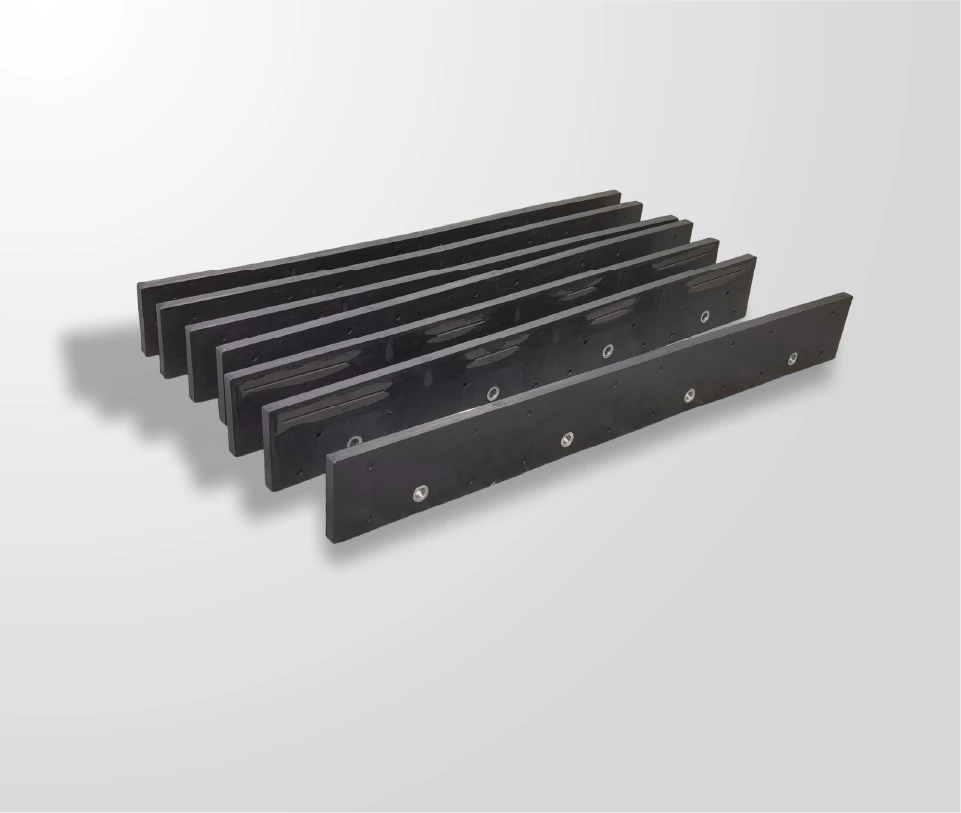
What a delaminated segment looks like
Delamination presents in a few recognisable ways, and the pattern points at the cause.
A segment that separates from one end with the rubber intact has usually failed at the bond rather than in the material. One that tears through the rubber while the bond holds has a compound or a design problem instead. One that separates along the whole length after a single season usually indicates a preparation or curing issue affecting the entire batch rather than a local defect.
Those three patterns are worth separating before any technical discussion, because the remedies are different. The bond failures are process problems; the through-rubber failures are specification problems; the batch-wide failures are evidence that a process window was missed rather than that the wrong material was chosen.
Rubber flex blade bonding: where the bond is decided
The bond is decided before the rubber is cured.
Compound, surface preparation and cure parameters set the joint together, and a failure at any of the three produces a segment that separates in service rather than wearing out.
The order matters. Surface preparation determines whether the rubber can attach chemically to the metal. The compound determines what it attaches with and how flexible the result is. The cure determines whether the attachment completes across the whole interface or only where the heat and the pressure reached.
Practically, that means a bonding problem is never fixed by changing the rubber alone. A supplier that responds to a delamination complaint by proposing a harder compound has not identified the cause, because hardness does not address the interface.
Rubber compound selection
The compound has to be chosen for the surface being cleared and for its ability to bond, and the two are decided together.
A softer compound conforms more closely to an uneven surface and absorbs impacts better, while a harder one resists abrasion and cutting more effectively. The choice follows the route: gravel and frozen gravel punish a soft compound with cutting, while rough paved surfaces with raised obstacles punish a very hard one with tearing at the edges.
| Condition | Pressure on the compound | What usually performs better |
|---|---|---|
| Gravel and frozen gravel | Abrasion and cutting | A harder compound with good rebound |
| Rough paved roads with obstacles | Impact and tearing at the edges | A softer, more compliant compound |
| Packed snow and ice | Continuous contact, low abrasion | Durability and bond integrity matter more than hardness |
| Mixed urban routes | Both, at low speed | A middle compound with a robust bond |
The bond requirement runs across all four rows. A compound that performs well against abrasion but bonds poorly to the prepared substrate will fail at the interface long before its wear properties matter.
Surface preparation for bonding
Surface preparation is the step that decides whether the rubber attaches at all, and it is the step most easily degraded under production pressure.
The steel substrate has to be clean, free of oil, scale and loose oxide, and given a surface profile that the bonding system can key into. Blasting or an equivalent mechanical preparation followed by a controlled cleaning is the usual route, and the interval between preparation and bonding matters because a prepared surface does not stay prepared.
Where a bonding agent is applied, its coverage and its drying interval belong to the process window in the same way that the cure temperature does. A shop that prepares the metal in the morning and bonds in the afternoon is working outside that window unless the parts are protected in between.
Vulcanization parameters
Vulcanization converts the rubber from a plastic mix into an elastic solid, and it simultaneously completes the bond to the substrate.
Temperature, time and pressure determine whether the cure reaches the whole section. A section that is thick relative to the cure rate will be over-cured at the surface and under-cured at the core if the cycle is set from the surface, and under-cure shows up later as a bond that fails or a rubber that takes a permanent set.
The pressure applied during cure matters for the same reason as it does in any bonding process: it keeps the rubber in contact with the substrate while the bond forms. A cycle that loses pressure, or a mould that does not close evenly, produces a segment with an intermittent bond that will separate in service without any visible defect during production.
Bond failure modes
Bond failures divide into those at the interface and those in the material, and the distinction decides the remedy.
Interface failures come from preparation, contamination or an incomplete cure. Material failures come from the compound, the design or an impact beyond what the segment was specified for. A third category sits between them: a failure that starts at the interface and propagates into the rubber, which usually indicates a local preparation defect that became a tear.
- Adhesive failure, where the rubber separates cleanly from the steel, points at preparation or cure.
- Cohesive failure, where the rubber tears while the bond holds, points at the compound or the application.
- Mixed failure, with rubber remaining on the steel across part of the face, points at an intermittent bond.
- Edge-initiated failure, starting where the segment meets the metal edge, points at the design or the fitment.
| Pattern | Appearance after separation | Indicated cause |
|---|---|---|
| Adhesive | Clean metal across the joint face | Surface preparation or contamination before bonding |
| Cohesive | Rubber remains on the metal; failure runs through the material | Compound selection or application beyond the design |
| Intermittent | Patches of rubber left on the substrate | Cure pressure or uneven contact during bonding |
| Edge-initiated | Separation starting at an end or an edge | Segment geometry, fitment or an impact load |
Reading a returned segment against this table is usually enough to tell a supplier where to look, and it is one of the few diagnostics in this field that a buyer can perform without any equipment.
Testing bond strength
Bond strength is tested on samples, because the test destroys the joint.
Peel tests measure the force required to separate the rubber from the substrate along a strip, and pull tests measure it across a defined area. The value recorded is useful mainly as a trend: what matters is whether successive batches sit in a stable band and whether the failure runs through the bond or through the rubber. A peel test that leaves rubber on the metal is showing that the bond is stronger than the material, which is the outcome the specification is looking for.
For a buyer, the practical requirement is that the test is performed on a sample from the production batch, that the result is recorded against the batch reference, and that the failure mode is stated alongside the value. Test methods for rubber and adhesion measurement are published by bodies such as ASTM International, with measurement practice published by the National Institute of Standards and Technology.
Inspection over service life
In service, the inspection that matters is the one a fitter can do in a yard, and it looks at the ends.
Separation usually begins at an end or an edge, so checking the first fifty millimetres at each end, and the point where the segment meets the metal, finds a developing problem before the segment is lost. A mark or a reference on the metal helps, because it shows whether the rubber has moved relative to the substrate, which is the earliest visible sign of a bond that is failing.
Recording the position and the machine for each finding turns a yard check into evidence. Two segments failing in the same position on different machines points at the product; the same segment position failing on one machine points at the machine or its fitment.
What to specify when ordering
A specification for flex segments works when it covers the interface as well as the rubber.
The steps below are the ones that produce a verifiable order rather than a description of a product.
- State the compound and its hardness range, with the surface the segment will be clearing.
- State the segment dimensions, the fixing pattern and the substrate material.
- State that the substrate is prepared and bonded in a controlled sequence, with the interval between the steps defined.
- State the cure window and require the cycle to be recorded against the batch.
- Require a peel or pull test on a sample from each production batch, with the failure mode recorded.
- Require the batch reference to appear on the segment or its label, and the lot pack to carry it.
The third item is the one that separates a supplier who understands the process from one who assembles. Preparing metal in advance of an undefined bonding schedule is the most common cause of a batch-wide delamination, and it is invisible in the finished product. Fitment conventions that the fixing pattern has to meet come from SAE International and the American Association of State Highway and Transportation Officials, and the buying practice around plough programmes is published by the Snow and Ice Management Association. The segment range SENTHAI produces is described on the flex blade page and the inspection routine on the quality control page.
FAQ
Why do rubber flex segments delaminate?
Usually because of the bonding interface rather than the rubber: an unprepared or contaminated metal surface, a curing cycle outside its window, or a compound that was not formulated to bond to that substrate.
How is the bond between rubber and steel tested?
By peel or pull tests on samples, which measure the force required to separate the rubber from the metal and show whether the failure runs through the bond or through the rubber itself. Kits that bond to the substrate indicate a sound interface.
What should a buyer specify when ordering flex segments?
The compound hardness and the segment dimensions, the substrate preparation expectation, the bond test and its sampling basis, and the lot documentation. The service conditions, especially the surface being cleared, belong in the same specification.
Send the surface the segments will be clearing and the failure pattern you are seeing. SENTHAI will respond with the compound, the bonding sequence and the test record that travels with each batch.