A distributor programme is decided by three numbers: the order quantity that changes the price tier, the lead time attached to it, and the share of the range that actually sells in the first season.
Get those wrong and the programme becomes a warehouse full of slow-moving stock with a good unit price on it. Get them right and the same product line funds itself, because the replacement demand comes back every season without a new sale. This is what the programme has to answer, in the order the decisions matter.

What a distributor programme has to answer
A workable programme answers five questions, and a quotation that answers only the first is not yet a programme.
The questions are what the range covers, what the documentation proves, what the minimum order and lead time are, what the price contains, and what happens when an end user has a problem. A supplier that can answer all five lets a distributor plan a season; a supplier that answers only the price leaves the distributor carrying the uncertainty.
The order matters because each answer constrains the next. A wide range with no stock commitment creates dead inventory. A short lead time with no documentation creates support calls the distributor cannot resolve. A low unit price without delivery terms creates a freight cost that appears later in the season.
Range and pack formats
The range a distributor needs is narrower than a factory catalogue, and it is defined by the machines its customers actually run.
The starting point is the installed base. A distributor serving arena operators needs the grip profiles and sizes that fit the resurfacer models in its territory, plus the consumable tips that wear out between equipment replacements. A distributor serving municipal or contractor fleets needs the wear items those machines consume in season. Where the two are mixed, the range usually splits into a core list that is stocked and a long tail that is ordered against a lead time.
Pack formats matter more than they appear to. Small, labelled packs suit a counter sale to an end user who buys a few tips; bulk packs suit a service company buying for a fleet. A programme that offers only one format forces either over-packaging for the small buyer or excessive handling for the large one, and both show up as margin erosion rather than as a visible cost.
Quality documentation per lot
Documentation is what allows a distributor to answer a technical question without escalating it to the factory.
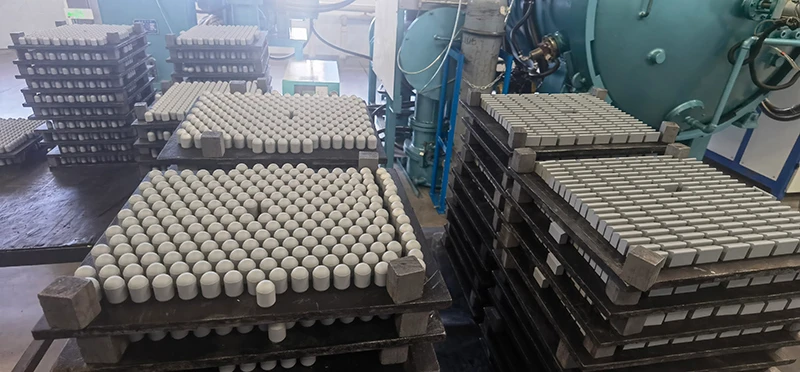
For a carbide wear part, the useful documents are a dimensional inspection record against the drawing, a material or grade identification, a lot number that ties the delivery to its production batch, and the packing list that matches the lot to the cartons shipped. With those four, a distributor receiving a complaint can establish whether the part met the specification before deciding what to do about it.
This is also the point where a low-cost source becomes expensive. A supplier that cannot provide lot traceability leaves the distributor absorbing the cost of every dispute, because there is no way to separate a genuine failure from a misapplication. SENTHAI manufactures in Thailand with a full in-house process chain and records inspection at each stage, so a lot number resolves back to the production conditions rather than to a shipping container.
MOQ and lead times
Minimum order quantity and lead time are the two constraints that decide how much capital a distributor has to commit before the season starts.
The two move together, and the relationship is the thing to negotiate rather than either figure alone.
| Order pattern | What it buys | What it costs the distributor |
|---|---|---|
| Small, frequent orders | Low inventory and cash tied up for a short period | Higher unit price and repeated freight and handling |
| One pre-season bulk order | Best unit price and the shortest in-season lead time | Capital committed early and stock risk if the season is mild |
| Split order with a defined top-up | A lower price on the committed portion and flexibility later | Requires the top-up quantity and its lead time to be agreed in advance |
| Stock held at the factory for call-off | Availability without inventory on the distributor’s floor | Depends entirely on the supplier’s willingness and the agreed call-off window |
The practical question is not which pattern is cheapest but which one matches the season the distributor expects. A territory with a long, reliable winter supports a bulk commitment; a territory where the season can be mild calls for the split arrangement with the top-up defined in writing.
Wholesale carbide ice grips: what the price actually contains
A delivered grip price is four costs, not one.
The tip, the body, the packing and the freight each have their own driver, and a quotation that shows only a unit price hides which of the four the distributor is paying for. The two that move most between suppliers are the carbide grade and the freight terms.
The tip is the carbide and the labour of forming and finishing it, so the grade and the dimensional tolerance are the drivers. The body is the shank or insert that carries the tip, and it is where a supplier can reduce cost without the buyer noticing. Packing covers the cartons, labels and the labour of counting, which is why pack format changes the price even when the grip does not. Freight covers the movement from the factory to the distributor’s door, and it is the cost most often left out of a comparison because it is quoted separately.
Written as a formula, the comparable figure is delivered cost per grip = (tip + body + packing) / quantity + freight and duty per grip. Comparing unit prices at the factory gate measures the first term and leaves the largest variable unexamined.
Pricing structure and rebates
A price structure that a distributor can plan against is worth more than a marginally lower opening price.
The components that matter are the price per quantity tier, the treatment of the top-up order, the currency the price is quoted in, and how long the price is held. A tier that changes at a quantity the distributor cannot reach is decorative; a tier that sits just above its realistic order is a negotiating position. Rebate arrangements work in the same way: a volume rebate is useful where the volume is predictable, and a growth rebate is useful where the distributor is building a new territory.
The item that catches distributors is the validity period. A price held for a season allows a margin to be set and quoted to customers; a price that moves with raw material without notice makes every quotation to an end user a risk. Terms of this kind, including the delivery and risk conventions used in a quotation, are defined by the International Chamber of Commerce.
| Cost element | Driven by | What a distributor can influence |
|---|---|---|
| Carbide tip | Grade, tip form, dimensional tolerance | Grade selection against the application rather than against price alone |
| Body and shank | Material and machining of the retention feature | Requiring the retention feature on the drawing |
| Packing and handling | Pack format, labelling, count verification | Choosing two pack formats instead of five |
| Freight and duty | Incoterm, mode, order frequency, destination | Consolidating orders and comparing delivered cost |
Duty and import treatment depend on the tariff classification of the part and the destination, and the schedules are published by the United States International Trade Commission. Market access and documentation requirements at destination are summarised by the International Trade Administration.
Private label options
Private label is a demand-capture decision rather than a product decision, and the sequence is short.
Work through the steps below in order, because each one determines whether the next is worth doing.
- Confirm the installed base the distributor already supports, since a private label needs a defined fitment rather than a general product.
- Decide the part numbers, because the replacement demand only returns if the number is the distributor’s own.
- Agree the packaging and labelling, including the marking that identifies the lot.
- Fix the drawing so the private-label part and the generic part are dimensionally identical unless there is a reason to differ.
- Set the stocking level and the reorder point against the same consumption record used for the generic range.
Where a distributor does not support the end user directly, private label adds packaging and inventory cost without changing who the customer buys from. Where it does, the label is what keeps the replacement sale from drifting to a part number the end user can search for.
Technical support that keeps the end user buying
Technical support is the part of the programme that determines whether the second order happens.
For a wear part on ice equipment, the questions that arrive are predictable: which grade suits a machine that crosses a concrete apron, why studs are pulling out, whether a replacement set is interchangeable with the original, and what tolerance the receiving body has to hold. A supplier that answers those questions with a drawing, a grade range and a retention requirement gives the distributor something it can pass on without risking its own credibility.
That support also shortens the sales cycle. A distributor that can tell an arena operator which tip form suits the way the machine is used is selling a specification rather than a price, and a specification is harder for a competing quote to displace.
Aftermarket competition factors
Competition in this category is decided on four factors, and price is only one of them.
- Fitment certainty, which determines whether the part can be sold without a return.
- Grade consistency, because a tip that performs differently between lots costs the end user a season.
- Availability inside the season, when the end user cannot wait for a lead time.
- Documentation, which decides who absorbs the cost when a part fails in service.
The structure of world trade in these components, including the tariff and rules-of-origin context that affects where a distributor can source, is documented by the World Trade Organization, and the material supply chain behind tungsten carbide is represented by the International Tungsten Industry Association.
FAQ
What order quantity makes a wholesale programme worthwhile?
The point at which the price tier changes is less important than the point at which the delivered cost per grip stops falling. Below that quantity the distributor is paying for handling, packing and freight rather than for the grip, and a larger order moves cost without improving the product.
Should a distributor private label ice grips?
Private label is worth it where the distributor already supports the end user and wants the replacement demand to come back to its own part number. Where the business is built on supplying whatever the customer asks for by reference, it adds tooling, packaging and inventory risk without changing the sale.
How should freight terms be compared between suppliers?
Compare the delivered cost at the same delivery term rather than the unit price at the factory gate. A lower unit price with the buyer carrying collection, export handling and insurance can end up above a higher quote that includes delivery, and the difference grows with order frequency.
If a distributor programme is being set up for carbide wear parts, send the installed base, the volumes and the destination and SENTHAI will set out the range, the documentation and the terms that go with it.