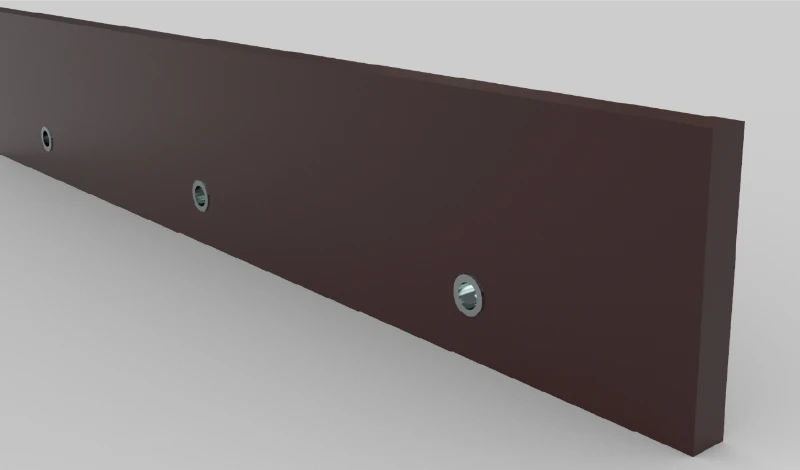
This chart is for measuring an edge you already have, or checking that the edge you are about to order will fit. It is a reference, not a catalogue: the mounting face on your blade is the only dimension that decides fit.
Every figure below is given in inches and millimetres, because imperial blades and metric tender documents do not always agree on what 3/8 inch means.
- LengthMeasured across the mounting face, outside flange to outside flange
- HeightMeasured on the edge itself, not on the moldboard
- ThicknessMeasured with a caliper, not estimated from the old edge
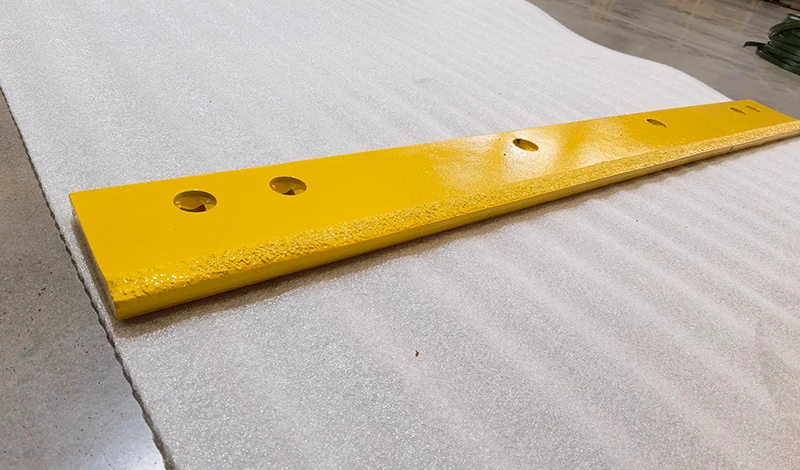
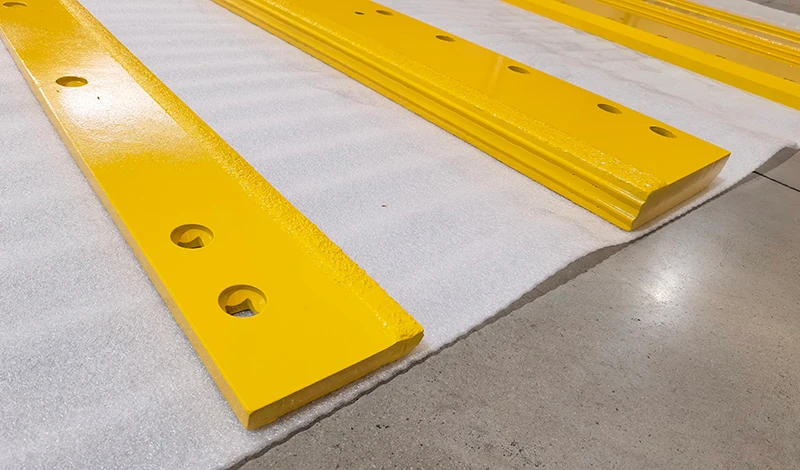
- Hole spacingCentre-to-centre across at least three consecutive holes
- Hole typeCountersunk or plain; they are not interchangeable
- SymmetryWhether the pattern mirrors, which decides if it can be flipped
Length by blade width
| Blade width | Edge length (inches) | Edge length (mm, nominal) | Typical machine |
|---|---|---|---|
| 6 ft | 72 in | 1,829 mm | Compact utility, small skid steer |
| 7 ft 6 in | 90 in | 2,286 mm | Half-ton pickup |
| 8 ft | 96 in | 2,438 mm | Three-quarter ton, skid steer |
| 9 ft | 108 in | 2,743 mm | Single-axle municipal |
| 10 ft | 120 in | 3,048 mm | Tandem-axle highway |
Height and thickness
| Dimension | Common values (in) | Metric (nominal) | Where it appears |
|---|---|---|---|
| Edge height | 4, 5, 6, 7, 8 in | 102, 127, 152, 178, 203 mm | Truck to highway plow |
| Thickness | 3/8, 1/2, 5/8, 3/4 in | 9.5, 12.7, 15.9, 19.1 mm | Set by truck class and duty |
| Bolt diameter | 3/8, 1/2 in | 9.5, 12.7 mm | Matched to countersink |
| Hole spacing | 6, 8, 12 in centres | 152, 203, 305 mm | Pattern-specific; measure |
Measuring an unknown edge in five steps
- Width. Tape across the mounting face, outside flange to outside flange.
- Height. Measure the edge, not the moldboard lip behind it.
- Thickness. Caliper at three points; worn edges are thinner at one end.
- Spacing. Centre-to-centre over three holes, at both ends if the blade is long.
- Hardware. Photograph the bolt head in place; countersunk and plain need different edges.
Metric caution
Tender documents often round 3/8 inch to 10 mm. That is not the same dimension, and a blade cut to the rounded figure will not sit correctly. Keep both numbers and state which one controls.
What to send with the drawing
Send the five measurements above with a photograph of the mount and a tape measure in frame. If the pattern is not one we hold, we reverse-engineer it and confirm the drawing before cutting. Related pages cover truck, skid steer, grader and loader blades.
How this chart is meant to be used
The figures are reference values for checking a measurement, not a catalogue of stocked sizes. The mounting face on your blade is the only dimension that decides fit, and a chart cannot read it for you. Where a tender document rounds a fraction to a metric value, the two numbers describe different parts.
Where the chart stops being enough
Three cases: a mount that has been repaired or re-drilled, a pattern that changed across model generations, and a blade that has been fitted with a third-party edge at some point. In all three, the measurement has to come from the blade itself rather than from any table, including ours.
From chart to quotation
Send the five measurements with a photograph and we confirm the pattern, quote the edge with the hardware, and hold the drawing on file for repeat orders. If the pattern is not one we hold, we map it and send the drawing back for approval before cutting.
Most relevant next steps
What to send, and what comes back
A photograph with a tape measure in frame resolves most size questions faster than a table can.
Quotation inputs
Machine make and model, blade width across the mounting face, edge height and thickness as fitted, hole spacing centre-to-centre across three consecutive holes, quantity for the season, and a photograph of the mount with a tape measure in frame.
Send measurements, confirm the size Upload a drawing instead
Download the measurement worksheet
Take the numbers once, in the right order, and send them with the photograph. The worksheet lists every field we need, the unit, and where each measurement is taken — the same sheet a dealer can hand to a customer.
Download the measurement worksheet (CSV)
How do I know what size cutting edge I need?
Measure the blade: width at the mounting face, edge height, thickness and hole spacing. Those four numbers identify the edge far more reliably than the model year.
Is a 3/8 inch edge the same as 10 mm?
No. 3/8 inch is 9.525 mm. A blade cut to 10 mm is a different dimension and may not seat correctly against the mounting face.
Can the bolt spacing be changed?
It can be drilled to a new pattern, but a modified mount should be measured from the blade rather than from a catalogue, and the drawing confirmed before production.