A workshop pulls a rubber-flex edge off a plow truck in February and finds two segments torn at the joint, one rubber base delaminated along half its length, and the rest of the blade still serviceable. The question that follows is not whether the blade broke, but whether the fleet buys one segment, sends the blade back for re-segmentation, or writes the whole edge off. The three answers carry very different costs and very different lead times.
This guide works through the sequence a fleet workshop actually faces: classify the damage, price the options against a like-for-like replacement, confirm that the base and the bond are still sound enough to carry the repair, and only then commit to the work. The decision points are ordered deliberately, because a workshop that prices a repair before it has classified the damage ends up quoting a job it may not be able to finish.
What has to be settled before anyone prices a repair
Three questions decide the outcome of every repair enquiry, and none of them is about the price of the parts.
The first is whether the damage is contained. A tear at one joint, a worn cutting edge on one segment, or a missing fixing is local damage. A base that has hardened, cracked along its length, or separated from its backing is not local, and no amount of workshop time brings it back. The second is how much service life is left in the segments that are still intact, because a repair that keeps a blade with two months of life in service for another three weeks costs more per hour of work than a replacement does. The third is who does the work, since a workshop that can restore a bond and hold segment geometry is doing a different job from one that can only bolt on parts.
Answer those three and the decision usually makes itself. Answer the price first and the workshop ends up comparing a repair against the wrong baseline: a new blade, rather than the service life the repaired blade still has in it.
Rubber flex blade repair: which damage types can be repaired
Torn segments and worn edges can be repaired.
Repair suits damage that is local and mechanical: a torn or missing segment, a worn or chipped cutting edge, or a joint that has opened far enough to let grit through. It also suits a blade whose rubber base is still flexible and still bonded across its full length.
The test is not how bad the damage looks but whether it can be isolated to the piece being replaced. A blade with one torn segment and three sound ones is a repair candidate; the same blade with a base that has gone hard along its length is not, however cheap the segment looks.
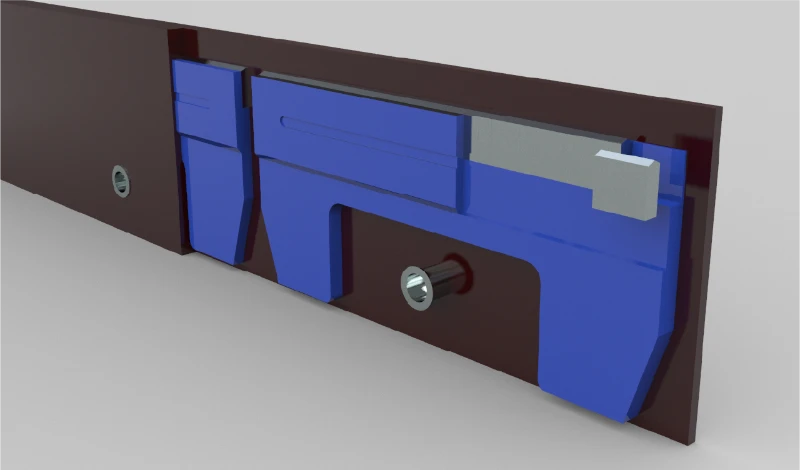
A flexible edge is a set of segments carried on a backing, with the rubber base bonded or mechanically fixed to it. That construction is what makes local repair possible in the first place: each segment is a defined unit, so replacing one does not disturb its neighbours, provided the fixing pattern around it is undamaged and the backing is still straight. The segmented approach is described on the snow plow blade range page, which sets out how the standard segment lengths divide a working width.
In practice, workshops sort candidates by where the damage sits relative to the load path. Damage at the cutting edge or at a segment joint is usually repairable, because the load path through the backing is untouched. Damage that runs along the interface between rubber and backing is not, because that interface is the load path. Reading the damage this way takes minutes and settles most of the argument before anyone opens a parts list.
Damage types that end the blade’s life
Some damage cannot be reworked at any reasonable cost, and recognising it early saves the workshop from quoting a repair it will end up crediting. The signs below are the ones that turn a repair enquiry into a replacement order.
- Rubber that has hardened or gone brittle across the whole edge, so it no longer flexes over a raised obstacle.
- Delamination running along the rubber-to-backing interface for a full segment or more.
- Cracks that propagate from a joint into the body of the base rather than staying at the edge.
- Backing deformation, bowing or a bent mounting line, which no amount of segment replacement corrects.
- Hole elongation across several consecutive fixing points, which means the pattern itself is no longer reliable.
The distinction matters commercially, not only technically. A blade in the last category will accept new segments and still fail, and the workshop that reworked it carries the argument. Sending those blades into the replacement decision is cheaper than defending the repair later.
Cost of repair versus replacement
A repair is not simply the cheaper option; it is a different set of costs. The table below separates the elements so a workshop can price the two paths against the fleet’s own labour rate and freight rather than against a rule of thumb.
| Cost element | Repair path | Replacement path |
|---|---|---|
| Parts | Replacement segments and fixings only | Complete edge and its fixings |
| Workshop hours | Strip-back, joint re-establishment, refit and inspection | Removal and refit |
| Freight | Two-way if the work goes to the supplier | One-way inbound |
| Downtime | Set by the workshop queue and the repair lead time | Set by the supplier’s lead time |
| Residual risk | Carried at the reworked joint | None beyond normal wear |
The element fleets most often leave out is the third. A repair that ships a blade to a supplier and back consumes two freight legs and two sets of handling, and on a small order those legs can outweigh the saving on parts. The fourth element is the one that decides the comparison in a busy season: a repair with a three-week queue is more expensive than a replacement on the shelf, whatever the invoice says.
In-house rework or return to the supplier
Workshops that hold the right equipment often do the simple jobs themselves and never see the arithmetic change. The dividing line is not skill but process: fitting a replacement segment to an existing pattern is a mechanical task, while re-establishing a joint and restoring bond continuity is a process task with a temperature and a pressure behind it. Brazing and welding practice in this industry is documented by bodies such as the American Welding Society, and the equipment needed to follow it is not something a fleet workshop improvises.
Where the work goes back to the supplier, three things are worth settling in the enquiry. The lead time, stated against the fleet’s next planned service rather than as a best case. The documentation that comes back with the blade, so the fleet can record what was replaced and against which drawing. And the treatment of warranty on a repaired assembly, because a reworked blade sits in a different position from a new one if a later claim arises.
Partial re-segmentation practice
Re-segmentation replaces a section rather than the edge, and it works only if the remaining segments still divide the working width correctly. That is the constraint most workshops underestimate. A blade built from four-foot segments that loses two of them cannot be rebuilt with a mixture of four-foot and three-foot pieces unless the joints are re-planned, and a joint that lands where the plow frame has no support will fail early.
The workable approach is to re-plan the joints from the ends inward, keep the joints in the regularly loaded part of the edge on the original spacing, and let any remainder sit at one end where it is easy to identify on the shelf. That keeps the non-standard piece visible, keeps the middle of the edge uniform, and avoids the situation where a fleet stocks two part numbers that look almost identical to a storekeeper in poor light.
Bond and rubber integrity checks
Before a repaired blade goes back on a truck, the bond around the repair needs a check that is more than visual. Tapping along the bond line and listening for a change in tone finds the voids that a visual inspection cannot, and it takes less time than fitting and removing the blade a second time. Rubber test methods for hardness and tensile behaviour are published by ASTM International, which is also where the terminology for describing a failed bond comes from.
Two further checks are worth writing into the workshop routine. Durometer readings taken across the repaired section and compared against the surviving segments show whether the new material matches the old closely enough to wear evenly. And a straight-edge check along the mounting line confirms that the strip-and-rebuild process has not pulled the backing out of shape, which is the failure that turns a good repair into a recurring misfit.
Warranty and liability implications
A repair changes who carries the risk at the repaired joint, and that is worth stating in the paperwork rather than discovering it in a dispute. Where the supplier reworks the blade, the question to settle in writing is what happens if the same joint fails again within the season: whether the reworked section is covered, and how the fleet proves that the second failure came from the repair rather than from the material around it.
Where the fleet reworks the blade in its own workshop, the position is simpler to state and harder to live with: the repair is the fleet’s work, and the manufacturer’s coverage on the rest of the assembly is unaffected but does not extend to the reworked area. Recording the replacement segments by their batch reference, and keeping the inspection measurements with the blade’s record in the quality control documentation, gives both sides something factual to work from.
Workshop capability requirements
Three capabilities decide whether a workshop can take on re-segmentation at all, and each of them is a tool rather than a skill. Without them, the honest answer to a repair enquiry is that the blade goes back to the supplier.
- Bond and pressure equipment capable of reproducing the original interface, not only a heat source.
- Measurement instruments for durometer readings and straight-edge checks along the mounting line.
- A record system that ties each repaired blade to the segments fitted, the batch they came from and the measurements taken.
Standards for testing and measurement are published by ISO, and where a fleet’s own quality system has to survive an audit, published maintenance practice from the Snow and Ice Management Association is a useful reference for how other workshops record the same decisions.
Decision checklist
Run the decision in this order and it takes a few minutes: classify the damage against the list above, then confirm that the base is still flexible and bonded, then establish where the repair would sit on the load path. If those three answers are favourable, price the repair against a like-for-like replacement including freight both ways and the queue, not against a parts list.
Two further checks belong at the end. Confirm that the remaining segments still divide the working width on the planned joint positions, and confirm the workshop or the supplier can reproduce the bond rather than approximating it. Failing either check is not a reason to argue about price; it is a reason to move the blade into the replacement decision and put the season’s money there.
The wider view is worth keeping: a repair programme is a way of extracting the service life already paid for, not a way of avoiding replacement indefinitely. Fleets that treat it as the former keep a stable edge count through the season, and the replacement blade programme is built to feed it with segments that match the original pattern. Background on how winter wear is measured across a network is published by the Transportation Research Board.
FAQ
Can you repair rubber flex plow blades?
Yes, where the damage is local. A torn segment, a worn or chipped cutting edge, or a joint that has opened can be reworked provided the rubber base is still flexible and still bonded to the backing. Damage that runs along the rubber-to-backing interface is a replacement decision, not a repair.
How do you re-segment a flex blade?
The blade is stripped back to sound material at the damaged section, the joint positions are re-established so the remaining segments still divide the working width, and replacement segments are fitted to the original fixing pattern. The whole edge is then checked for flatness and for bond continuity across the repaired area.
Is a repaired flex blade as good as a new one?
It is as good as the material around it. A repair restores a section; it does not renew the segments beside it or the base they sit on. Where most of the edge is still within wear limits a repair is sound, and where several segments are close to their limit the repair simply moves the next failure closer.
What does a repair cost compared with a new segment?
A repair trades the price of the parts for workshop hours, freight both ways and the risk carried by the reworked joint. It is usually the cheaper option when one or two segments are involved and the rest of the blade has life left; the arithmetic turns as soon as the labour and freight approach the price of the replacement.
Send the blade’s measurements, the segment layout you are working to and the damage you have found. The SENTHAI engineering desk will confirm whether the edge can be re-segmented and what the remaining segments should be.
This article is one step in the JOMA Style Rubber-Flex Blade Guide, which covers segments, clamps, insert retention and off-season storage.