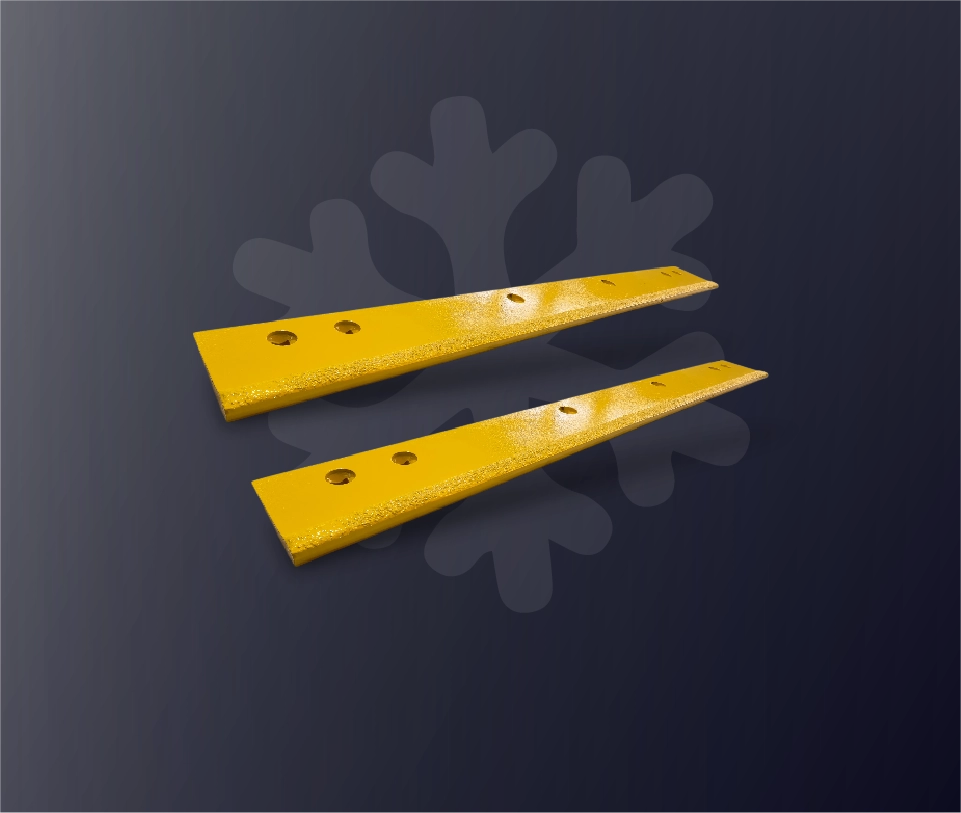
A single runner assembly that carries part of a plow blade’s weight is called a foot in one market and a skid shoe in another, and both names are used in the same catalogue depending on which page it is. Two fleets ordering the same part by the same word can receive two different assemblies, and neither order was placed carelessly.
This comparison sets out where the two names diverge, how the assemblies they describe differ in the ways that matter to an order, what wears inside each one, and how to specify a replacement so the name stops being the deciding factor.
Plow feet vs skid shoes: why the terms clash
Regional usage, not engineering, separates the two names.
In most of the trade the two terms describe the same function: a runner that carries part of the blade’s weight so the cutting edge is not loaded with all of it.
Where a distinction is made, it usually follows the mounting: a foot is taken to be a runner on an adjustable stem, and a skid shoe a flatter runner fixed closer to the blade. Both descriptions appear in catalogues, and both are defensible.
What causes problems is not the ambiguity itself but the assumption that it has been resolved. An order placed by name relies on the supplier and the buyer using the same definition, and that holds until it does not.
Regional terminology and what it costs
The cost of the terminology shows up as returned parts and as blades serviced with the wrong runner. A runner that mounts correctly but is too narrow behaves like an edge on a soft surface; one with a shorter adjustment range cannot be set high enough for an unsealed road; and one with the wrong stem diameter will not fit the bracket that is already on the machine.
Two practices reduce it. Recording the assembly on each machine by its dimensions rather than by its name, so a replacement order carries the numbers rather than the word. And keeping a photograph of the assembly in place with a tape measure visible, which is the fastest way to settle a question that a description cannot. What the runner does once it is fitted is covered on the plow shoe selection page.
Mounting methods compared
Mounting is the property that most often separates the two assemblies in practice, and it decides how much adjustment is available in service. A runner on a stem is adjusted by moving the stem through its bracket, which usually gives a range of height positions and takes a pin or a clamp to change. A flat runner bolted directly to the blade is adjusted by shimming or by turning the runner over, and it usually offers a smaller range.
The difference matters operationally. A machine that moves between sealed and unsealed routes needs enough adjustment for the operator to change the setting at a shift change, which points to a stem-mounted assembly. A machine that works one surface type can use a fixed runner and be set once. The distinction between the two assemblies is therefore a route question rather than a preference.
Wear parts within each assembly
Each assembly has one part that wears first, and ordering a replacement means knowing which.
- The runner itself, which wears on its underside and is the part replaced most often.
- The stem or bracket, which wears at the adjustment interface where it is clamped or pinned.
- The mounting bolts or pins, which wear and corrode in the same conditions as the edge hardware.
- The attachment points on the blade, which can elongate if the assembly is allowed to move.
The fourth entry is the one worth checking before ordering. A runner replaced onto an attachment point that has already worn will not sit at the height it was set to, and the machine will come back with the same complaint.
Adjustment range and shimming
Adjustment range decides how much of the setting work can be done in the field, and the table below sets out what each approach allows.
| Property | Stem-mounted foot | Flat skid shoe |
|---|---|---|
| Adjustment method | Move the stem through the bracket | Shim or turn the runner over |
| Range available | Wider, with discrete or continuous positions | Narrower, limited by the shim stack |
| Field change possible | Usually, with basic tools | Sometimes, if access allows |
| Failure mode | Stem wear at the clamp | Runner deformation and bolt wear |
The third row is the one to confirm at the specification stage rather than after purchase. A fleet that intends to change settings between routes needs that capability to exist on the machine, not in the workshop.
Interchangeability limits
The two assemblies are interchangeable only where the mounting and the adjustment range both match, and there are three limits worth checking.
- Mounting pattern: hole spacing, hole diameter and the surface the bracket seats against.
- Stem diameter and length, where the machine’s bracket expects a stem-mounted assembly.
- Runner width and thickness, which set how the load is distributed on the surface.
A fourth limit is legal rather than dimensional on some machines, where the manufacturer’s specification constrains what may be fitted to the blade. Equipment standards and manufacturer documentation are the place to check that, and the standards that constrain these assemblies are maintained by SAE International and the Association of Equipment Manufacturers.
Ordering the right part first time
An order that does not depend on the terminology carries five items: the machine make and model, the mounting dimensions, the stem or runner dimensions, the height range required, and the surface the machine works. With those, a supplier can identify the assembly regardless of what it is called in either party’s catalogue.
Two additions make the order checkable on arrival. A photograph of the fitted assembly, including the mounting bracket. And a note of the adjustment position currently in use, which tells the supplier what the machine actually needs rather than only what it will accept. The same discipline applied to edges is set out on the gravel road shoe page.
Catalogue data to keep current
Catalogue data ages, and the entries that matter are the ones a fleet orders from. Three are worth reviewing each season: the part numbers actually used across the fleet, the supersessions or replacements notified by the supplier, and the dimensions recorded against each part so a substitution can be checked rather than assumed.
A fleet that keeps those three current can substitute a part when stock runs out and know whether the substitute will fit. One that keeps only a list of names will order whatever the name currently returns. Dimensional and drawing conventions for recording this kind of data are published by ISO, and fleet-level record practice by the National Association of Counties and the Transportation Research Board.
SENTHAI manufactures plow edges, shoes and carbide inserts in Rayong, Thailand, and produces edges to a measured pattern with the mounting confirmed against the customer’s machine. Where a runner assembly has to be identified from dimensions rather than a name, the details can be sent through the contact page.

FAQ
Are plow feet and skid shoes the same thing?
Often, and not always. In much of the trade the names are used interchangeably for the runner assembly that carries part of the blade’s weight. Where a distinction is made, a foot usually refers to a shoe on an adjustable stem while a skid shoe is taken to be a flat runner bolted directly to the blade.
Why does the terminology differ by region?
Because the parts evolved from different machine traditions and dealers in each market standardised on their own catalogue language. The hardware is broadly similar; the names attached to it are not, which is why an order placed by name rather than by measurement is the common cause of a wrong part.
How do I order the right shoe or foot first time?
Order from the mounting dimensions and the machine rather than the name: hole spacing and diameter, stem diameter where the assembly is adjustable, runner width and thickness, and the height range required. A photograph of the assembly in place with a tape measure resolves most of what remains.
Send the machine type, the mounting dimensions and a photograph of the assembly in place. The SENTHAI engineering desk will confirm the part and the adjustment range the route needs.