The counter-intuitive part of edge rotation is that it is a way of spending material rather than of saving it. A blade with a wear flat at one end still has sound material elsewhere, and rotating it moves that material into the working position so the blade reaches its limit evenly. Where a blade is already wearing evenly, rotation does nothing except add labour, which is why the programme has to begin with a measurement rather than with a schedule.
This is the implementation path for such a programme: what rotation can and cannot fix, how moves are triggered, which moves are physically available on a given blade, what the labour and scheduling cost looks like, and how to record a season so the programme can be judged rather than assumed.
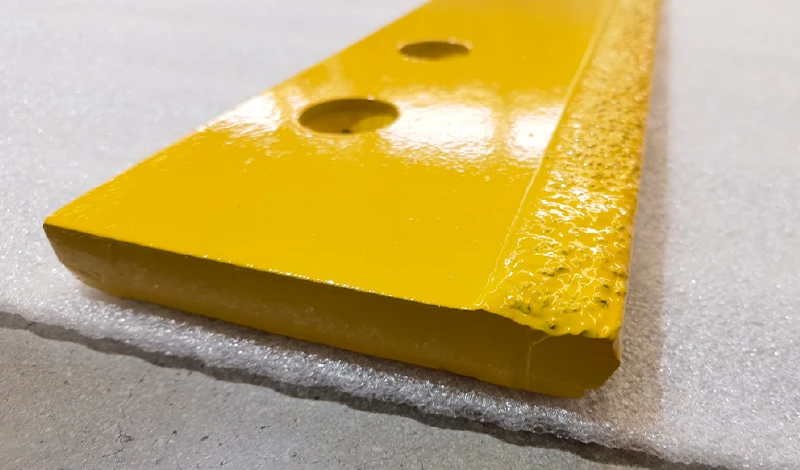
What rotation can and cannot fix
Rotation redistributes wear. It does not change the rate at which wear happens, and it does not fix a machine. Those two limits decide which blades belong in the programme.
Where the cause of uneven wear is the route, rotation helps: the hardest-wearing positions move to sections of the blade that see less work, and the remaining material is spent evenly. Where the cause is the machine, rotation delays the symptom. A blade on a machine with a bowed mounting line or uneven down pressure wears fastest at the same place whatever position it is fitted in, and moving it between machines simply spreads the problem across a larger fleet.
That is why the first step in a programme is not a schedule but a diagnosis. The wear pattern tells you which of the two situations you are in, and the diagnostic sequence is described on the wear pattern page.
Triggering rotations by measurement
Trigger a rotation on the spread, not on the calendar.
The trigger is a difference between the lightly worn and heavily worn positions, and the size of that difference is what makes a rotation worth doing. A blade with a small spread across its width reaches its minimum everywhere at about the same time.
A blade with a pronounced localised loss still has useful material at the other positions, and moving it is what recovers that material.
Two further conditions belong in the trigger. The edge must go back into service still within its wear limit at the worn position, since rotating a blade that is already at the limit just relocates the problem. And the rotation must not put the heavily worn section where it will wear faster still, which happens when a blade is reversed onto a route where the hard-wearing section is at the opposite end.
Front to underbody and left to right moves
Four moves are available in most fleets, and each one redistributes wear in a different way. The table below sets out what each move does and what it requires.
| Move | What it redistributes | Requirement |
|---|---|---|
| Reversing the edge end to end | Wear at one end of the working width onto the other | A symmetric pattern and a blade that permits reversal |
| Moving between machines on similar routes | Wear concentrated by one machine’s setup | Comparable mounting and recorded positions |
| Front to underbody position | Wear from the main cutting line onto a secondary one | A machine that runs both positions with the same edge |
| Left to right on the same machine | Asymmetric wear caused by blade angle | A machine that accepts the edge in either position |
The fourth move is the one that most fleets already perform informally, and it is the one with the clearest record requirement. Because the edge’s position changes what the operator sees, an unrecorded swap makes the next inspection uninterpretable.
Labour and scheduling implications
A rotation is not free; it costs the same labour as a partial blade change, and that cost has to be weighed against the material it recovers. The comparison is straightforward once both sides are measured: the hours the move takes, against the fraction of a replacement edge whose service life is recovered by spending the remaining material evenly.
Scheduling matters as much as the cost. A rotation is a planned job and belongs in a quiet window, because a rotation performed during a storm is a machine out of service in the worst week of the year. Where the fleet cannot bring the machine in on a planned basis, the programme will not survive its first busy month however sound the economics.
Records that make the case
The record has to answer one question at the end of the season: did the blade deliver more service because it was rotated? Four fields make that answerable.
- The measurement at each position before and after every move, taken at marked positions.
- The position the edge occupied between readings, and the date or event count it was there for.
- The number of hours the rotation itself consumed.
- The outcome at the end: the blade’s total service life compared with the fleet’s history for that route.
The fourth field is the one that turns a workshop practice into a programme with a result. Without it, rotation is a thing the fleet does; with it, rotation is a thing the fleet can judge.
Results from a season of rotation
A first season produces three results, and only one of them is the headline. The obvious one is the change in service life per edge, which should be visible as either more events before the wear limit is reached or fewer edges consumed over the same work.
The second is a change in the wear pattern itself, since rotated blades load differently and may show a spread rather than a flat. The third, and the most useful for the following season, is which positions along the working width consistently wear fastest. That distribution is a fact about the route and the machine rather than about the edge, and it is what tells a fleet where to look next. The measurement regime that produces these figures is set out on the blade wear measurement page.
Failure modes a rotation programme misses
Rotation addresses one failure mode — uneven abrasion — and there are four others it does not touch.
- Impact damage, which is a load event rather than a wear process and is unaffected by where the material sits.
- Loosening and hardware failure, which depends on the joint rather than on the blade’s position.
- Deformation of the blade body, which rotation cannot correct and which will keep loading the edge unevenly.
- Seat or pocket wear, which changes how the replacement edge sits rather than how it wears.
A fleet that adopts rotation as its whole wear strategy tends to find that these four account for a growing share of its blade costs, because the programme has been aimed at the one cause it can address. The other failure modes and what each one indicates are described on the failure modes page.
Writing the programme so it survives a season
A programme that survives is short, measured and owned. The sequence below is the one that has worked for fleets running more than one machine type.
- Establish which moves are physically possible on each blade and machine combination, and record them.
- Mark measurement positions on the edges and take a baseline reading on every blade at fitment.
- Set the trigger as a difference between positions rather than as an interval.
- Record each move with its before-and-after readings and its labour hours.
- Review the season’s figures once, at the end, and change one thing for the next season.
The fifth step is what separates a programme from a routine. A fleet that reviews the figures and changes one variable each season learns which of its routes responds to rotation and which does not, and it can then stop rotating on the routes where nothing is being recovered.
When not to run a rotation programme
There are three conditions under which the programme is not worth starting. Where the fleet’s blades wear evenly along the working width, because there is nothing to redistribute. Where the machines are stable enough that a blade’s position makes no measurable difference to its wear rate. And where the workshop cannot reliably bring a machine in for a planned job, because a programme that runs only when there is time will produce records that cannot be compared.
The honest alternative in those cases is a measurement programme without rotation: the same readings, used to set replacement intervals and to identify routes whose edges need a different specification. Fleet-level maintenance practice for programmes of this kind is published by the Snow and Ice Management Association and the National Association of Counties, winter maintenance research by the Transportation Research Board, and network guidance by the American Association of State Highway and Transportation Officials and the Federal Highway Administration.
SENTHAI manufactures plow edges, wear plates and carbide inserts in Rayong, Thailand, and produces edges to the pattern and profile each machine requires, which is what makes a recorded position meaningful across a fleet. Routes whose wear distribution suggests a specification change can be discussed through the contact page.
FAQ
Does rotating plow edges actually save money?
It does where the wear is uneven and the rotation is triggered by a measurement, because it spends material that would otherwise be left on the blade when the worn section reaches its limit. Where wear is already even, rotation adds labour and saves nothing, which is why the programme has to start with a measurement rather than a schedule.
How often should plow edges be rotated?
When the measurement shows a difference between the lightest and heaviest worn positions that is worth redistributing, not on a fixed interval. A blade worn evenly has nothing to redistribute, and one with a flat beside a fixing needs the cause corrected rather than the blade moved.
What rotation moves are available?
Reversing the edge where the design allows it, moving it between positions on the same machine, and moving it between a front and an underbody or wing position. Which of those is possible is a property of the blade and its mounting, so it has to be established before the programme is written.
What should a rotation record contain?
The measurement before and after the move, the positions the edge occupied, the number of events or kilometres between readings, and the reason the move was made. Without the before-and-after readings the programme cannot show whether it did anything, and it becomes a habit with paperwork attached.
Send the wear readings along each blade, the positions they were taken at and the moves the fleet can make. The SENTHAI engineering desk will confirm which routes respond to rotation and which need a different edge specification.