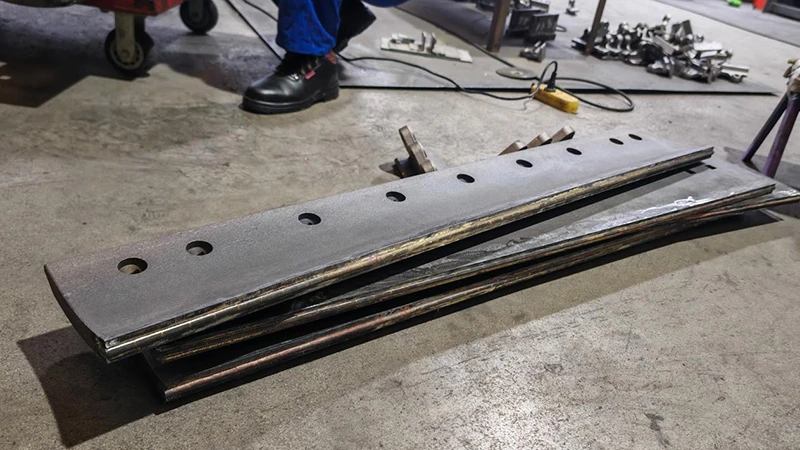
An operator reports for three shifts that the blade is not clearing the same way at one intersection, and nothing is written down. By the time the blade reaches the workshop the condition that caused it has worn itself away, and the workshop replaces the edge without ever finding out what the operator had noticed. The observation existed; the maintenance system had no way to receive it.
This is the implementation path for a reporting programme: what operators can see that inspectors cannot, how short a form has to be to survive a night shift, how reports are escalated, how they are paired with measurements, and what to do so the programme is still running in February.
Operator blade inspection: what operators see that inspectors miss
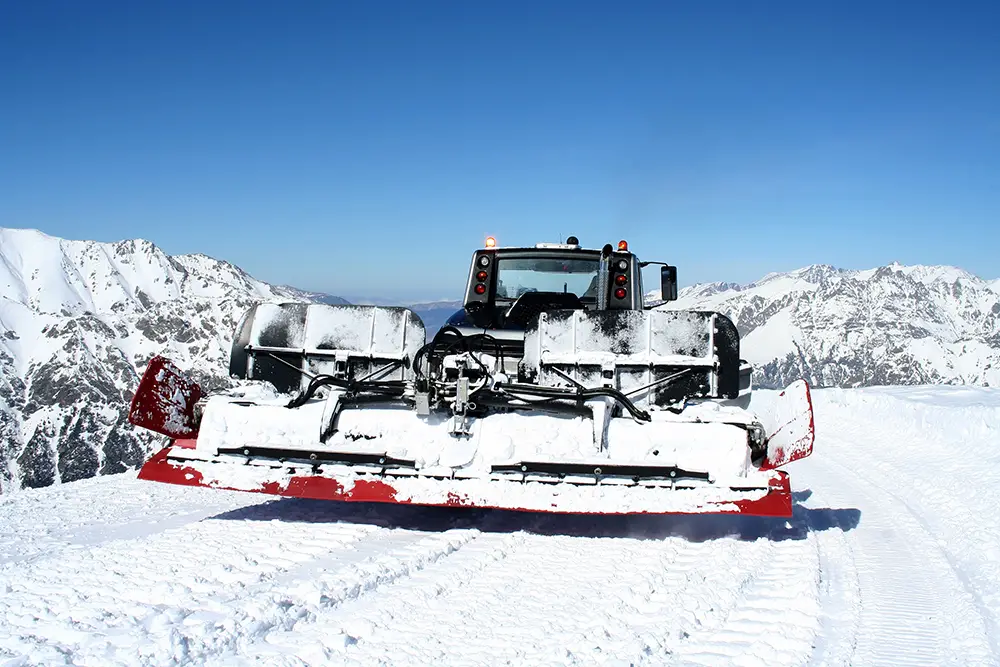
Operators see the blade in motion, inspectors at rest.
Four observations fall to the operator because they only exist while the machine is working: where on the route the blade stops clearing effectively, what the surface looks like immediately after a pass, whether the machine took an impact and roughly where, and whether the blade sounds or moves differently under load.
None of those are visible on a machine parked in a bay, and all of them point at a position on the blade that can then be measured.
What an inspector adds is the dimension, the frame condition and the joint inspection. The two roles are complementary rather than alternative, and a programme that relies on only one of them is either measuring the wrong places or looking in the right ones too late.
Why reports stop coming in
Most reporting programmes fail for one of three reasons, and none of them is operator reluctance. The form is longer than the conversation it is meant to replace, so it is completed only on quiet shifts. The reports produce no visible response, so the operator concludes that reporting is paperwork. Or the form asks for judgements the operator is not equipped to make, which turns a simple observation into a risk.
The third is the most damaging and the easiest to fix. An operator asked to assess whether an edge needs replacing is being asked to be wrong in writing; the same operator asked what the blade did differently at a particular bridge will answer accurately, because it is an observation about the machine rather than a verdict on a component.
A short reporting form that gets used
The form should fit on three lines and be fillable in the cab at the end of a shift. Four fields are enough: the machine, the position on the route, what the blade did differently, and any impact taken. A photograph field is optional and usually useful, because a picture of the surface frequently explains the observation better than a written description.
Two design choices keep it in use. It should be available where the shift ends, rather than in an office the operator does not visit, and it should take less time to complete than the verbal handover it replaces. Where the fleet already has a defect reporting route for other vehicle faults, the blade report belongs on the same route rather than on a separate one.
Photographs and thresholds
Photographs are the single most useful addition to a written report, and they need one instruction to be usable: include something of known size in the frame. A tape, a coin or the blade’s own fixing hardware gives the reader a scale, and a photograph without a scale can only be described rather than measured against anything.
Thresholds work differently from photographs and should be used sparingly. A threshold tells an operator when to escalate rather than what to report, and setting it too low produces a stream of reports that the workshop ignores. Two thresholds cover most fleets: any impact that produced a visible change in how the machine worked, and any route position where the blade has stopped clearing on more than one shift. Both are observable, and neither requires a technical judgement.
Escalation rules
Escalation is what turns a report into an inspection, and the table below sets out how the routes differ.
| Report | Response | Timeframe |
|---|---|---|
| Impact with a structure or fixed object | Machine inspected before its next shift | Same day |
| Position on route not clearing, repeated | Edge measured at the corresponding position | Next service |
| Change in noise or movement at a given angle | Mounting and hardware check | Next service |
| General observation with no repeat | Logged, and reviewed against other reports | End of week |
The first row is the only one that is urgent. An impact that changes the machine’s behaviour can have moved the mounting line, and a bent frame will damage the next edge as well as the current one. The fourth row is where most reports belong, and logging them with no immediate action is correct — the value appears when three of them point at the same route position.
Closing the loop with feedback
A report that produces nothing visible stops the programme. The feedback does not need to be elaborate; it needs to be visible to the person who reported. Three forms work: a note on the machine’s record that the report was received, a workshop finding written back to the operator, and a change that the operator can see on the route.
The second is the one that most improves future reports. Telling an operator that a blade was found worn at the position they reported teaches them what to look for, and it converts a single observation into a capability across the shift rota.
Pairing reports with measurements
The report and the measurement do different jobs, and pairing them is what makes the programme produce maintenance data rather than a file of opinions.
| Finding | Report contributes | Measurement contributes |
|---|---|---|
| Not clearing at one route position | Where and when it happens | The wear distribution across the edge |
| Impact at a known place | The event and the machine’s behaviour after | Mounting line and hole condition |
| Noise or movement at an angle | The condition under which it appears | Hardware torque and seat condition |
| Blade wearing faster than the fleet average | Route and duty as worked | Wear rate per event against the baseline |
The fourth row is where the two sources produce something neither can alone. The operator supplies the duty, the workshop supplies the rate, and the combination identifies which routes are consuming edges faster than their specification assumes. The measurement method is described on the blade wear measurement page.
Training points per season
Three short sessions across a season keep the programme current without turning it into a course.
- Before the season: what to look for, and what the form asks for.
- After the first month: examples of reports that led to a finding, so the connection is visible.
- Mid-season: any change in the fleet’s edges or settings, and what a difference will look like from the cab.
The second session is the one that matters. A programme taught once and never reinforced becomes a form that gets filled in at the start of the season and forgotten by the first hard week.
What not to ask operators to do
A reporting programme is weakened by asking for things the operator cannot provide.
- Do not ask for a judgement on whether a component is serviceable, since that is a measurement decision.
- Do not ask for causes, because the observation and the diagnosis are different tasks and mixing them reduces the reliability of both.
- Do not ask for a report on every shift, since a mandatory daily entry becomes a repeated line that no one reads.
- Do not ask for reports through a system the operator cannot reach at the end of a shift.
The second entry is the most common design error. An operator who is asked why a blade is wearing at one end will offer a theory, and theories are much less useful than the plain observation that the route position in question is a bridge joint.
Measuring whether the programme works
Two figures show whether the programme is functioning, and neither is the number of reports.
- The proportion of reports that produced an inspection and a recorded finding.
- The number of findings that a workshop inspection would not have produced on its own.
The second is the programme’s value. Where reports are consistently producing findings the workshop would otherwise have missed — a route position, an impact, a setting change — the programme is doing what it was created for. Where reports are producing nothing, the form is asking for the wrong observations. What the findings turn into when they are aggregated across a fleet is described on the failure modes page and the mid-season audit page.
Where the programme fits in the season
Reporting is continuous, and it feeds two events rather than replacing them. The mid-season audit is where the accumulated reports are checked against measurements on a sample of machines. The end-of-season assessment is where the same data is used to decide what is refurbished, reused or scrapped.
Treating the reports as an input to those two events, rather than as a separate administrative task, is what makes the programme worth running. Fleet-level practice for programmes of this kind is published by the Snow and Ice Management Association and the National Association of Counties, winter maintenance research by the Transportation Research Board, and network guidance by the American Association of State Highway and Transportation Officials and the Federal Highway Administration.
SENTHAI manufactures plow edges, wear plates and carbide inserts in Rayong, Thailand, and produces edges to the pattern each machine requires, which is what makes a reported position on a blade refer to the same place in the workshop. Fleets setting up a reporting route for blade condition can raise the inspection points through the contact page.
FAQ
What should operators report about blade condition?
Four things, and nothing more: where on the route the blade behaved differently, what it looked like afterwards, any impact the machine took, and any change in noise or movement. Those four are observations only the operator can make, and none of them requires a judgement about the blade.
How do you get operators to fill in a reporting form?
By making it shorter than the conversation it replaces, and by showing that the reports change something. A form of three lines that gets used beats a page of fields that gets ignored, and a report that produces a visible fix is what keeps the next one coming.
Should operators be asked to judge whether a blade needs replacing?
No. Asking for a judgement puts the operator in the position of being wrong, and it produces either no reports or reports written to be safe. Ask for the observation and let the measurement decide, which is what the workshop is for.
How do reports fit with workshop measurements?
The report says where to look and the measurement says what is there. A report of poor clearing at one end of a route sends an inspector to the same position on the edge, and the measurement taken there is what turns the observation into a maintenance decision.
Send the route positions where the fleet already sees recurring problems and the machines involved. The SENTHAI engineering desk will confirm the edge specification and the inspection points that correspond to those reports.