A transfer chute that was relined in steel at the start of the campaign is holed eight weeks later, and the shutdown it forces costs more than the reline ever did. The wear was not unusual; it was in a place where a small area takes the whole stream.
(Last modified date: November 12, 2026)
Carbide earns its place at points like that, and only at points like that. This is how a plant works out where, and what it takes to specify and run a programme.
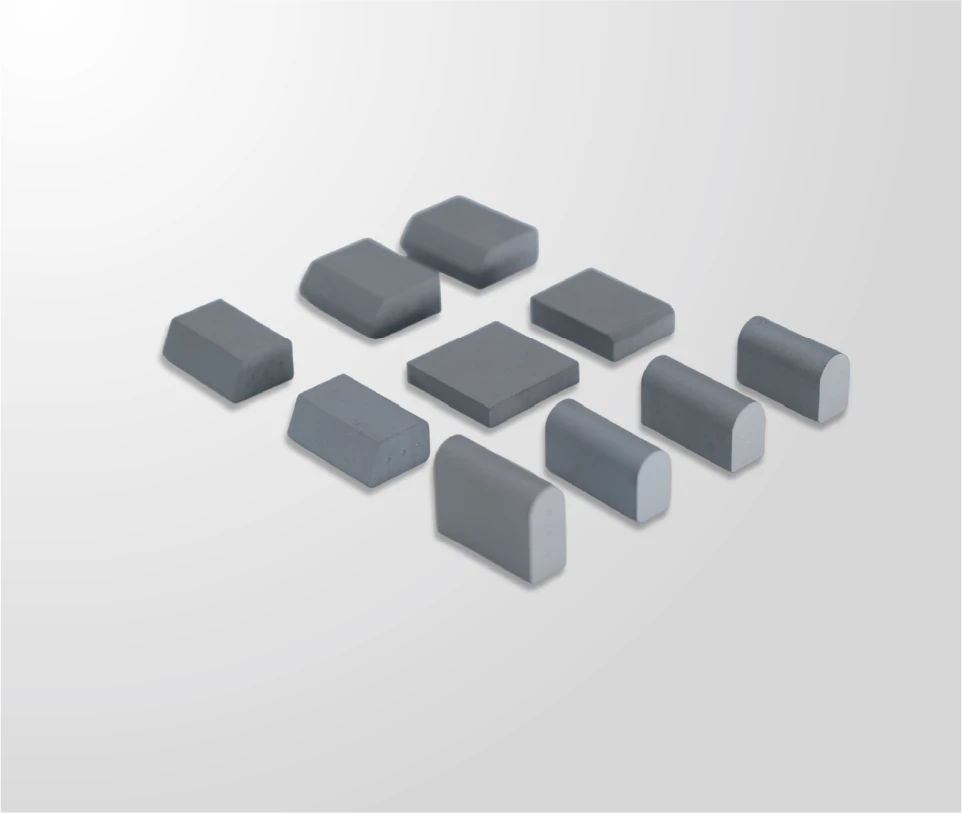
Tungsten carbide wear parts mining: where carbide earns its place
Carbide pays in three conditions.
Those three conditions are what separate a wear point that justifies a carbide solution from one that is better served by steel, composite or a design change.
Concentration matters because carbide is expensive per unit of area. A wear point that covers a square metre is a steel or composite problem; a point that wears in a band a few centimetres wide is a carbide problem, because the hard material is doing work across a small area rather than covering a large one.
Continuity matters because carbide resists abrasion and tolerates impact poorly. A point that sees a steady stream of material behaves differently from one that occasionally takes a heavy lump, and the second is where a carbide solution can fail suddenly instead of wearing out predictably.
Reachability matters because a wear part that cannot be replaced quickly is not a wear part, it is a maintenance project. A programme built around components that require a crane and a week of access will not be sustained.
Where carbide earns its place underground and on surface
Underground and surface operations place wear differently, and the difference changes what is worth protecting.
Underground, space is tight and access is the limiting factor, so the value of a wear part that lasts is high even at a premium price. Loading and transfer points, bucket protection and cutting tools are the usual candidates, and the constraint is usually how quickly a component can be brought in and fitted.
On surface, output is governed by throughput and shutdown cost rather than by access. Crusher circuits, transfer chutes, screens and stockpile handling are where the wear concentrates, and the economics are dominated by the interruption a failure causes.
Both cases share the same rule: carbide goes where the wear is predictable. A site that cannot forecast where the wear will appear is not ready for a carbide programme, because the programme depends on knowing which points are worth protecting before the campaign starts.
Where tungsten carbide wear parts are used in mining and crushing
| Wear point | Typical carbide form | What to watch |
|---|---|---|
| Rock drilling | Carbide buttons and inserts in drill bits | Grade toughness against rock hardness and impact |
| VSI crusher rotors | Carbide rotor tips and tip sets | Feed size and tramp metal; see VSI crusher wear parts |
| Chutes and transfer points | Carbide tiles or carbide-faced liners at the impact zone | Mounting and backing so tiles are not knocked out |
| Conveyor belt cleaners | Carbide-tipped scraper blades | Belt splice damage and blade tension |
| Ground engaging and edges | Carbide inserts in steel edges and teeth | Impact at the toe; see loader bucket cutting edges |
| HSI blow bars | Usually alloy steel or composites, not solid carbide | Impact dominates; see HSI crusher parts |
The cost logic is the same at each point: carbide costs more per piece, so it pays only where the stop it avoids is expensive and the wear is abrasive rather than impact. Insert-based designs, like the carbide inserts used in edges, keep the carbide where the wear is and let steel take the shock.
Crushing circuit wear points
The crushing circuit concentrates wear at the points where rock changes direction or speed.
Feed points, crusher internals, discharge chutes and screen decks each load material differently, and each has a characteristic wear pattern. Identifying the points that wear fastest is what turns a general wear problem into a list of components with a specification.
| Point | Mechanism | Solution that usually fits |
|---|---|---|
| Feed and transfer points | Impact from falling material | Impact-tolerant liner, with carbide only where the stream concentrates |
| Crusher internals | Impact and abrasion together | Material chosen for the balance in that machine |
| Discharge chutes | Sliding abrasion at speed | Carbide inserts or tiles where the stream runs fastest |
| Screen decks and panels | Abrasion plus repeated loading | Panel material selected by aperture and duty |
| Stockpile and bin surfaces | Sliding abrasion over a large area | Steel or composite liner across the bulk of the surface |
The fifth row is the useful counterweight to the first four. A large surface that wears slowly does not need the hardest material available; it needs a liner that can be replaced on a planned interval, and the correct answer for most of that area is not carbide.
Material handling wear points
Material handling wears differently from crushing, because the material is moving rather than being broken.
The wear is dominated by sliding abrasion at the points where the stream is fastest or where it changes direction: transfer chutes, skirt liners, hopper walls below the throat and the impact zone where the stream lands. Those are the points where a hard liner changes the interval between repairs most significantly.
There is also a design element that no material solves. A transfer point where the stream falls directly onto a liner will wear regardless of what the liner is made of, and the cheapest change is often to reduce the drop or angle the impact, after which a liner lasts as intended.
Carbide insert systems versus solid carbide
The two approaches put the hard material in different places and suit different components.
A solid carbide component is made entirely of the material, which suits small parts where the whole item is the wear surface, such as inserts and cutting tools. An insert system attaches carbide to a steel body, which suits larger components where only part of the surface wears and the rest carries structural load.
| Property | Solid carbide component | Inserts on a steel body |
|---|---|---|
| Where the hardness sits | The whole component | The contact area only |
| Impact tolerance | Limited by the material | The body absorbs what the insert resists |
| Repair route | Replace the component | Replace individual inserts where the design allows |
| Cost driver | Material volume | Number of inserts and the mounting method |
The third row is the one that decides most programmes. Where inserts can be replaced individually, the cost of maintaining a wear point becomes a routine parts activity rather than a shutdown, and that is what makes the economic case for the harder material.
Specification and tolerance requirements
A plant specification has to describe the component well enough that two suppliers deliver the same thing.
The essentials are the grade with its hardness and grain structure, the dimensions that control fitment, the surface finish where it matters, the mounting method, and the exposure of the wear material above the supporting body. The last item is the one most often omitted and the one that decides how the component behaves under load.
The tolerance that matters most is the one on the mounting interface. A component that fits loosely works, then fails at the fixing, and the failure is attributed to the material rather than to the fit.
Traceability in a mine environment
Traceability in a mining operation has to survive a working environment rather than an office one.
What a plant needs is the ability to take a failed component and resolve it to a batch and a set of records, which means the mark has to be readable on the component and not only on the packaging. Batch references that fade, fall off or sit on the outside of a pallet are of little use once the components are in service.
The practical requirement is a mark that survives installation, and a documented link from that mark to the material and process records for the lot. Everything else in a traceability system exists to support that link.
Cost per tonne and downtime avoided
The economic case for a carbide programme is made from two numbers, and the second is usually the larger.
The sequence below is the one that produces a defensible comparison for a plant.
- Record the component cost and the cost of the change as separate figures.
- Record the tonnage processed over the interval the component ran.
- Calculate cost per tonne as (component cost + change cost) / tonnage.
- Estimate the interruption cost avoided, using the plant’s own downtime figure.
- Compare over a full campaign rather than one interval, so the comparison covers the range of feed conditions.
The fourth item is the one that changes the answer most often. On a plant where a shutdown costs more than the component by a wide margin, the solution that extends the interval wins even when its own price is high.
Supplier qualification questions
A supplier can be qualified with five questions, and each answer should be checkable rather than reassuring.
The list below is written for a plant that intends to run a programme rather than place a single order.
- What grade is being offered, and what does the supplier expect it to suit?
- Which processes are performed in house, and which are subcontracted?
- What does the lot documentation contain, and does the mark on the component carry the batch reference?
- How is the mounting interface toleranced, and how is it verified?
- What lead time can be held through the plant’s operating season?
Where carbide is the wrong choice
Carbide is the wrong answer wherever the conditions that justify it are absent.
Those points are worth naming explicitly, because a programme that includes them will produce disappointing results that are then blamed on the material.
Large surfaces that wear slowly, points where the impact is heavy and irregular, components that cannot be accessed without a major shutdown, and any application where the plant cannot forecast where the wear will occur are all better served by other solutions. Each of those cases has a cheaper answer that works, and the discipline of a programme is to use carbide only where it earns its cost.
What a plant should record
The record a plant keeps is what allows the programme to improve rather than to repeat itself.
For each protected wear point, the useful entries are the component and grade fitted, the date and tonnage at installation, the measurement or condition at removal, and the reason for removal. With those four, the next specification decision has evidence behind it, and the comparison between two grades on the same point becomes a calculation rather than an argument.
Material and test standards that a specification can reference are published by ASTM International and the American Society of Mechanical Engineers, with measurement practice published by the National Institute of Standards and Technology. Equipment conventions come from SAE International, and industry practice is documented by the Association of Equipment Manufacturers and the Snow and Ice Management Association.
FAQ
What tungsten carbide parts are used in mining?
Components where a small area carries the wear: crusher tips and wear components, chute and transfer liners, bucket and loader protection, and cutting tools. Carbide is used where its hardness can be placed on the surface that wears, rather than across a whole structure.
How fragile is tungsten carbide?
It is hard and brittle relative to steel, so it tolerates compression well and impact poorly. That is why it is mounted rather than used as a structural material, and why the mounting and the exposure are specified along with the grade.
Does carbide pay on every wear point in a plant?
No. It pays where wear is concentrated and continuous and where the component can be replaced without major work. Where the load is intermittent and heavy, or where access is difficult, a steel or composite solution usually gives a better cost per tonne.
Is carbide worth it on every crusher part?
No. On impact-dominated parts such as HSI blow bars, steel or composite materials usually win. Carbide pays where abrasion dominates and the shutdown it avoids costs more than the part.
Send the wear points, the material being handled and the tonnage, and SENTHAI will say which points justify carbide and what specification each one needs.