The counter-intuitive part of reading a bolt pattern standard is that it does not specify the pattern. It defines a family of layouts and the language used to describe them, which is why two edges can both be described as conforming to the same standard and still not fit the same machine. What a fleet actually needs is the member of the family its machine uses, and that comes from a measurement rather than from the standard’s name.
This is a compliance walkthrough rather than a table of dimensions. It covers what the standards do and do not establish, where compatibility between families ends, how to specify a pattern so a conforming delivery still fits, and how to verify a lot at goods-in against the requirement.
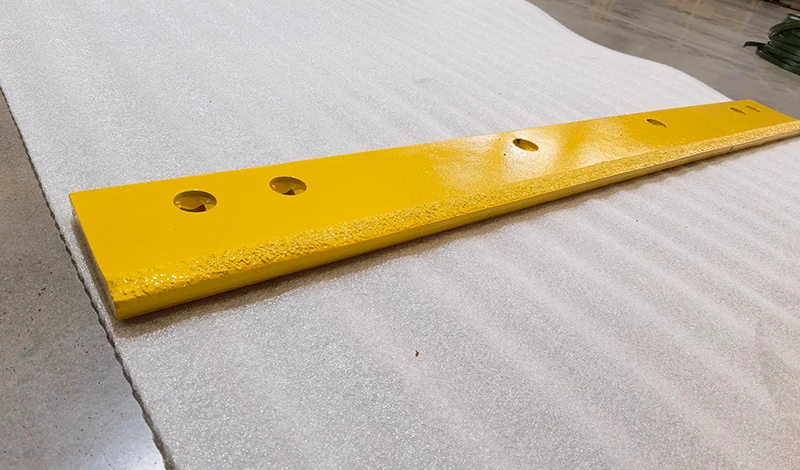
AASHTO bolt pattern: what the standards actually specify
A standard defines a family, not one layout.
What the published standards establish is a set of cutting edge fixing arrangements used across road maintenance equipment, together with the way those arrangements are described.
That covers how hole positions are dimensioned, how hole detail is called out, and what the relationship between the edge and the machine’s mounting is. It is what allows an edge from one supplier to be fitted to a machine built by another, which is the purpose of the standard in the first place.
What the standard does not do is tell a fleet which member of the family its machine uses. That is a property of the machine, recorded in its manual or established by measuring the edge that fits it. Reading the standard’s name as though it were a specification for one machine is the first misreading in this area, and it is the one that produces deliveries that conform and do not fit. The standards bodies publish the material through the American Association of State Highway and Transportation Officials and the equivalent international bodies through ISO.
Typical hole spacing and diameter
The dimensions that vary between the families and within them are the same four that decide whether an edge fits, and each one has to be verified against the machine rather than assumed from a family name.
| Feature | What varies | How to verify |
|---|---|---|
| Hole spacing | Centre-to-centre distance, and whether it is constant across the width | Measure between each adjacent pair on the edge that fits |
| Hole diameter | The clearance provided for the fastener | Measure with a gauge or callipers at several positions |
| Countersink or counterbore form | Angle, diameter and depth where the head is recessed | Inspect the form and check the fastener seats flush |
| End distances | Position of the first hole from each end of the edge | Measure from both ends, not from one |
The fourth row is the one that decides most near misses. A pattern can match a family’s spacing exactly and still be positioned differently relative to the ends, which puts the first and last fixings outside their clearance on the machine.
Hardware compatibility between patterns
Hardware compatibility follows from the hole detail rather than from the family, and it is worth treating as a separate question from the pattern. A fastener of the right diameter will pass through a hole in either family, and it will only seat correctly if the head form matches the countersink in the edge.
Two consequences follow. An edge from one family fitted with hardware from another can be tight and still not seated, which produces the wear and loosening associated with a poorly seated head. And where a fleet is running hardware across several machine types, the head forms in use need to be recorded alongside the patterns, because the two decisions are made together and are often recorded separately. Hardware selection is set out on the conical nut and plow bolt page.
Mixed fleets and adapter approaches
A fleet running machines built to different families has three options, and the choice is a procurement question rather than a workshop one. It can carry both edge patterns, which is the simplest in the workshop and the most complex in the store room. It can standardise on one family and use adapters where the mounting differs, which reduces stock but adds a component that has to be inspected.
The third option is to standardise on the machine rather than the edge, so new equipment is bought to a family the fleet already supports. That is a slow solution and the only one that reduces the number of patterns permanently, which is why it tends to be adopted by fleets that have been through the first two.
Specifying patterns in tenders
A pattern clause that cannot be misread contains the standard and the dimensions, in that order.
- Name the standard family the layout is drawn from, so the vocabulary is shared.
- State the specific dimensions the machine requires: spacing, hole diameter and end distances.
- State the hole detail, including the countersink or counterbore form and its angle.
- Require the bidder to quote the drawing revision and the pattern back in the offer.
- State the tolerance that applies to hole position, since a pattern without one is an assumption.
The fourth item is what turns the clause into something enforceable. Where a bidder has to quote the pattern back, a misreading is caught before the order rather than at delivery. The wider clause set for a component tender is set out on the tender specification page.
Verification at goods-in
Verification against a standard is a measurement exercise, and it takes minutes on a delivered lot.
- Confirm the drawing revision and the standard family named on the documentation.
- Lay the edge on a flat surface and measure the hole positions against the layout, not against a pitch figure.
- Check hole diameter and countersink form at two or three positions.
- Confirm the end distances from both ends.
- Offer a fastener up to at least one position to confirm the head seats flush.
The fifth step is the one that catches a lot which is dimensionally correct and functionally wrong, because it tests the pattern and the hardware together. Where a lot fails, the measured value against the stated requirement is what makes the notification actionable. Receiving practice for this kind of component is described on the bolt pattern verification page.
Common misreading of pattern charts
Pattern charts are useful summaries and are not standards, and most disputes in this area come from treating them as though they were. Three misreadings recur. The first is assuming that a chart entry is the only layout in its family, when a chart usually lists the arrangements a supplier stocks. The second is reading a chart from one market as though it described another, since the families were developed separately and their summaries do not map one to one.
The third is subtler: a chart entry may describe a layout that is compatible with a machine’s mounting without being the pattern the machine was built to, which is acceptable for a spare and not acceptable where the tolerance stack matters. The standard and the machine manual outrank the chart in every one of these cases.
Where a pattern chart is not enough
The table below sets out the questions a chart can answer and the ones it cannot, so that a fleet knows when a measurement is required.
| Question | Chart | Measurement or manual |
|---|---|---|
| Which family a layout resembles | Answers it | Not required |
| Which member the machine uses | Cannot answer it | Required |
| Whether hole detail matches the hardware | Usually incomplete | Required |
| Whether end distances suit the frame | Cannot answer it | Required |
| Whether a substitute edge will fit | Indicates a possibility | Required before ordering |
Read down the second column and the pattern is clear: the chart shortlists, and everything that decides fitment is established by measurement. A fleet that keeps its own measured layouts on file stops needing the chart for anything except a first look.
What a supplier should provide for the pattern
Three items turn a delivered edge into something a fleet can hold a supplier to. The drawing revision the lot was produced to, with the standard family named. The measured dimensional record for the hole positions and detail. And the batch reference that ties the lot to its production record.
Those three also make a substitution check possible, which is where they earn their keep. A fleet considering an edge from a different family can compare the measured record against its own layout before ordering, rather than after the machine is out of service. Drawing and dimensional conventions for recording this data are published by ASME, equipment standards by SAE International and the Association of Equipment Manufacturers.
SENTHAI manufactures carbide and rubber-flex plow edges, wear plates and inserts in Rayong, Thailand, and produces edges to a measured pattern with the layout and hole detail confirmed against the customer’s machine rather than against a family name. Edges that need their pattern checked against a standard or a drawing can be raised through the contact page, and the edge range these patterns are applied to is described on the carbide snow plow blade page.
FAQ
What is an AASHTO bolt pattern?
It is a family of cutting edge fixing layouts used across North American road maintenance equipment, defined so that edges from different suppliers can be fitted to the same machines. The standard sets out the layout and hole detail; the machine’s own manual says which member of the family it uses.
Can a DIN pattern edge be used on an AASHTO machine?
Only where the dimensions coincide or an adapter is used. The two families were developed separately, so hole spacing, hole diameter and countersink form can differ even when the layouts look alike on a chart. Compatibility is established by measurement, not by comparing family names.
Why do pattern charts show different dimensions for the same standard?
Because a chart is a summary made by a supplier, not the standard itself, and summaries make choices about which members of a family to list. Two charts can describe different subsets of the same family and both be accurate. The standard, or a measured pattern, is what settles a question.
How should a pattern be specified in a tender?
By naming the standard the layout belongs to and stating the specific dimensions the machine requires, with the hole detail. Naming only the standard leaves the supplier to choose a member of the family, which is how two conforming deliveries arrive with different patterns.
Send the standard family, the measured layout and the machine type. The SENTHAI engineering desk will confirm the pattern and the hole detail the edge should be produced to.