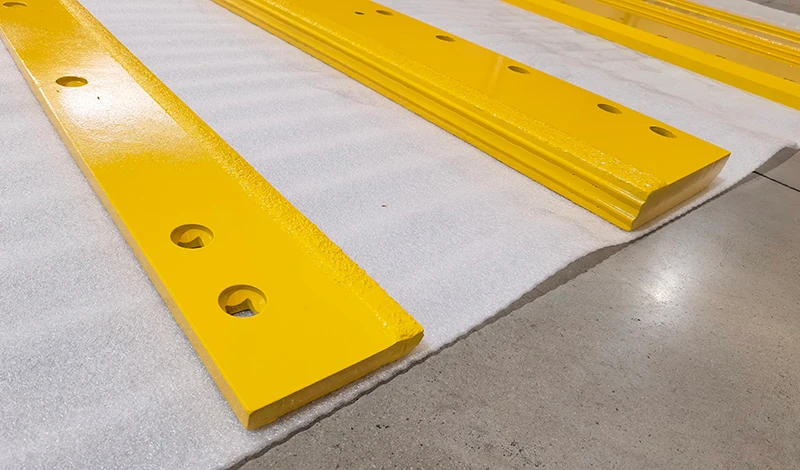
Two inputs decide whether a carbide edge pays back: how many change-outs it removes over a season, and what a change-out costs the fleet. Both move with the winter, which is why a single season is a poor test — a mild winter removes the change-outs the edge was bought to eliminate, and a severe one produces more of them than any specification can absorb.
This comparison sets out the two scenarios side by side: the inputs each one uses, the break-even event count between them, and how to present both cases so the discussion is about the break-even point rather than about which winter is typical.

Why one season is not a fair test
A payback case built on one season measures the winter as much as the edge. In a mild winter the steel path may need only one change-out, so there is nothing for a longer-lived edge to eliminate, and the premium is spent without a return. In a severe winter the same fleet runs two or three change-outs on the same route, and the longer interval saves labour, downtime and route disruption on each one.
The consequence for how the case is built is that it should be expressed in events rather than in seasons. A fleet that knows its edge removes a change-out every X events can calculate what that is worth in a winter of X events and in a winter of three times X, and the answer changes with the winter in a way that both parties can see.
What makes the two scenarios comparable
Two scenarios are only comparable if they differ in severity and nothing else. Four inputs have to be held constant between them.
The route and its surface mix, since abrasiveness drives the interval more than the edge does. The price difference between the two specifications, including freight. The labour hours per change-out at the fleet’s own rate. And the treatment of downtime, which has to be either included in both scenarios or reported alongside both.
Where those hold, the difference between the two results is attributable to the event count, which is the variable the fleet cannot control and the reason for presenting both cases at all.
Carbide edge payback: mild winter scenario inputs
Model the mild case with the fewest events.
The mild scenario uses three inputs: the number of change-outs the steel path needs in a mild winter, which is often one; the number the carbide option needs, which is often still one; and the labour and downtime attached to a change-out the fleet would not have to perform.
Where both options need a single change-out, the saving is zero and the premium is the whole cost of the case, which is the honest result for a genuinely mild season. What the scenario really measures is how much of the fleet’s exposure disappears when the season is short, and on most routes the answer is most of it.
The useful output is not the saving but the point at which the saving becomes positive. That figure — the number of events at which the two options break even — is what the fleet can quote in any winter, because it does not depend on which winter actually arrives.
Severe winter scenario inputs
The severe case uses the same inputs with a higher event count, and it introduces a category the mild case does not have. Beyond a certain number of events the steel path needs more than one change-out, and each additional change-out carries labour, downtime and the risk of landing in a weather window.
Two additional effects appear in a severe winter and are worth modelling explicitly. Failure cost rises, because a part replaced early in a hard season disrupts a route that is already under pressure. And change-out capacity becomes a constraint, since the workshop cannot perform unlimited changes in the week a severe spell hits — a fleet with more change-outs than capacity has a problem that no edge specification fully solves.
Break-even event count
The break-even count is the number of events at which the saving in change-outs equals the premium paid. The table below sets out how each input moves it.
| Input | Effect on break-even | Where the figure comes from |
|---|---|---|
| Price premium | Raises the event count needed to pay back | The two quotations, landed |
| Labour per change-out | Lowers it, since each removed change-out saves more | The fleet’s own change-out hours |
| Downtime per change-out | Lowers it where change-outs land in weather | Route records and the scheduling pattern |
| Extra interval delivered | Lowers it directly, since it is the source of the saving | The fleet’s own wear record |
The fourth row is the one a fleet should be least willing to accept from a supplier estimate. Where the interval is assumed rather than measured, the break-even count inherits that assumption, and the case is then arguing about a number rather than presenting a result. The measurement method is described on the blade wear measurement page.
Making the case with two scenarios
The two scenarios should be presented together, with the break-even count as the headline. Three points make the presentation work.
State the break-even count first, because it is the figure that survives any argument about the weather. Show the mild case as a case rather than as a failure, since a fleet that models only the severe winter is assumed to be arguing for the premium. And give the severe case the same structure as the mild one, so the reader can see that the difference between them is the event count and nothing else.
Risk of under-specifying for bad years
The case against specifying for a mild winter is not that the edge wears out faster. It is that the fleet arrives at its worst week with the wrong specification and insufficient change-out capacity, and the cost of that is the routes it fails to treat rather than the parts it saves.
That exposure can be stated without inventing a figure. The question to put to a budget holder is what the fleet’s change-out capacity is per week, and what happens in a week that requires more. Where the answer is that the fleet relies on being able to change edges quickly, the specification decision is also a capacity decision.
Presenting to a budget committee
The table below sets out what each element of the case contributes when it reaches a committee.
| Element | What it establishes | Why it belongs |
|---|---|---|
| Break-even event count | The conditions under which the edge pays | Survives any dispute about the weather |
| Mild scenario | The exposure if the season is short | Shows the case is not based on a worst case only |
| Severe scenario | The exposure if the season is long | Shows what the fleet is buying protection against |
| Change-out capacity | Whether the fleet could cope with either case | Turns the decision into one about service rather than parts |
| Wear record | The source of the interval assumption | Removes the strongest objection, that the life is assumed |
The fifth row is the one worth preparing in advance. Where a fleet can show its own measurements for the interval, the committee is deciding between two modelled outcomes; where it cannot, the meeting becomes a discussion about whether the supplier’s figure is credible.
What the scenarios cannot settle
Three questions sit outside a two-scenario payback case.
- Whether the fleet can hold and fit the specification the case recommends.
- Whether the route’s service standard changes if the edge is changed less often.
- Whether a severe winter would exhaust change-out capacity on either option.
The third is worth stating openly rather than avoiding. A payback case that shows a specification performing well in a severe winter is stronger when it also acknowledges that the fleet’s capacity, not its edge choice, is the binding constraint in the worst week. The wider cost framework the case sits inside is set out on the total cost of ownership page.
Reviewing the case after the season
The case is verified by comparing what happened with what each scenario predicted, and one comparison is enough: the number of change-outs the fleet actually performed against the number the scenario assumed. Where those agree, the break-even count was well estimated. Where they differ, the event count was wrong rather than the edge, which is a more useful correction than concluding that the specification did not work.
Recording that comparison is what makes the following season’s case cheaper to build and easier to defend. Cost and performance research for winter operations is published by the Transportation Research Board, network guidance by the Federal Highway Administration and the American Association of State Highway and Transportation Officials, public sector budgeting practice by the National Association of Counties, and fleet practice by the Snow and Ice Management Association.
SENTHAI manufactures carbide and rubber-flex plow edges, wear plates and inserts in Rayong, Thailand, and matches the edge specification to the failure mechanism and duty a route produces, which is what makes a break-even case meaningful rather than hypothetical. Cases that need the interval and the specification confirmed can be raised through the contact page.
FAQ
Does a carbide edge pay back in a mild winter?
Often not on cost alone, and that is not a reason to reject it. A mild winter produces few events, so there is less change-out labour and downtime for a longer-lived edge to eliminate. The payback case in a mild winter rests on the seasons either side of it rather than on that winter.
What is the break-even event count?
The number of events at which the saving in change-outs equals the premium paid for the edge. It comes from four inputs: the price difference, the labour per change-out, the number of change-outs each option needs, and any downtime difference. It is a figure the fleet can quote, which makes it a stronger argument than a season’s totals.
Why present two scenarios rather than one?
Because a single case invites the reader to dispute the weather assumption instead of the decision. Two cases show what happens when the assumption moves, which turns the discussion towards the break-even point and away from a debate about which winter is typical.
What is the risk of specifying for a mild winter?
That the severe winter arrives with the fleet on the wrong specification, when change-out capacity is scarce and the cost of a failure is highest. The exposure is not the premium saved but the change-outs the fleet cannot perform in the week it needs them.
Send the route, the two specifications under consideration and the change-out hours you record. The SENTHAI engineering desk will confirm the interval assumptions and the specification details the case needs.