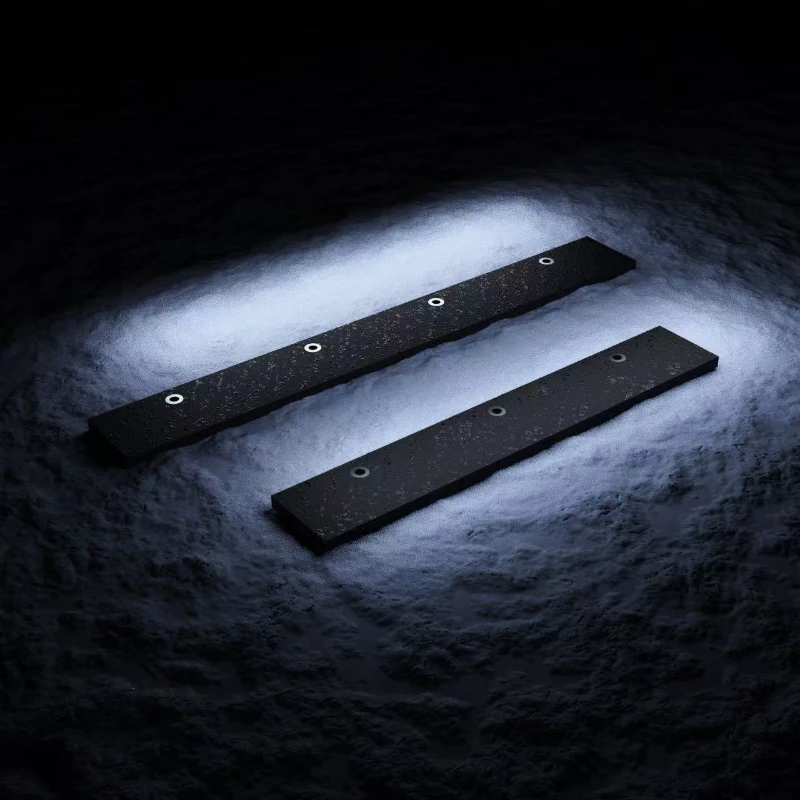
Two depots buy the same insert at the same price and fit it to the same edge length; at the end of the season one has spent roughly twice as much per metre as the other. Neither has been overcharged, and neither has a better supplier. The difference comes from labour, scrap and service life, which are part of the same figure and are usually left out of it.
This is a cost anatomy rather than a price guide. It breaks the figure into its four inputs, shows how each one moves the result, builds the calculation on a worked edge, and sets out what a quote request has to state so two suppliers can be compared on the same basis.

Carbide insert cost per metre: the four inputs
Cost per metre is a rate, not a price.
Insert cost per metre is the insert price multiplied by the number of positions per metre, divided by the metres of edge those inserts actually serve before replacement, with labour, scrap allowance and any resulting downtime added.
Two fleets buying the same insert at the same price can reach very different figures, because the other three inputs differ between them.
Keeping the figure as a rate rather than a total is what makes it portable. A 3.6 m edge and a 2.4 m edge cannot be compared on the price of a set, but they can be compared on cost per metre, and that comparison holds whichever machine each edge is fitted to.
Insert price, density and edge length
The numerator of the calculation has three parts, and only one of them is the price a buyer negotiates. Insert price is the obvious one. Density is the number of insert positions per metre, which is set by the pitch and is a specification decision rather than a market one. Edge length is the multiplier that turns both into a quantity.
Because density sits in the numerator, two identical edges cut to different pitches do not cost the same per metre before they have turned a wheel. That is not an argument for wider spacing; it is an argument for treating the pitch as a cost input at the point where it is chosen rather than discovering it later. How pitch is selected against the surface is set out on the spacing and density page.
Labour per insert change
Labour is usually the largest single input, and the one fleets most often estimate from the wrong starting point. The hours that matter are not the time spent with a tool; they are the hours from bringing the machine in to releasing it, including removal, preparation, fitting and inspection.
Two properties of labour make it decisive in the comparison. The first is that it is charged per change-out event rather than per insert, so an edge that needs the same work twice as often carries twice the labour even if the parts quantity is identical. The second is that it does not fall when the parts price falls, which is why a cheaper insert that shortens the interval can raise the rate rather than lower it.
The honest way to record it is as hours per change-out by task, converted to cost at the fleet’s own labour rate. Where the rework involves a controlled thermal process, it is a workshop job and should be priced as one; where it is a field change, the cost includes the mobilisation that goes with it.
Scrap and rework allowances
Scrap and rework are the inputs that never appear in a quotation and always appear in a season. An allowance belongs in the rate for three specific events: inserts damaged during fitting, positions that have to be reworked because a seat or fixing would not accept the new insert, and inserts lost in service before reaching their expected interval.
Each of those three is a real cost with a measurable frequency, and a fleet that records them can put a defensible figure in the model rather than a contingency. The practical approach is to record them as a percentage of inserts consumed over a season and add that percentage to the numerator rather than holding it outside the calculation, where it will be forgotten when the two options are compared.
Service life inputs
The denominator is where most of the variability between two otherwise similar fleets lives. Metres of service is not the same as edge length: it is the edge length multiplied by the number of times that set of inserts serves it before replacement, which is the figure the wear record produces.
Any consistent unit will do for the denominator, provided it is the same on both sides of the comparison. Hours of route work, lane-kilometres treated and seasons completed are all usable. The unit that causes the most trouble is seasons, because a mild winter and a severe one are not the same quantity, so a fleet switching to cost per metre is usually better served by a unit tied to work done than to time elapsed.
Worked example on a 3.6 m edge
The worked example below keeps the arithmetic visible and substitutes the fleet’s own figures at the end. Symbols are used deliberately: the point is the structure of the calculation, and a fleet’s own numbers are the only ones that make it meaningful.
| Step | Input | How it is obtained |
|---|---|---|
| 1 | Insert price (P) | Quoted price per insert for the specified grade and profile |
| 2 | Positions per metre (n) | Pitch on the drawing, converted to positions per metre |
| 3 | Set cost | P multiplied by n multiplied by 3.6 |
| 4 | Labour per change (L) | Recorded hours by task at the fleet’s labour rate |
| 5 | Scrap allowance (s) | Observed percentage of inserts consumed outside normal wear |
| 6 | Service delivered (D) | Metres of edge served per set, from the wear record |
| 7 | Cost per metre | (Set cost multiplied by (1 + s), plus L) divided by 3.6, divided by the number of times one set serves that edge |
Reading the last row as a formula rather than as a total is what makes the model useful. Change any of the seven inputs and the effect on the rate is visible immediately, which is the point of building it in the first place.
Where the cost moves fastest
Sensitivity matters more than precision in this model, because two of the inputs move the answer far more than the rest. The table below ranks the inputs by how much a change in each moves the rate.
| Input | Effect of a change | Who controls it |
|---|---|---|
| Service delivered per set | Largest: it divides the whole numerator | Grade, geometry and duty together |
| Labour per change | Large: charged per event, not per insert | Workshop method and edge design |
| Positions per metre | Direct multiplier on parts | Pitch decision at specification |
| Insert price | Proportional but bounded | Purchase negotiation |
| Scrap allowance | Small individually, cumulative over a fleet | Fitting practice and seat condition |
The order explains a common result: a fleet that negotiates a lower insert price and leaves the service interval unchanged has moved the smallest input in the model. A change in the interval, produced by grade or geometry, moves the largest one.
Comparing suppliers on the same basis
Two quotations can only be compared if they describe the same duty, and the discipline is to fix the specification before asking for prices. Fix the insert profile and dimensions, the grade class and the pitch, then ask each supplier to quote against that. Where one supplier proposes a different grade or pitch, ask for the reason and cost that alternative as a separate option rather than mixing it into the comparison.
Two further items belong in the request. The service interval each supplier expects from the specification, stated in the fleet’s own unit, since that is the denominator of the calculation. And the documentation that travels with the lot, because the ability to trace a delivered batch back to its production record is part of what the price buys. Equipment specification practice is published by the Association of Equipment Manufacturers and the Transportation Research Board.
What a quote request has to state
A quote request that produces comparable answers contains six items, and a request missing any of them tends to come back with prices that cannot be lined up.
State the edge length and the pitch, so density is fixed. State the insert profile, dimensions and grade class, so the part is defined. State the surface and the duty, so the supplier can judge the interval. State the quantity and the delivery pattern. State the documentation required with the lot. And state the basis on which the suppliers will be compared, which for this exercise is cost per metre with the fleet’s own labour and service figures.
Stating the comparison basis at the outset affects the answers. Suppliers who know the figure will be built into a rate tend to quote the interval they actually expect rather than the one that flatters the price.
What a low cost per metre can hide
A low figure is not always good news, and three patterns produce one that will not survive a season. The first is an unrealistically long service interval, which appears when the denominator was taken from a supplier estimate rather than from the fleet’s record. The second is a grade that shifts the failure from wear to chipping, which shortens the interval in practice and transfers cost into unplanned work.
The third is the most expensive: a lower parts price achieved by an insert that is deliberately specified at the light end, so it wears faster and the interval shortens. The rate looks better in the quotation and worse in the season, and the difference shows up as more change-outs rather than as a visible cost.
Placing cost per metre next to cost per lane-kilometre
Insert cost per metre is a component figure, not the decision. It answers what the cutting edge costs to keep working over a metre of edge; it does not answer what the route costs to treat. The two belong side by side, because the exposure that matters to a fleet is the one where a change-out collides with a storm.
The inputs needed to carry the figure up to route level are listed on the cost per mile inputs page, and the wider model that places the edge inside a whole-of-life figure is set out on the total cost of ownership page. Guidance on how winter treatment decisions affect a network is published by the Federal Highway Administration.
SENTHAI manufactures tungsten carbide inserts and plow edges in Rayong, Thailand, with the insert row, pitch and grade confirmed against the drawing before production, so a quotation is built against a defined part rather than an approximate one. Fleet cost practice at this level is published by the American Association of State Highway and Transportation Officials and the Snow and Ice Management Association, and county-level budgeting practice by the National Association of Counties.
FAQ
How do you calculate carbide insert cost per metre?
Multiply the insert price by the number of positions per metre of edge, divide by the metres of service the set delivers, and add labour, scrap allowance and any downtime the change-out causes. The figure is a rate rather than a price, which is what makes it comparable between two edges of different lengths.
Why is a cheap insert not the cheapest per metre?
Because the numerator is only one of four inputs. An insert that costs less but is replaced twice as often, or that needs the same labour twice, produces a higher rate. Labour per change is often the largest single input, and it does not fall when the parts price does.
Should downtime be included in insert cost per metre?
Yes, where the change-out can collide with a storm. If the work is always planned into a quiet window, a nominal figure is enough; if it sometimes pulls a truck off route, the rate has to carry that exposure or it will understate the cost of the more frequently serviced option.
How many positions per metre does an edge have?
It depends on the pitch at which the inserts are set, which is a specification decision rather than a constant. That is why density belongs in the cost calculation: the same insert at a closer pitch costs more per metre in parts and in labour before the edge has turned a wheel.
What service life figure should be used?
Use the fleet’s own record rather than a supplier estimate. Hours of route work, lane-kilometres treated or seasons completed are all usable, provided the same unit is used on both sides of the comparison. Where no record exists, one season of measurement produces a better figure than any assumption.
Send the edge length, the pitch, the insert profile and the service interval you are working to. The SENTHAI engineering desk will quote against that defined specification so the figure can be placed into your own cost per metre model.
This article is one step in the Carbide Insert Selection and Replacement Guide, which covers grade, geometry, spacing, fitment tolerance and the replace-or-re-plate call.