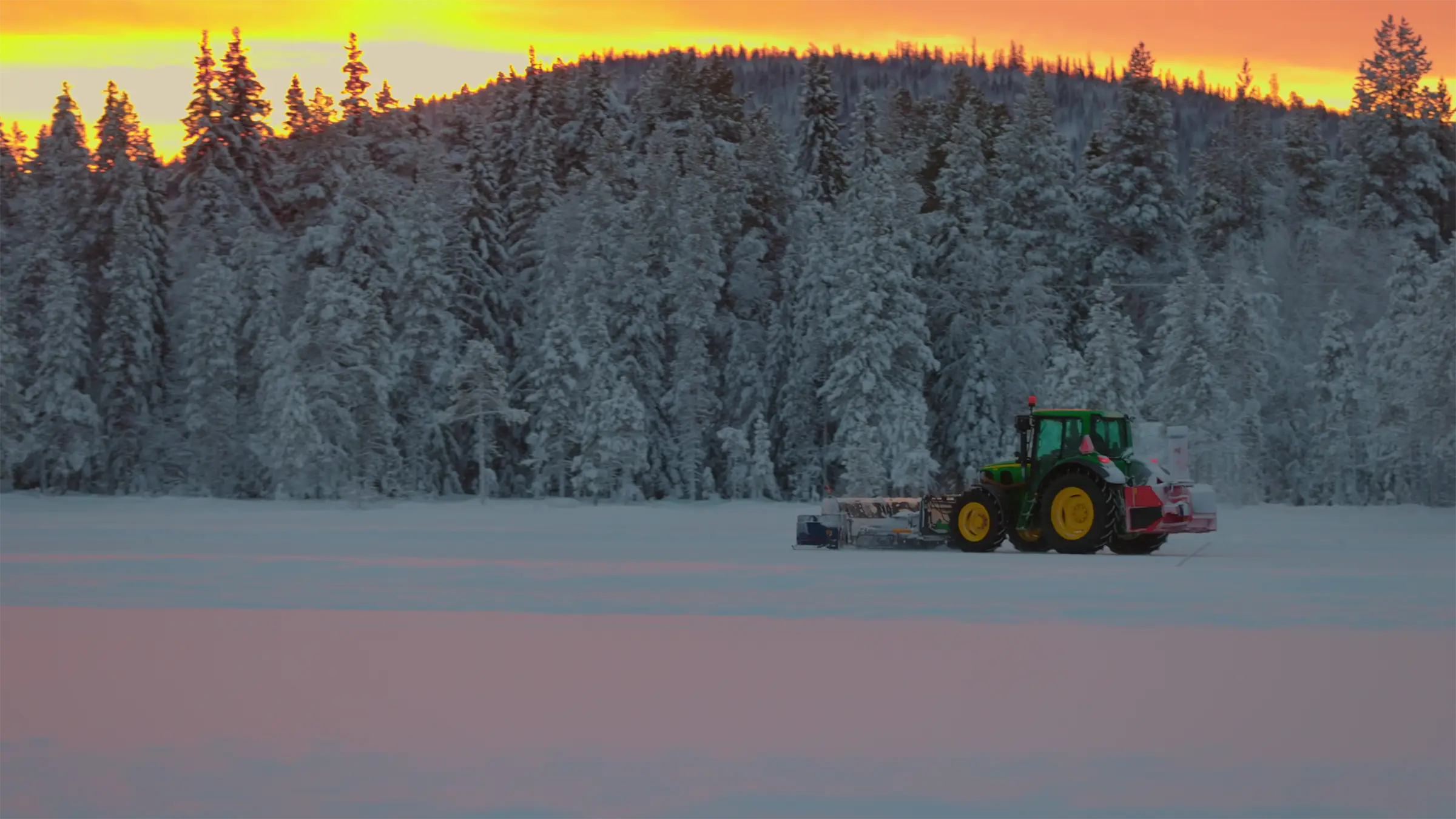
A grade that survives a mild winter without a single chip can start cracking once the same edge works through a night shift at -20 °C and below, and the material has not changed. What has changed is the duty: the ground is harder, the grit is locked into the surface, and the material being cleared yields instead of deforming, so the edge absorbs more energy at the moment it meets the road.
This is a question-driven guide rather than a grade chart reading. It works through what low temperature actually does, why frozen grit wears an edge differently from loose aggregate, how hardness and binder content move the trade-off, and how to validate a grade choice on a real route before committing a fleet to it.
What cold actually does to a plow edge
Cold weather changes four things that matter to an insert, and only one of them is a property of the carbide itself. The road surface becomes harder and less yielding. Grit that would move aside on a mild day is held in place, so it acts as a fixed abrasive rather than a loose one. The material being cleared changes from slush to bonded ice and hardpack. And the machine sees that material at the same speed with less give in it, which raises the energy delivered at each contact.
Those four changes arrive together, which is why a grade that performed well in a shoulder season can disappoint in mid-winter without anything having gone wrong. A specification that was matched to abrasion at moderate impact is now being asked to carry more of both.
Carbide grade for cold conditions: the mechanism people get wrong
Cold does not simply make carbide brittle.
Cemented carbide does lose some toughness as temperature falls, and that effect is real. But in most fleets it is a smaller contributor than the change in duty.
The failure mode that appears in January is usually a consequence of harder ground, locked-in grit and reduced yield in the material being cleared, all of which raise the load the insert has to carry. A grade chosen purely to compensate for low-temperature brittleness therefore tends to be tougher than the route needs and wears faster than it should.
Test methods for hardness and transverse rupture strength of cemented carbides are published by ASTM International, and the classifications used to describe hardmetal microstructure by ISO. Asking a supplier which of the two measurements their grade was selected on is a quick way to find out whether the cold-weather claim has anything behind it.
Low temperature effects on toughness
Toughness describes how much energy a material absorbs before it fractures, and like most material properties it moves with temperature. For cemented carbide the movement is gradual rather than a threshold, which is why there is no single temperature below which an insert suddenly becomes unsuitable.
What matters practically is that the margin between normal operating load and the load that causes fracture narrows as the edge gets colder. An insert that was running with a comfortable margin in November may be running with a much smaller one in January, even though nothing about the assembly changed. That is why cold-weather failures are so often reported as sudden: the load was always there, and the margin went away.
Abrasion from sand and aggregate
Frozen grit is a different abrasive from loose grit. Where the surface is soft, aggregate rolls or is pushed aside as the edge passes; where the surface is frozen, the same particles are held and the edge cuts across them instead. The result is faster material removal at the contact face and more of it concentrated at the leading edge.
Two further effects follow from that. The wear rate rises, so the interval between services shortens. And the distribution of wear changes, with more loss at the point of first contact and less in the middle of the face, which produces a profile that reads like a geometry problem when it is really a seasonal effect. Reading that profile correctly is what stops a fleet changing geometry to solve a wear rate that only needs a grade adjustment, and the diagnostics are set out on the wear pattern page.
Hardness versus fracture resistance
Hardness and fracture resistance are the two ends of the same trade-off, and a cold-weather specification is essentially a decision about where to sit between them. Raising hardness improves resistance to the abrasive contact that dominates on a frozen road; lowering it improves the ability to absorb the impacts that arrive when the edge meets something it cannot cut.
The decision is not made by choosing one end. It is made by identifying which of the two failure modes the route has actually produced, and the previous season’s inserts carry that answer. A row that comes back shortened and polished has been abraded. A row that comes back chipped, or with inserts missing, has been overloaded. Those two readings point in opposite directions, and applying the wrong one is how a fleet ends up with faster-wearing inserts than the ones it replaced.
Binder content and cobalt selection
Binder content is the second lever, and it is the one most often left out of a comparison because it does not appear on a simple hardness chart. The binder is the metal phase that holds the hard grains together; raising its proportion produces a material that absorbs more energy before cracking, at the cost of some wear resistance.
Because binder content and grain size both move the same trade-off from different directions, two grades with the same hardness can behave differently in service. A fine-grained grade with a modest binder content reaches its hardness through grain refinement, and a coarser grade with more binder reaches a similar figure differently. On a route that combines abrasion with regular impact, the second may survive where the first chips, and on a purely abrasive route the first will usually last longer.
Field validation approach
The only reliable test of a cold-weather grade is a comparison on the route, and the steps below are what make it evidence rather than an impression.
- Split the fleet so both grades run the same route mix, the same drivers and the same rotation practice.
- Record insert height at removal on both groups, from the same number of positions along each edge.
- Record service events as well as wear, since a grade that wears at the same rate but needs more changes is not equivalent.
- Photograph one edge from each group at the end of the season, so the failure mode is documented rather than described.
- Keep the results against the route, not against the machine, so the comparison is repeatable next season.
The third item is the one that is usually missing. A grade change that moves the failure from wear to chipping can leave the final measurements looking better while the fleet spends more time changing inserts, and only a service-event count exposes it.
Grade selection table
The table maps the duty to the direction the specification should move. It assumes the insert geometry and pitch are already fixed, since those change the load path before the material matters.
| Route condition in winter | Dominant mechanism | Direction |
|---|---|---|
| Frozen grit and sand over pavement | Abrasion at high contact pressure | Harder, finer structure with adequate binder |
| Deep freeze with rail crossings or ironwork | Impact energy raised by low yield in the ground | More binder for impact tolerance |
| Bonded ice and hardpack | Concentrated crushing load | Geometry first, then a tough grade to survive contact |
| Mixed route with frozen shoulders | Abrasion along the width, impact at the ends | Sections specified separately rather than one grade |
| Mild shoulder season on the same edge | Abrasion at lower load | Hold the winter specification; do not re-optimise per month |
The fifth row is a specification-discipline point rather than a technical one. Changing grades to suit the shoulder season produces an inventory that carries two parts for the same duty and a fleet that never builds a season-long comparison.
Where over-specifying costs money
Over-specifying in this context means buying impact tolerance the route never uses, and it is a more common error than under-specifying. A grade with more binder wears faster on an abrasive surface, so a specification chosen to survive a hypothetical impact produces a shorter interval and more change-outs on a route that never delivers one.
The same argument applies to grain refinement. A finer structure costs more and delivers more wear resistance, but on a route where impact dominates the extra hardness buys nothing and the smaller flaw size does not compensate for a lower binder content. The premium is only repaid where the failure mode it addresses is the one the route produces. How those two structures compare on a chart is set out on the grade chart and cross-reference page.
Three cold-weather grade myths
Three beliefs about winter grade selection recur often enough to change purchasing decisions, and each one is worth testing against the fleet’s own records.
- That every edge needs a tougher grade for winter. Only routes with real impact events benefit, and the rest pay for it in wear rate.
- That a lower temperature demands a different material. What changes at low temperature is the margin, not the mechanism, and the mechanism is still decided by the surface.
- That a grade which survived last winter will survive the next one. Route conditions move, grit applications change and machine down pressure is adjusted, and any of those can change the mechanism without changing the grade.
The third is the one that produces the most surprising failures. A fleet that treats a grade as settled stops reading its own inserts, and the first sign that the duty has changed becomes a season of unexplained chipping. Material behaviour under load is documented through the test methods published by ASTM International, and the equipment context through the standards maintained by SAE International.
Writing the cold-weather specification
A cold-weather specification that can be manufactured against states five things: the insert profile and dimensions, the pitch, the grade direction with the reason for it, the binder content where it has been agreed, and the dimensional tolerance that keeps the seat fit repeatable.
Two further items belong with it for the fleet’s own benefit. State the surface and the route condition the specification was chosen for, so a later review knows what it was matched to. And require the delivered lot to be identified against that specification, so a comparison across two seasons is comparing two known things. Published guidance on how winter conditions and treatment decisions interact across a network is available from the Federal Highway Administration.
SENTHAI manufactures tungsten carbide inserts and plow edges in Rayong, Thailand, with grade selection matched to the wear mechanism a route produces rather than to a general rule about climate. Material data published by carbide producers such as Plansee is useful for reading the property values behind a grade, and routes that need the specification built from their own wear records can be discussed through the contact page.
FAQ
Does carbide get brittle in the cold?
Cemented carbide does lose some toughness as temperature falls, but that is rarely the main reason a cold-weather edge fails early. The larger change is in the duty: frozen ground is harder, grit is locked into the ice, and the material being cleared yields less, so the edge absorbs more impact energy and sees more abrasive contact.
Should I go softer for winter work?
Not automatically. A softer, tougher grade will chip less where the edge meets ironwork, and it will wear faster on a route carrying frozen grit. The choice follows the failure mode that the previous season produced, which is why one season of wear records is worth more than a general rule about cold weather.
What does binder content change?
Binder content is the proportion of the tough phase in the material, so raising it trades wear resistance for impact tolerance. Two grades at the same hardness can have different binder content, which is why a hardness figure alone does not predict how a grade behaves on a route with both abrasion and impact.
How do I test a grade for a cold-weather route?
Split the fleet, run both grades through the same season, and record wear measurements and service events for each group. The comparison only holds if the route mix, drivers and inspection routine stay the same for both. One season run that way settles the question better than several seasons of changing one variable at a time.
Is a harder grade always the better specification?
No, and on a mixed route it can be the worse one. Hardness raises wear resistance and reduces tolerance for impact at the same time, so a grade chosen for the abrasive sections can fail where the edge meets raised ironwork. On routes with both conditions, specifying sections separately usually outperforms a single compromise grade.
Send the route surfaces, the winter temperature range and the wear pattern from last season. The SENTHAI engineering desk will confirm the grade direction and report the values behind it so the choice can be compared.
This article is one step in the Carbide Insert Selection and Replacement Guide, which covers grade, geometry, spacing, fitment tolerance and the replace-or-re-plate call.