A flexible edge usually clears broken pavement more completely than a rigid one, which is the opposite of what most operators expect before they run one. The advantage is not softness. It is contact: the base deflects locally so the cutting line follows the surface instead of bridging across it, and the insert row keeps working where a rigid edge would lift clear.
That single difference explains most of the behaviour described below, including where flex edges are the wrong tool. This guide covers what a flex blade on rough surfaces actually does: conformity, cleaning performance on broken pavement and gravel, casting distance, the adjustments that matter and the wear signs worth watching.
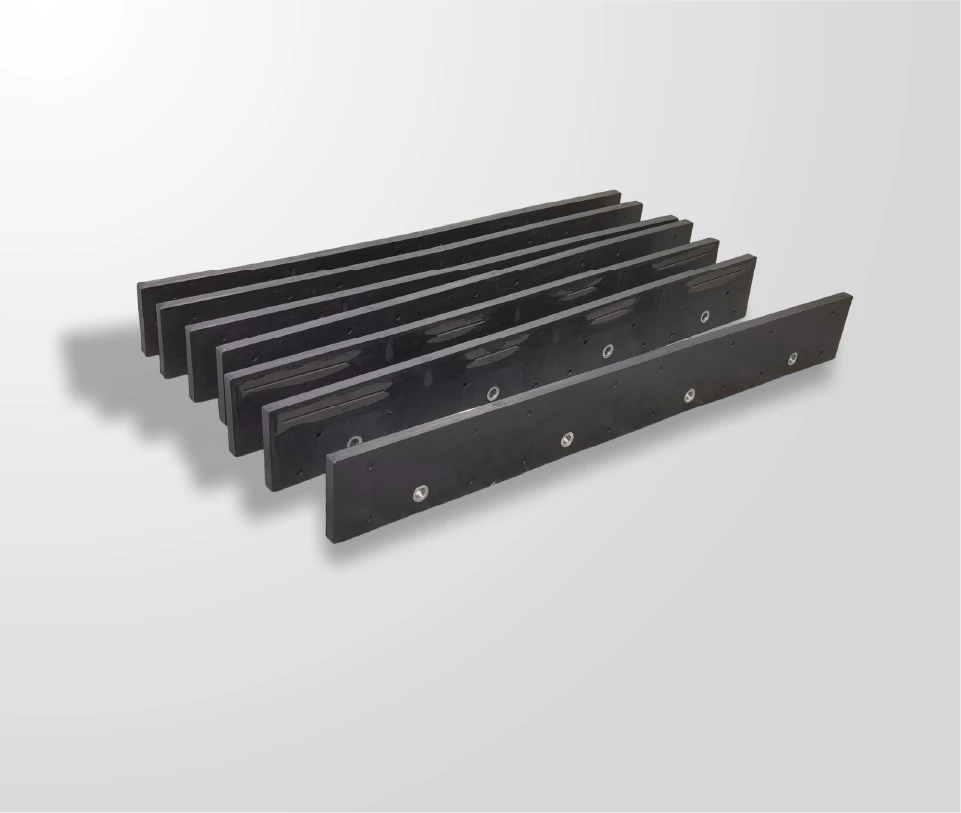
How a flex blade on rough surfaces stays in contact
It deflects locally, so the edge follows the surface.
A rubber-flex base bends over a dip or a lump instead of bridging it, which keeps the insert row in contact where a rigid edge would lift and stop cutting.
The mechanism is worth separating into its two parts. The base provides conformity: it is the component that allows a local change of shape without transmitting the whole impact into the moldboard. The insert row provides the cutting action, and it is still a hard material working against an abrasive surface. A flex edge therefore does not clear better because it is soft; it clears better because the hard part stays in contact with more of the surface.
Three conditions decide whether that contact is maintained in practice. The blade has to be loaded, because a flex edge that is not touching anything conforms to nothing. The segmentation has to be sound, since a joint that has opened interrupts the contact line. And the mounting has to allow the assembly to move as designed, which is why the fitting procedure matters as much on a flex system as on a rigid plate.
Myth: a flexible edge clears less because it bends
The claim assumes the blade is there to scrape, and on broken pavement it is not. A rigid edge that cannot follow the surface clears the high points and rides over the low ones, so the material it leaves sits exactly where the pavement is already weakest.
The measurement that settles the argument is contact continuity rather than blade stiffness. A flexible base conforms across a change in surface height, which means the edge is in contact for a greater proportion of the pass than a rigid edge that spans the same change. On a stretch of patched or jointed pavement the difference shows up as material left in the low areas rather than as material missing from the high ones.
Where the claim is right is on bonded layers. A flex edge does not concentrate enough pressure to fracture hardpack or ice, so on those surfaces the bending is a disadvantage and the honest answer is a different tool rather than a different technique.
Cleaning performance on broken pavement
Broken pavement is where the difference between the two edge types is easiest to see. A rigid blade spans the gaps between raised patches, joints and settled slabs, so the cutting line touches the high points and skips the low ones. The result after a pass is a pattern of cleared and uncleared strips that the next pass has to correct.
A flex edge follows that profile. Where the pavement drops away, the base bends and the insert row continues to scrape; where it rises, the base absorbs the change instead of transferring it into the moldboard. Operators usually report two things after switching: fewer uncleared strips, and less shock reaching the machine. The second effect is often the one that shows up in the maintenance record first, because it removes the repeated impact loading that loosens fasteners and distorts mounts.
The trade is subtle rather than dramatic. A flex edge removes surface material less aggressively than a rigid carbide edge on hard, uniform pavement, because the contact pressure at any single point is lower. On sound asphalt that difference is small; on a route made up mostly of broken pavement, the conformity usually more than compensates for it.
Gravel and unsealed surface behaviour
Unsealed roads are the surface a flex edge suits best, and the reason is that the objective changes. On gravel the goal is to move snow without cutting into the road, so the edge has to ride over embedded stone rather than catch on it. A rigid edge finds every stone that stands proud; a flexible one deflects over the obstruction and continues.
The operating setting has to match. Set the blade to float and the flexible edge leaves a layer of snow that protects the surface and prevents the gravel from being windrowed to the verge. Set it low and the same edge will cut into the surface, because conformity to the profile does not prevent the blade from being pressed too deep overall.
Wear behaves differently here as well. Impact loading is lower, so fastener and mount failures become less common, while abrasion from grit remains. The practical consequence for a fleet is that the failure mode moves from structural to consumable, which is easier to plan for and cheaper to absorb.
Casting distance versus rigid edges
Casting distance is a function of moldboard geometry, blade angle and speed, not of the edge material alone. A flex edge does not change the moldboard, so the throw over a bank at a given speed depends mainly on how the snow is lifted and released by the curve behind the edge.
What the edge changes is the state of the material as it arrives. A rigid edge cuts a clean line and starts material moving with more direction; a flexible edge conforms and often leaves a slightly thicker layer at the point of contact, so the material that reaches the moldboard is already partly carried rather than being cut loose. On short throws — clearing to the verge, working a car park or a residential street — the difference disappears into the geometry. On long throws at speed, where material has to travel over a bank, a rigid carbide edge generally casts further, and that is a legitimate reason to keep one on highway routes.
Operator adjustments that matter
Four adjustments decide how a flex edge behaves on a given route, and all four are within the operator’s control. Down-pressure sets how hard the edge is pressed to the surface; speed sets how much energy each contact carries; depth control sets the gap the edge works in; and blade angle sets the direction the material is pushed.
Down-pressure and depth control work together, and the honest rule is to use the least pressure that keeps the edge loaded. Extra pressure increases wear at the contact line, loads the fasteners, and presses the base further into the surface than the profile requires. Depth control is what makes low pressure possible: set correctly, it holds the working height so the operator does not have to compensate with force.
Speed follows the surface. On rough pavement and gravel, a lower speed keeps the contact consistent and reduces the impact energy that reaches the segments and the mount. On long straight runs where casting matters, speed is set by the need to move material rather than by the desire to finish quickly.
Wear indicators to watch
Read the row in two parts, because the two parts fail for different reasons. The insert row is the consumable: carbide loses its profile under abrasion and the segment is replaced when the wear face reaches its limit. That is normal service and it should be planned from records rather than discovered.
The base is the diagnostic component. A base that has taken a permanent set no longer seats flat; a base showing cracking along its length is losing the conformity the design depends on; and a base that is being consumed faster than the inserts usually means the blade is running deeper than the surface allows, so the rubber is doing the scraping. Checking the base at the same interval as the inserts is what keeps this a maintenance decision rather than a breakdown.
Where a fleet runs both edge types, the comparison between them is usually settled by how each one fails rather than by how long each one lasts. That comparison is set out in the guide to rubber-flex versus carbide snow plow edges, and the route-level view of which task suits which construction is in snow plow blade selection by road class.
Do flex edges damage gravel roads?
The objection is the reverse of the truth on unsealed surfaces. A rigid edge bearing down on gravel lifts stones and pushes the top layer into the verge; a flexible edge deforms over a stone rather than levering it out, so the surface stays where it belongs.
What a flex edge does require on gravel is the right height. Set too low it still cuts into the surface, and the giveaway is a visible windrow containing road material rather than snow. Set correctly, the edge rides the loose layer and leaves a thin running surface, which is the compromise that keeps the road intact through the season.
The comparison against a rigid edge on gravel therefore comes down to two numbers: how much material ends up on the shoulder, and how much the fleet spends putting it back in spring. On most unsealed routes the second number decides it.
How a rubber flex base behaves in extreme cold
Rubber is not a constant material across the temperature range a winter fleet works in. As the temperature falls the base stiffens, so the same edge behaves as a more rigid blade on the coldest mornings and as a fully conforming one in milder conditions.
Two consequences follow for an operator. The first is that a setting which follows a crowned road well at around freezing will scrape more firmly at the low end of the range, so the height may need to be adjusted for the conditions rather than left where it was set. The second is that the stiffness change affects how the edge behaves over obstructions: a cold base is less forgiving, which raises the load transferred into the mounting on those mornings.
The practical response is to treat the flex edge as a component with a working temperature range rather than a fixed behaviour, and to record the settings used in each condition. That record is what makes next season’s setup a starting point instead of an experiment.
| Condition | Base stiffness | Surface conformity | Operator response |
|---|---|---|---|
| Around freezing | Most flexible | Highest | Set height for light contact and let the base conform |
| Well below freezing | Noticeably stiffer | Reduced over sharp changes | Check height again; reduce speed over obstructions |
| Repeated refreeze cycles | Stiff on the cold pass | Variable through the shift | Re-check after the first pass rather than at the start |
| Thawing surface | Flexible again | High, with a wet substrate | Watch for material being cut rather than cleared |
Choosing shoes for a flexible edge
Shoes and a flexible edge solve overlapping problems, and fitting both without thinking about which is doing the work is a common source of poor clearing. On a route where the edge conforms well, shoes set high simply lift the assembly off the surface and remove the benefit the flex base was fitted for.
The useful division is by surface rather than by machine: where the edge can be allowed to reach the surface, let the flex base do the conforming and set any shoes at the minimum height. Where the surface must be protected from the edge entirely — decorative paving, a weak shoulder, a new surface dressing — the shoe is doing the protecting and the edge is following it.
Deciding which role each part plays before the season is what prevents the usual outcome of a flex edge fitted with shoes that keep it clear of the ground for the whole winter.
When flex edges should not be used
There are four situations where a flexible edge is the wrong specification, and recognising them prevents the disappointment that follows from using one tool for every job. The first is bonded ice in deep cold, where the surface has to be broken rather than followed and a rigid insert edge does that work more directly. The second is high-speed highway clearing, where casting distance and a consistent cutting line matter more than conformity.
The third is a route where abrasion is so dominant that insert life alone decides the cost per lane-kilometre, because a flexible assembly adds components that do not contribute to that number. The fourth is a machine whose mounting cannot support the assembly’s movement, where the conformity the design offers is not available in practice.
Outside those cases, the behaviour described above is consistent enough to plan around. Winter severity, which decides how often a route presents broken pavement, ice or loose snow, is a planning input published by services such as the National Weather Service, and the wider research on how surfaces and equipment interact is published by the Transportation Research Board and by the Association of Equipment Manufacturers. Where mechanical clearing reduces the amount of de-icing material required, the environmental case is documented in the EPA nutrient pollution material, and operator practice is covered by the Snow and Ice Management Association. Material and hardness claims can be referenced to published test methods from ASTM International.
The conclusion for a fleet is to specify the flex edge for the routes it suits — broken pavement, mixed surfaces and unsealed roads — and to keep a rigid insert edge for the work it suits better. Set the blade to float on gravel, keep down-pressure low on pavement, inspect inserts and base together, and treat casting distance as a property of the moldboard rather than a reason to choose one edge over another. SENTHAI produces rubber-flex JOMA style blades and carbide cutting edges in Rayong, Thailand, with lot-level traceability and fitment confirmed against the mounting pattern.
FAQ
Do flex blades clear rough asphalt as well as rigid edges?
On broken or patched asphalt they often clear the surface more evenly, because the base follows the profile instead of bridging over the low spots. The advantage comes from contact rather than from force, so it depends on the edge staying loaded. On smooth, sound pavement the difference is small, and the deciding factor becomes insert wear and operating speed.
How fast can a rubber-flex edge be used?
Speed is limited by the surface rather than by the edge alone. The flexible base tolerates impacts that a rigid edge would transfer into the moldboard, which is why these edges suit rough and mixed routes, but casting distance and clearing width fall away as speed rises and material is thrown less effectively. Match speed to the surface and to the machine’s traction.
What wears out first on a flex blade?
Read the row in two parts. Insert wear is the normal consumable: the carbide loses its profile and the segment is replaced at its limit. Base wear or a base that has taken a permanent set is a different signal, pointing to handling, storage or excessive down-pressure. Cracking along the base is the condition to catch early, because it changes how the whole segment conforms.
Can a flex blade be used on gravel and unpaved roads?
This is one of the surfaces the design suits best, provided the blade is set to float. On gravel the objective is to move snow without cutting into the surface, and a flexible edge rides over embedded stone where a rigid one catches. Expect a layer to remain: on unsealed roads that layer is the surface protection, not a failure to clear.
Send the route mix, the surfaces and the machine models. The SENTHAI engineering desk will confirm whether a rubber-flex assembly suits the work, specify the segments with their hardware, and quote the spares interval alongside it.
This article is one step in the JOMA Style Rubber-Flex Blade Guide, which covers segments, clamps, insert retention and off-season storage.