The comparison that decides most flex blade purchases is not blade against edge. It is what two steel change-outs a season cost you in parts, workshop hours and route time, measured against a system that is bought once and re-segmented afterwards.
This guide sets out the model, the inputs you need to run it, and the break-even logic that turns the comparison into a decision a procurement analyst can defend.
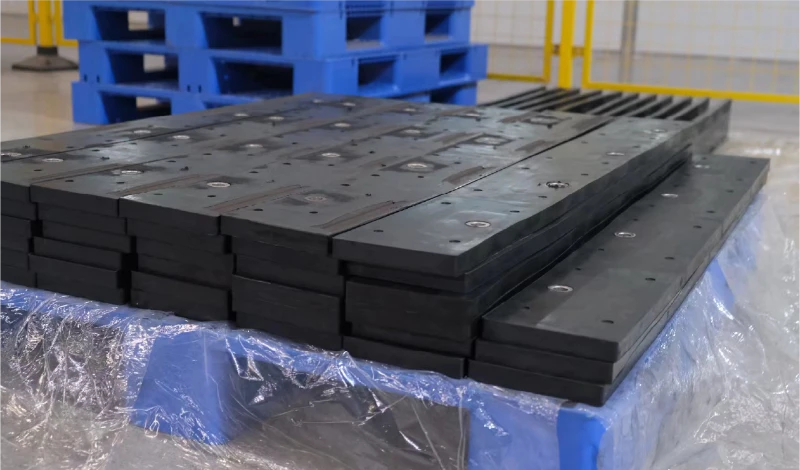
JOMA blade cost: purchase price versus cost per season
Cost per season is the total of parts, workshop hours and downtime over a defined period, divided by the number of seasons that period contains.
Purchase price enters that calculation once, while the other three lines recur. That is the whole structure of the comparison, and it explains why the two options order themselves differently depending on the route. A steel edge is inexpensive to buy and is consumed repeatedly; a flex assembly costs more up front and is renewed in parts, with the body outliving several segment sets.
Write the model down before comparing quotations, because a supplier’s price list cannot tell you which side wins:
Cost per season = (parts + workshop hours × your hourly rate + downtime hours × your downtime cost) ÷ seasons covered
Two practical notes on the inputs. Workshop hours should include the time to handle the blade, not only the time to tighten fasteners, because handling is the larger part of a change-out on a heavy assembly. Downtime should be valued at whatever the machine’s unavailability actually costs: a contract penalty, a hired replacement, or simply the route running late. The comparison should use your numbers, not a supplier’s.
Labour and workshop hours
Labour is the line most often omitted and the one that shifts the answer fastest. A change-out is not a bolt-on operation: the machine has to be brought in, the blade supported, the fasteners removed, the mounting face cleaned, the new edge fitted, the cutting line checked and the depth setting restored. Several of those steps repeat every time the edge is changed, which is why a route that consumes two edges a season also consumes the workshop time twice.
A flex system changes the shape of that labour rather than removing it. The initial assembly takes longer than a single edge change, because a full row of segments has to be aligned and torqued. Subsequent segment replacements are shorter per event and often partial: the worn segments come off, the replacements go on, the row is re-checked. Recording hours per event, rather than a single figure for the season, is what makes the comparison honest over several seasons.
Downtime on route
Downtime is the cost of a machine that is not clearing, and it is usually larger than the parts being replaced. Two effects belong in the calculation. The direct one is the hours the machine is unavailable while the work is done, which for a mid-shift failure includes recovery and travel as well as the repair. The indirect one is the effect on the rest of the route: a delayed machine either runs late, which carries its own cost, or leaves part of the route for a second pass.
The reason this line favours a longer-life assembly is that the failure is predictable. A system that is inspected and re-segmented on a schedule produces planned downtime in a workshop; a system that fails when the edge reaches its limit produces unplanned downtime on a route. The two are not equivalent even when the hours are the same, and the calculation should reflect that.
Route length and surface effects
Route length and surface decide how many change-outs a season contains, which is the input that drives everything else. Abrasive surfaces such as gritted highways consume edges faster; impact-heavy routes with joints and buried obstacles damage them; short routes on smooth pavement may finish a season on a single edge. The per-lane-kilometre payback method is set out in the analysis of carbide edge payback per lane kilometre, and it applies to a flex assembly in exactly the same way.
The practical consequence is that one fleet can justify a flex system on one route and not on another, using the same procurement rules. That is not inconsistency; it is the model responding to the only input that varies between them. Comparing materials on a single route is the fastest way to learn which of your routes belongs in which category, and the route-level selection logic is described in snow plow blade selection by road class.
Two-season comparison example
The table below is the structure to fill in, with the inputs expressed as quantities rather than as prices, so the model can be run with your own figures. Two seasons is the shortest period that shows the difference, because it contains a segment replacement on the flex side and at least three steel change-outs on the other.
| Cost line | Steel edge, two change-outs a season | Flex blade system |
|---|---|---|
| Parts | Edge price × change-outs × 2 seasons | Assembly once + segment set as consumed |
| Hardware | New fastener set per change-out | Fastener set per replacement, fewer events |
| Workshop hours | Hours per change-out × events | Assembly hours once + shorter partial replacements |
| Downtime hours | Unplanned events, mid-season | Planned events, scheduled in the workshop |
| Sub-total per season | Total ÷ 2 seasons | Total ÷ 2 seasons |
Where the numbers turn
The break-even is expressed as change-outs avoided. Take the total cost of one steel change-out, including parts, hours and downtime, then divide the extra purchase cost of the flex assembly by that figure. The result is how many change-outs the flex system has to avoid before it has paid for itself. On a route that consumes one edge a season, that number is rarely reached; on a route that consumes two or three, it usually is.
Three factors move the break-even in favour of the longer-life option: a higher labour rate, a higher cost of machine downtime, and a longer route that consumes more edges. Two factors move it the other way: a low annual consumption, and a surface where inserts are consumed rather than worn evenly, because in that case the segment cost dominates and the body’s longevity matters less.
Documenting the decision for auditors
Public-sector and larger private buyers increasingly have to show how a specification decision was reached, and the model above produces exactly that evidence if it is recorded. Keep the inputs, their source and the date: consumption per route from the fleet’s own records, hours per change-out from workshop logs, the labour rate from payroll, and the downtime estimate with its basis stated.
Record the break-even figure and the assumption behind it, then revisit both after the first full season. A decision that is documented can be corrected with evidence; a decision recorded only as a preference cannot. The purchasing side of the same logic, including how a fleet compares replacement parts between suppliers, is covered in the material on choosing between rubber-flex and carbide edges.
The conclusion is that JOMA blade cost is a seasonal figure rather than a purchase figure. Count parts, hours and downtime over at least two seasons, convert the comparison into change-outs avoided, and let the route decide which side of the break-even it sits on. Route-level operating assumptions and their effect on equipment cost are also covered in the research published by the Transportation Research Board and by the Association of Equipment Manufacturers, with operator practice published by the Snow and Ice Management Association. Where material cost movements affect the parts line of the model, the published market data in the USGS mineral commodity summary for tungsten is a useful reference, and material and hardness claims in a quotation can be referenced to methods published by ASTM International.
FAQ
Are JOMA blades worth the price compared with steel edges?
They are worth it where a route consumes more than one steel edge a season, where change-out hours are expensive, or where a blade out of service costs more than the parts. They are not worth it on short routes that finish a season on one steel edge, or where the surface is abrasive enough that the inserts are consumed rather than worn evenly. The route decides, not the price list.
What belongs in a cost-per-season comparison?
Four lines: parts, workshop hours at your labour rate, downtime for the machine, and any consumables such as hardware. A comparison that counts only parts understates the case for the longer-life option, because the change-out hours and the route time repeat with every replacement. Add the value of a route that stays on schedule as an operational cost, not a soft benefit.
How many steel change-outs make a flex blade pay?
Calculate the total cost of one change-out, including parts, hours and downtime, and divide the extra purchase cost of the flex assembly by that figure. The result is the number of change-outs the flex system has to avoid to break even. If your route consumes two steel edges a season and the assembly lasts several seasons, that calculation usually settles the question.
Should segment replacements be counted as a cost?
Yes, and they are the reason a flex system is compared over several seasons rather than one. The blade body outlives the segments, so the recurring cost is the segment set rather than a complete assembly. Counting only the first purchase flatters the numbers, while counting a full replacement every season punishes them; both distortions make the decision harder than it needs to be.
Send the route lengths, the change-out hours and the surfaces you work on. The SENTHAI engineering desk will confirm the fitment and supply the parts and documentation side of the model so the comparison can be run with your own figures.