The attachment that clears a road fastest is often the one that cannot cut packed snow, and that mismatch is behind a large share of the ice-control work a city does every winter. A wide blade travelling at speed clears loose snow efficiently and rides straight over a bonded layer without touching it, which is why the surface looks treated and behaves as if it has not been.
This decision path works through the choice one step at a time: what the surface on a municipal route is actually made of, which of three actions suits it, what the carrier has to supply, and how to run a trial that produces a defensible answer rather than an impression.

What the surface on a municipal route is actually made of
A municipal route in mid-winter is usually a patchwork rather than a single surface, and the patchwork is what makes a fleet-wide answer wrong. The same street can carry loose snow at the kerb, polished hardpack in the wheel tracks, bonded ice at a junction and bare pavement on the sunny side.
Those sections were produced by different mechanisms and respond to different tools. Loose snow yields to a blade; polished hardpack needs contact pressure to break it; bonded ice at a junction needs the same pressure concentrated further. A fleet that specifies one attachment for the whole route is choosing which section to serve well and which to leave.
The mapping work is worth doing once per route and repeated each season, because the sections move. A route’s shaded sections, gradients, bridge decks and stop-start junctions are the parts that consistently produce bonded material, and they are the parts to describe when asking for advice.
Snow cutter for packed snow: scraping, cutting or scarifying
Three actions cover packed snow: scrape, cut, scarify.
Scraping removes material lying on the surface and suits loose or partly broken snow, which is what most plow blades are built for.
Cutting applies concentrated pressure until the bond between the layer and the pavement fails, which suits hardpack and thin bonded ice, and it is the action a carbide insert edge is arranged to produce. Scarifying breaks the surface up without removing it in one pass, which suits thick bonded layers where the immediate aim is to open the surface so treatment or traffic can do the rest.
The three actions can also be combined along one route rather than chosen between, which is where most municipal fleets end up. A cutting edge on the carrier that works the icy sections and a scarifying attachment deployed when a layer has built up over several cycles is a more realistic arrangement than a single tool expected to do all of it.
Types of packed snow and ice layers
Distinguishing the layers is the step that most often changes the answer, because layers that look similar from the cab behave differently under a tool.
- Wind-packed snow, consolidated by weather rather than traffic, usually firm rather than glassy and responsive to a cutting edge.
- Traffic-polished hardpack, dense and smooth in the wheel tracks, which needs contact pressure concentrated at a small area.
- Refrozen meltwater, which forms the hardest and glossiest layer and responds to cutting only at low speed and high pressure.
- Grit-embedded ice, where spread abrasives have been locked into the surface and add wear to whatever is cutting it.
- Bridge-deck and overpass glaze, which forms early and clears late because the structure stays colder than the surrounding ground.
The third and fifth entries are the ones that most often defeat a standard edge, and both are route features rather than weather events, which is why they belong on the route map.
Carrier and down-pressure requirements
The carrier has to be able to supply two things: a consistent cutting line and adjustable down pressure. Where either is missing, no attachment choice compensates for it, and the fleet ends up with a tool that works well on one machine and disappoints on another for reasons that are not about the tool.
Consistency matters because a cutting edge works by concentrating pressure, and a blade that floats or follows the pavement raises and lowers that pressure along the route. Adjustability matters because the right setting depends on the layer: more pressure to break bonded ice, less to avoid cutting into a soft or newly treated surface. A carrier that can do both is a candidate for a cutting attachment; a carrier that can do neither is a candidate for a different route assignment.
Blade versus specialty cutter attachments
The table below compares the main options on the variables that decide which one suits a given section of route.
| Option | Action on the surface | Best suited to |
|---|---|---|
| Conventional steel or clad blade | Scrapes and casts | Loose and partly broken snow across the whole route |
| Carbide insert cutting edge | Cuts by concentrated contact pressure | Polished hardpack and thin bonded ice |
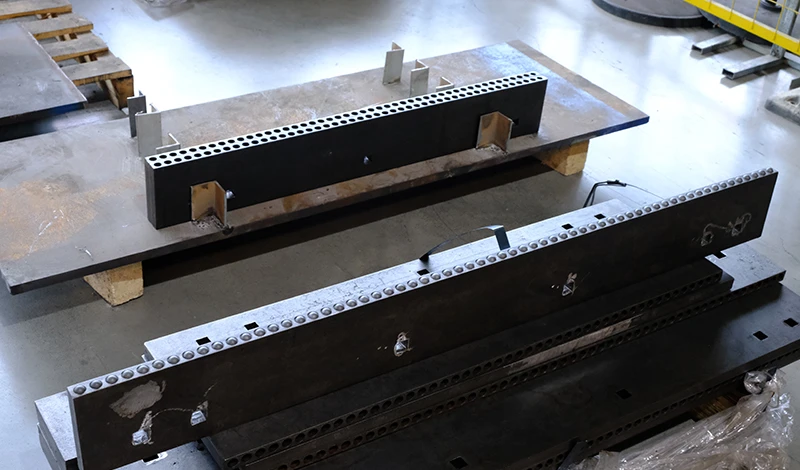
| Isolated insert array on a dedicated edge | Cuts with the highest contact pressure per point | Thick, refrozen layers and intersection ice |
| Scarifying attachment | Breaks the layer up without removing it | Layers built up over several cycles, ahead of treatment |
| Underbody blade with the same edge | Cuts beneath the front blade’s line | Routes where the front pass leaves material in the wheel tracks |
The fifth row is worth considering before any new purchase, because a second pass with an existing underbody edge changes the result on a route without adding a tool to the shed.
Choosing for intersections, hills and shaded sections
Three route features produce most of the packed snow a city deals with, and each points to a slightly different answer. Intersections generate polished hardpack and refrozen slush, because vehicles stop and restart through the freeze and the surface is disturbed and refrozen repeatedly. Hills produce the same layer plus a traction problem, which raises the cost of leaving it.
Shaded sections and bridge decks produce material that forms earlier and clears later than the rest of the route, so a fleet working to a route-average schedule is always behind on those sections. The practical response is to identify them on the route map and treat them as separate work rather than as part of a pass.
Matching the cutter to the route rather than the fleet
A fleet-wide standard is easier to manage and usually produces a worse result, because the sections that generate bonded hardpack differ between routes. The compromise that works is to standardise the mounting and the insert type while varying the arrangement and the setting per route group.
Two conditions make that manageable. The same insert and fixing pattern across the fleet, so spares and training stay simple. And a written setting for each route group, with the surface it was chosen for, so a new supervisor inherits the reasoning rather than the number. How the arrangement itself is specified is set out on the packed ice kit page.
Trial plan on one route
The trial is what turns a recommendation into a decision, and it needs a baseline recorded before anything is fitted.
- Choose the route with the most persistent bonded sections and the highest recorded cycle count.
- Record a full season of the current position: passes per storm, applications, call-outs and surface condition after each event.
- Fit the attachment to that route only, and keep the records in the same format and the same units.
- Record the effective speed on bonded sections separately, since it will differ from the current routine.
- Compare the two seasons on the recorded events rather than on operator impressions.
The fourth item is the one that keeps the trial honest. A cutting edge works at lower speed on thick layers, and a trial that does not record that difference will report a saving that includes work simply moved into another shift.
What a trial has to measure
Four measurements carry the result: passes per storm, applications of chemical and abrasive per storm, out-of-hours call-outs, and the surface condition of the bonded sections after each event. Together they describe the work the route needed, which is what a change of tool is supposed to reduce.
Two further records make the result durable. Insert or edge height at the start and end of the season, so the wear cost is in the comparison rather than outside it. And the settings used, including down pressure and operating speed, so the result is attributable to the arrangement and not to a change in how the route was worked.
Cost and availability considerations
The cost side is not only the purchase price, and treating it as such is how a justified decision becomes a difficult one at budget time. Three lines belong in the comparison: the attachment and its consumable inserts, the operator hours the new routine requires including the slower speed on bonded sections, and the training time to run it consistently.
Availability has a seasonal dimension that is easy to overlook. Inserts and kit components come from a supply chain with its own lead time, and a fleet that standardises on an arrangement it cannot restock in January is exposed in the way that matters most. Confirming the reorder position before the season, rather than during it, is part of the specification rather than part of procurement.
Common selection mistakes
The mistakes below account for most of the disappointing trials, and none of them is about the attachment being unsuitable in principle.
- Choosing an attachment before mapping the route, so the tool is matched to the average surface rather than the worst section.
- Fitting a cutting edge to a carrier that cannot hold down pressure, which produces riding rather than cutting.
- Running at the speed the route has always been worked, which takes the contact time away from the insert.
- Changing an attachment and a route schedule in the same season, which leaves neither result attributable.
The fourth entry is the most common and the most avoidable. A fleet that changes one thing at a time gets an answer it can use; a fleet that changes several gets a season of data it cannot interpret.
What to write in the specification
A specification that produces a repeatable result names the working width and the arrangement across it, the insert profile and dimensions, the grade direction with the duty it was chosen for, the mounting pattern with its tolerance, and the documentation that travels with each lot.
Two further items belong on the order for the fleet’s own benefit: the route group the arrangement was chosen for, and the reorder level that keeps the fleet supplied through the season. Published guidance on how conditions and treatment decisions interact across a network is available from the Federal Highway Administration and its road weather programme, and research on winter maintenance performance from the Transportation Research Board.
SENTHAI manufactures packed ice carbide kits, inserts and cutting edges in Rayong, Thailand, with the insert arrangement confirmed against the carrier and the surface the route produces. Equipment specification practice is published by the Association of Equipment Manufacturers and fleet operations practice by the Snow and Ice Management Association, and routes that need an arrangement matched to their own sections can be discussed through the contact page.
FAQ
What cuts packed snow on a city street?
A tool that concentrates contact pressure enough to break the bond between the layer and the surface. On a municipal route that is usually an edge carrying carbide inserts rather than a continuous steel strip, because the same down force divided across a small contact area is what turns riding into cutting.
Do I need a separate machine for packed snow?
Often not. What matters is whether the carrier can hold a consistent cutting line and supply adjustable down pressure. A machine that floats its blade or has fixed down pressure will not develop the contact a cutting attachment needs, and where that is the case the attachment choice will not fix it.
Is a scarifying attachment better than a cutting edge?
They do different jobs. Scarifying breaks the surface up so that treatment or traffic can work on it, which suits thick bonded layers where the aim is to open the surface. A cutting edge removes the layer, which suits thinner hardpack where the aim is to restore the pavement in one pass.
How do I run a trial on one route?
Record the route’s current baseline for a full season first, then fit the attachment to that route only and keep the records in the same format. Measure passes, applications, call-outs and the surface condition after each event, so the comparison rests on records rather than on what the operators remember.
Send the route map, the sections that stay bonded and the carrier’s down-pressure capability. The SENTHAI engineering desk will confirm which action suits each section and what the arrangement should be.
This article is one step in the Packed Ice Edge Guide, which explains why a standard edge skates across hardpack and how to set one up so it bites.