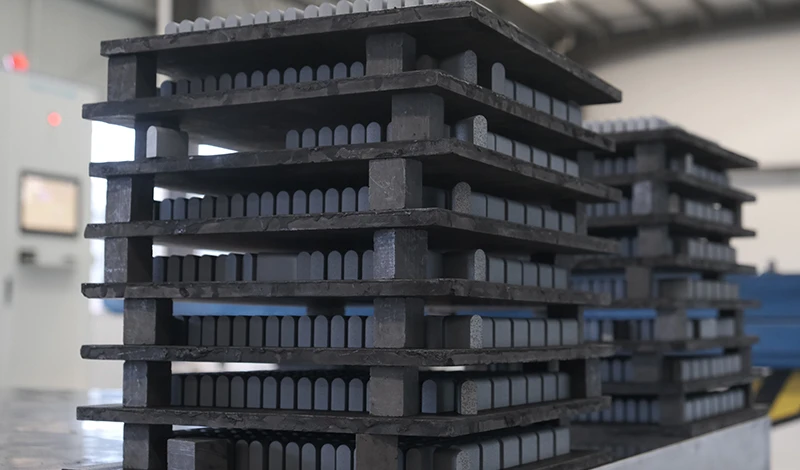
Why do carbide prices rise? Mostly because the two raw materials, tungsten concentrate and cobalt, get more expensive or harder to source; then sintering energy, freight and demand from other industries add to the cost. Each of those drivers moves on its own clock, so a price letter should say which one changed.
(Last modified date: November 12, 2026)
A price letter arrives saying that material costs have increased, and the buyer has no way to tell whether the increase is real, overstated, or simply the annual review arriving early. Carbide is one of the few materials where the answer can be checked, because the drivers are published.
The cost of a finished edge is built from five blocks, and each one behaves differently. Knowing which block moved is what turns a price letter into a conversation.
Carbide price increase: what actually moves
Five cost blocks build the price of an edge.
Tungsten concentrate supply, cobalt price volatility, energy and processing costs, freight and cross-industry demand each push on a different part of the total, and they rarely move at the same time.
Only the first two of those blocks are specific to carbide, which is why a general percentage increase is difficult to check. A supplier that reports a movement in the material block can support it with a powder price reference; one that reports an increase across all five is usually passing through a commercial decision.
The rest of this article takes each block in turn, in the order they usually appear in a supplier’s own cost build.
Tungsten concentrate supply
Tungsten is the largest single input, and its supply is concentrated enough that a change in one producing region moves the price everywhere.
Mining is limited to deposits worth developing, and a significant share of output comes from a small number of sources. Processing capacity sits close to that base. When a producing country changes export rules, restricts licences, or experiences a disruption, every manufacturer buying powder feels it, because there is no second supply chain to switch to at short notice. The industry association for tungsten publishes supply and market information for the sector, and export measures between markets sit inside the framework administered by the World Trade Organization.
| Block | What drives it | How fast it moves |
|---|---|---|
| Tungsten content | Concentrate supply and export policy | Months, in steps |
| Cobalt content | Battery and alloy demand, plus supply disruption | Weeks to months |
| Processing and energy | Furnace operation, labour, local power cost | Seasonally and with tariffs |
| Freight | Container rates, fuel, routing | Weeks |
| Margin and overhead | Commercial decision rather than market input | At review |
The fourth row is the one buyers most often forget to check. Freight can move faster than the material, and in a period of high container rates it can account for a larger share of an increase than the tungsten did.
Cobalt price volatility
Cobalt is the binder that holds the carbide grains together, and it is the most volatile line in the material block.
Demand for cobalt comes largely from industries other than wear parts, which means the price a blade manufacturer pays is set by decisions made in battery and aerospace supply chains. A change in those markets reaches the grades used in plow edges through the powder price, even though nothing about the blade changed.
The practical consequence is that two grades with different binder content do not move together. A tougher, higher-cobalt grade carries more of the volatile input than a harder, lower-cobalt one, so a buyer with the freedom to choose either has some insulation available at the specification stage.
Energy and processing costs
Sintering is an energy-intensive process, and that cost sits with the manufacturer rather than with the mine.
A furnace running a full cycle per load consumes power and often gas, and the cost of both varies by region and by season. Powder production adds milling, drying and analysis on top. That block is therefore the one most sensitive to where the plant is and how it is scheduled, and it is the block a manufacturer can influence by running fuller loads and reducing changeovers.
The same block also carries the cost of quality: analysis, inspection and the records that accompany a lot are processing costs, and they are invisible in a material index. A buyer comparing two offers should expect the one with more documentation to carry a higher processing line.
Freight and logistics
Freight moves faster than any other block and is the one most often left out of a buyer’s own landed-cost model.
Container rates, fuel surcharges and routing decisions can change within weeks, and the delivery term decides which party pays them first. Where goods cross a border, the classification and the declared value decide how much of that cost the duty is applied to, and the requirements are administered by the destination authority, such as US Customs and Border Protection.
For a buyer, the useful discipline is to separate the material increase from the freight increase in every price revision. The two are negotiated differently, and a supplier that can show them separately is giving the buyer something to work with.
Demand from other industries
Carbide and its raw materials are bought by several industries at once, and wear parts are a small share of that demand.
Cutting tools, mining and construction bits, oil and gas components, aerospace and electronics all consume tungsten and cobalt. When one of those sectors expands, the effect reaches a blade manufacturer through the powder price and through the queue at the processing plant, even if nothing in the winter maintenance market changed.
That is why demand from outside the industry belongs in a buyer’s explanation of a price movement. It is also the reason a wear parts programme can be affected by an upturn in a completely unrelated sector, and why the timing of a buying window matters as much as its size.
How increases reach buyers
The route from a raw material movement to a buyer’s invoice has several steps, and each one adds delay rather than immediately passing the change through.
A manufacturer usually holds powder stock, works through existing orders, and only then revises the price for new ones. That lag is why a price letter often arrives after the market movement the buyer has already read about, and why asking when the increase takes effect is more useful than asking why it happened.
- The raw material price moves and the powder supplier revises its quotation.
- The manufacturer works through the powder it already holds at the old cost.
- The manufacturer revises quotations for new orders and informs existing customers.
- The buyer sees the change on a quotation, a price letter or a delivery.
- The change reaches the buyer’s own customer through a revised project cost.
The second step is the one that gives a buyer room. Placing an order before existing stock is exhausted is a legitimate way to buy at the earlier price, and it is the reason price validity periods matter more in this category than in most.
Reading a supplier price letter
A price letter can be assessed in a few minutes if it contains the four items that make the increase checkable.
The useful letters name the driver rather than the total, state the effective date, explain what happens to orders already placed, and give the period the new price will hold. Without those, the buyer is being asked to accept a percentage without knowing whether it is a cost or a decision.
- Which block moved: material, energy, freight or margin.
- The date the new price takes effect, and whether it applies to open orders.
- The validity period of the new price, stated in weeks or months.
- Whether the increase is tied to an index, and if so which one.
A supplier that can answer all four is managing its own cost base. One that cannot is passing on a number, and the difference matters most in the second revision rather than the first.
What buyers can negotiate
The material and freight blocks are set by markets the buyer does not control, so negotiating them directly rarely works.
What a buyer can influence is the specification, the timing, the volume and the packaging. A grade choice with a lower binder content can reduce exposure to cobalt volatility. Placing an order inside a price validity window captures the older material cost. A larger commitment can reduce the processing line by allowing fuller furnace loads. And a simpler packaging specification removes a cost that is quoted as a fixed item rather than a variable.
| Lever | What it changes | When it helps most |
|---|---|---|
| Grade and binder content | Exposure to cobalt rather than tungsten | When the application allows either grade |
| Order timing | Which material cost the order carries | When stock is still being consumed at the old price |
| Volume commitment | Furnace loading and changeover frequency | When the forecasts are reliable enough to commit |
| Packaging specification | A fixed cost quoted per unit | On any order where the packing is not customer-driven |
Those levers are worth more than a percentage argument, because they change the cost rather than the description of it. Material and test standards the specification can reference come from bodies such as ASTM International, and the sector context for these movements is published by the International Tungsten Industry Association and the Snow and Ice Management Association.
For the wider 2026 picture see global tungsten carbide wear parts trends; insert grades affected by binder content are listed on the carbide inserts page.
FAQ
Why is the price of carbide going up?
Tungsten concentrate and cobalt are the main inputs, and both are affected by concentrated supply, export rules and demand from other industries. Energy for sintering and freight add to it. Ask a supplier which of these blocks moved.
Why is carbide so expensive?
It is made from tungsten, a scarce metal, bonded with cobalt, then pressed, sintered at high temperature and ground with diamond tooling. Each step costs more than steelmaking, which is why carbide is used only where its wear life pays back.
Where can I follow the carbide raw material price trend?
Public tungsten statistics are published by the U.S. Geological Survey, and industry associations publish market commentary. Use them to check whether a supplier’s material increase matches the market.
Isn’t every price increase just the supplier raising margin?
Not always. A credible letter names the cost block that moved, the effective date, the validity period and any index. If it cannot, treat the increase as a commercial decision and negotiate on specification, timing and volume.
Request an Application Review
Send SENTHAI the carrier or machine model, drawing or dimensions, operating surface, route condition, current failure mode, expected quantity, and target service interval. The engineering team can then review a suitable product path without changing the evidence requirements described above.